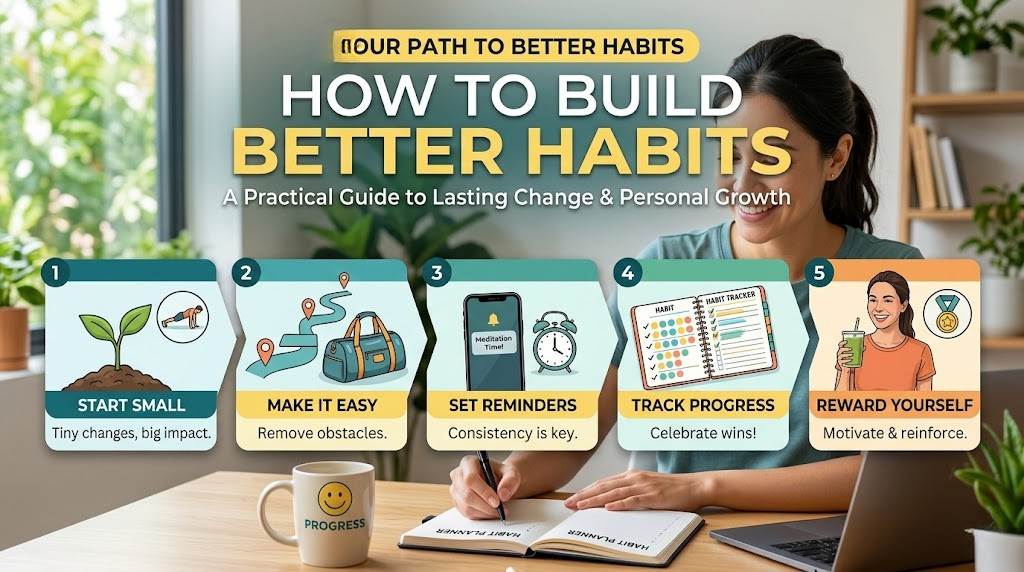
How to Build Better Habits: A 4-Step Guide for 2026
Every year, many of us set ambitious goals: exercise more, read more, learn a new skill, wake up earlier, save money, or finally launch that side project. Yet, after a few weeks of heroic effort, we often find ourselves back at square one, scrolling through the same apps, eating the same junk food, and skipping the same workouts. We feel guilty, blame ourselves for being “lazy,” and promise to try harder next Monday. Then the cycle repeats. Why is it so hard to make good habits stick?
The problem usually isn’t a lack of motivation, willpower, or character. It’s a lack of an effective system. Motivation is unreliable; it spikes and crashes like a sugar rush. Willpower is a finite resource that depletes throughout the day, especially when you’re already drained from making thousands of decisions from the moment you wake up. Discipline alone is exhausting and unsustainable. What actually works is a quiet, well-engineered system that runs in the background, making the right choice the easy choice and the wrong choice the hard choice.
Drawing from behavioral psychology, neuroscience, and the work of experts like James Clear (Atomic Habits), Charles Duhigg (The Power of Habit), and BJ Fogg (Tiny Habits), this guide provides a simple, science-backed framework for building habits that last. Whether you’re trying to start meditating, get into shape, read more books, save more money, or just become a calmer, more focused version of yourself, the principles in this guide will give you the playbook to actually do it. We’ll cover the four laws of behavior change, the identity layer that most people skip, the dangers of relying on motivation, the role of environment design, and a full troubleshooting guide for when life inevitably knocks you off track.
The Science of a Habit
Every habit follows a 4-step neurological loop: Cue (the trigger that signals your brain to start a behavior), Craving (the motivational pull or anticipated reward), Response (the actual behavior or thought you perform), and Reward (the satisfaction that closes the loop and trains your brain to repeat it). To build a good habit, we just need to make each of these four steps work in our favor. To break a bad one, we make each step work against us. This is the operating system that runs roughly 40% of your daily actions, according to research from Duke University.
Why Most Habit Plans Fail (And What Actually Works)
Before we dive into the four laws, let’s address why most habit-building attempts crash and burn. Understanding the failure modes is half the battle. The good news: it’s almost never your fault. The bad news: most popular advice is built on shaky foundations.
Mistake 1: Relying on motivation. Motivation is an emotion, and emotions are weather, not climate. You wouldn’t plan a beach trip based on the weather six months from now, and you shouldn’t plan your habits around a feeling that lasts about as long as a YouTube ad. The people you admire who run every morning, journal every night, and eat clean every day are not running on motivation. They’re running on systems and identity.
Mistake 2: Going too big, too fast. The classic January 1st mistake: “I’ll work out for an hour every day, meditate for thirty minutes, journal three pages, read fifty pages, and only eat salads.” By January 8th, exhaustion sets in. By January 15th, you’re back on the couch wondering what’s wrong with you. The answer: nothing’s wrong with you, but everything’s wrong with the plan. Tiny is the new huge.
Mistake 3: Focusing on outcomes instead of identity. “I want to lose 20 pounds” is an outcome. “I am the kind of person who never misses a workout” is an identity. Outcome-based goals expire the moment you hit them — and often deflate the moment you fail. Identity-based habits compound for life.
Mistake 4: Ignoring the environment. Trying to build a reading habit while your phone sits next to your bed, glowing with notifications, is like trying to diet inside a bakery. The negative self-talk that follows a “willpower failure” is, more often than not, just the predictable output of a bad environment.
Mistake 5: Treating habits as separate from life. Habits aren’t a hobby you do for thirty minutes a day. They are the architecture of your life. A morning routine is a habit. The way you brush your teeth is a habit. The phrase you say to your partner when you walk through the door is a habit. Once you see this, you stop trying to “add habits” to your day and start redesigning your day around the habits you want.
Identity-Based Habits: The Layer Most People Skip
Here’s the single biggest reframe in modern habit science: you do not rise to the level of your goals; you fall to the level of your identity. Every action you take is a vote for the type of person you want to become. Skip the gym? That’s a vote for “person who skips workouts.” Drink water instead of soda? That’s a vote for “person who takes care of their body.” You don’t need a unanimous vote — just a consistent majority.
There are three layers of behavior change. The outer layer is outcomes (the results you want). The middle layer is processes (the systems you build). The deepest layer is identity (the beliefs you hold about yourself). Most people start at the outside and work in: “I want to lose weight, so I’ll diet.” The trouble is, the diet is in conflict with their inner identity (“I am someone who loves food and hates restriction”). The identity wins. It always does.
The fix: flip it. Start with identity. Don’t ask “What do I want?” — ask “Who do I want to be?” Then ask, “What would that person do today?” A reader reads, even if it’s one page. A runner runs, even if it’s around the block. A saver saves, even if it’s a dollar. You become the person by acting like the person, not the other way around. This is how James Clear’s Atomic Habits reframed an entire generation’s approach to behavior change, and it’s the lens we’ll use throughout the rest of this guide.
The 4 Laws of Building Better Habits
Now we get into the practical engine room. The four laws map directly onto the four-stage habit loop: cue, craving, response, reward. Each law is a knob you can turn to make a behavior more or less likely. Master all four and almost any habit becomes inevitable. Skip even one and the loop limps.
Law 1: Make It Obvious
The Cue
You can’t perform a habit if you don’t remember to do it. The goal is to make the cues for your good habits a visible and unavoidable part of your environment. Most people think they have a motivation problem; they actually have a visibility problem. Your brain is brilliant at responding to what’s in front of it and lousy at responding to abstract intentions stored somewhere in your prefrontal cortex.
How to do it:
- Habit Stacking: Link your new habit to an existing one. Instead of “I will meditate,” try “After I pour my morning coffee, I will meditate for one minute.” The formula is simple: “After [CURRENT HABIT], I will [NEW HABIT].” Your existing habits act as built-in reminders. Brushing your teeth, making coffee, sitting down at your desk, plugging in your phone at night — every one of these is a free cue waiting to be repurposed. You can even build entire chains: “After I pour my coffee, I will write three sentences in my journal. After I write three sentences, I will read one page. After I read one page, I will plan my top three priorities for the day.”
- Implementation Intentions: Use the formula “I will [BEHAVIOR] at [TIME] in [LOCATION].” Studies have shown that people who write down a specific time and place for a behavior are two to three times more likely to follow through. “I will exercise” is a wish. “I will do 20 pushups at 7:00 AM in my living room” is a plan.
- Design Your Environment: If you want to read more, put a book on your pillow so you literally cannot get into bed without moving it. If you want to drink more water, fill up a water bottle and place it on your desk every morning. If you want to play guitar, leave the guitar out of its case and on a stand in the middle of the living room. If you want to reduce screen time, charge your phone in another room overnight. Make your cues impossible to miss and the wrong cues impossible to find.
- The Pointing-and-Calling System: Borrowed from Japan’s railway system (where it has reduced errors by up to 85%), pointing and calling means verbally narrating the behavior you’re about to do. “I am about to put my keys in the bowl by the door so I can find them tomorrow.” Saying it out loud forces conscious attention, which is exactly what you need when a behavior is still new and easy to skip on autopilot.
The Habits Scorecard:
Before you can change your habits, you have to know what they are. Spend a single ordinary day writing down every habit you do — from the moment you open your eyes to the moment you fall asleep. Brushing teeth. Checking phone. Pouring coffee. Driving to work. Eating lunch. Then mark each one with a plus sign (positive habit), minus sign (negative habit), or equals sign (neutral). The point isn’t judgment; it’s awareness. You can’t redesign a system you can’t see.
Why Cues Decay (and How to Refresh Them):
One under-discussed problem with cues is habituation. The book on the pillow becomes invisible after two weeks. The sticky note on the mirror fades into the background. To prevent this, rotate your cues. Move the book to a new spot. Change the color of your sticky note. Use your phone’s lock screen as a rotating reminder. The brain notices novelty, so feed it small doses of novelty to keep your cues alive. Remember: a cue you’ve stopped seeing is no longer a cue.
Law 2: Make It Attractive
The Craving
We are more likely to repeat behaviors that we find appealing. You can make a new habit more attractive by pairing it with something you already want to do, by understanding what your brain is actually craving (hint: it’s usually dopamine, not the activity itself), and by surrounding yourself with people who make the habit feel like a natural extension of who you are.
How to do it:
- Temptation Bundling: Link an action you want to do with an action you need to do. For example: “I will only listen to my favorite podcast while I’m on the treadmill.” “I’ll only watch my guilty-pleasure show while I fold laundry.” “I’ll have a cup of my favorite fancy tea while I plan my week.” This works because you stop framing the habit as a sacrifice and start framing it as the price of admission to something you already love. The behavior change feels less like a discipline tax and more like a deal.
- Join a Culture Where Your Desired Behavior Is the Norm: Surround yourself with people for whom your desired habit is normal behavior. Joining a running club, a book club, a meditation circle, or a writing group makes the habit more attractive because it’s a shared activity, not a solo battle against your own resistance. We are wired to imitate three groups: the close (family, friends, partners), the many (the crowd, the tribe), and the powerful (people we admire). Pick a group where the behavior you want is unremarkable, and watch how quickly your sense of “what’s normal” shifts.
- Reframe the Story: Your brain is a meaning-making machine. The story you tell yourself about a habit determines how attractive it feels. Stop saying “I have to wake up early.” Start saying “I get to wake up early to enjoy a quiet, undisturbed hour of my own.” Stop saying “I have to save money.” Start saying “Every dollar I save is a dollar of future freedom.” Words are software for the brain, and changing the words can dramatically change the craving.
- Use the Dopamine Stacking Technique: Do something you love right after you complete the new habit. The pleasure of the reward gets associated with the behavior, and over time, the brain begins to crave the behavior itself. This is exactly how slot machines, social media apps, and video games hook you — they pair small actions with bursts of dopamine. You can use the same wiring for good.
The Difference Between Wanting and Liking:
Neuroscience has revealed a strange but useful truth: in the brain, “wanting” (the craving that drives behavior) and “liking” (the actual pleasure of the experience) are processed by separate systems. You can deeply want something you don’t even like, which is why people scroll Instagram for 45 minutes and then feel hollow. Building good habits means engineering both systems to align: you want to do the behavior, and you actually enjoy it once you start. The first few weeks are the hardest because the wanting hasn’t kicked in yet — you’re running on intention. Push through, and the craving arrives.
Beware of “Anti-Habits” Disguised as Rewards:
Many people sabotage their own habit building by celebrating with the very behavior they’re trying to escape. “I worked out today, so I’ll order pizza.” “I saved money this month, so I’ll splurge on a $300 gadget.” Your reward should never be in conflict with your identity. A celebratory reward should be small, immediate, and aligned with the type of person you’re becoming. A great reward for finishing a workout might be a cold smoothie, a hot shower, or simply a tick on your habit tracker. We’ll get deeper into trackers in Law 4.
Law 3: Make It Easy
The Response
The biggest enemy of habit formation is friction. The more energy a habit requires, the less likely you are to do it when motivation is low — and motivation is low more often than you’d like to admit. The key is to make starting as easy as possible. Once started, momentum takes over. Most habits aren’t lost at the doing; they’re lost at the starting.
How to do it:
- The Two-Minute Rule: When starting a new habit, scale it down to something that takes less than two minutes to do. “Read every day” becomes “Read one page.” “Run 3 miles” becomes “Put on my running shoes.” “Meditate for 20 minutes” becomes “Take three deep breaths.” “Write a novel” becomes “Open the document and write one sentence.” The goal is to master the art of showing up first. You cannot improve a habit that doesn’t exist. Once the habit of showing up is established, you can scale up. But never scale up before the gateway behavior is automatic.
- Decrease Friction: Prepare for your habit in advance. Lay out your workout clothes the night before. Pre-chop vegetables for healthy meals on Sunday. Pre-write a meeting agenda the day before. Pre-load your audiobook on your commute device. Set out your journal and pen on the kitchen table. Every small obstacle you remove from the path of a good habit is a small dose of motivation you no longer need.
- Increase Friction for Bad Habits: The reverse also works. Want to stop snacking? Don’t keep junk food in the house — make yourself drive to the store every time you want it. Want to stop scrolling? Delete the app and only re-install it when you actually want to use it. Want to stop watching TV at 11 PM? Move the remote to a hard-to-reach drawer or unplug the TV. Friction is a tax. Tax the bad and subsidize the good.
- Master the Decisive Moment: Every day is full of small decisive moments — the moment you walk in the door from work, the moment you finish lunch, the moment your alarm goes off. These tiny forks in the road determine the entire trajectory of your day. Identify the three or four decisive moments in your routine and engineer them in advance. The moment you walk in the door, your gym bag is by the entryway. The moment your alarm goes off, your phone is in another room and your meditation cushion is by the bed.
- Use Technology and Automation Wisely: Automation is the ultimate friction reducer. Set up an automatic transfer to your savings account every payday and you’ve automated a financial habit. Use a meal prep service one night a week and you’ve automated dinner. Use a scheduling tool to block your most important work first thing in the morning. Tools like the ones in this guide to AI tools for daily automation and these time-saving Chrome extensions can do for your habits what a dishwasher did for your kitchen: turn an act of willpower into an act of pressing a button.
The Goldilocks Rule:
Humans experience peak motivation when working on tasks that are right at the edge of their current abilities — not too easy, not too hard, just right. This is sometimes called the Goldilocks Zone, and it explains why a habit can stop feeling rewarding once it becomes effortless. Once a behavior is fully automatic, the dopamine pulse weakens. The fix isn’t to abandon the habit; it’s to gently raise the bar. If you’ve been reading one page a day for three months, try five pages. If you’ve been doing 10 pushups, try 15. The trick is to upgrade after the behavior is locked in, not before.
Why “Doing It Once” Beats “Doing It Hard”:
One of the most counterintuitive insights in habit science is that the frequency of a behavior matters far more than its intensity. Meditating for two minutes every day for a year will reshape your brain more than meditating for an hour once a month. Saving $5 a week will build wealth faster than trying to save $200 once and giving up. Habits compound on the law of large numbers; they need reps, not heroics. If you only have time for the two-minute version today, do the two-minute version. The win is showing up.
Friction Audit Exercise:
Once a month, do a “friction audit” of your environment. Walk through your day and ask: where am I leaking energy on small obstacles? Maybe your home gym is in a cold basement and you dread going down the stairs. Maybe your healthy lunch ingredients are stuck in the back of the fridge. Maybe your journal is upstairs but you do your morning routine downstairs. Move things. Rearrange. The goal is to make the right behavior the path of least resistance. If your environment is fighting you, no amount of motivation will save you.
Law 4: Make It Satisfying
The Reward
Your brain is wired to repeat rewarding behaviors and avoid painful ones. To make a habit stick, you need to feel successful immediately after you perform it. The trouble with most good habits is that the reward is delayed (a fitter body, more savings, deeper knowledge), while the cost is immediate (sore muscles, less spending, mental effort). Bad habits are the opposite — the reward is immediate (sugar high, dopamine hit) and the cost is delayed (weight gain, debt, regret). To win, you have to make the immediate experience of the good habit feel good now.
How to do it:
- Immediate Reinforcement: Give yourself a small, immediate reward that doesn’t conflict with your identity. After you finish your workout, you can enjoy a delicious smoothie, a hot shower, or two minutes of stretching to a song you love. After you save money, transfer the saved amount into a labeled account named after a future goal (“Bali 2027” or “Down Payment Fund”). The reward must come right after the habit to reinforce the loop. The brain’s reinforcement window is short; aim for seconds, not hours.
- Track Your Progress: Use a habit tracker app or simply put an “X” on a calendar every day you complete your habit. The visual evidence of your streak is incredibly satisfying and creates a powerful incentive not to “break the chain.” This was famously called the “Seinfeld Strategy” — Jerry Seinfeld reportedly told a young comedian to write one joke a day and put a big red X on the calendar for every day he did it. After a few weeks, the chain becomes its own reward. This list of goal-tracking apps covers digital options if you prefer your chain on a screen, while a paper option (more on this below) works beautifully for those who prefer offline tools.
- Never Break the Chain — But Never Let the Chain Break You: Streaks are powerful motivators, but they can also become tyrants. The point of a streak is to encourage consistency, not perfection. If you miss a day, the chain is not “ruined” — you simply restart. The danger is the all-or-nothing mindset that says “I broke my streak so the whole thing is over.” That mindset has destroyed more good habits than any single missed day ever did.
- Habit Contracts: For higher-stakes habits, consider creating a written contract with an accountability partner. Specify the behavior, the time, the place, and the consequence for missing. The consequence should sting just enough to matter — donating $20 to a cause you dislike, doing a friend’s chore, or losing one weekend privilege. The pain of the consequence makes skipping the habit unsatisfying in the moment, which is exactly what your brain needs to feel.
- Celebrate Tiny Wins: BJ Fogg, the Stanford behavior scientist, calls this “celebration.” After completing your habit — even the two-minute version — physically celebrate. Pump your fist. Say “yes!” out loud. Smile. The micro-celebration releases a small burst of positive emotion that the brain associates with the behavior. It feels silly the first ten times. It works anyway.
The Compound Effect of Tiny Improvements:
Here’s the math that should change your life: if you get just 1% better at something every day for a year, you’ll be 37 times better by the end of it. Compounding works in habits exactly like it works in finance — the early returns look pathetic, the middle returns look modest, and then suddenly the curve goes vertical. Most people quit before the curve turns. The line between people who build great habits and people who don’t is rarely talent or willpower; it’s usually patience to stay in the game long enough for compounding to do its work.
The Plateau of Latent Potential:
Progress in habit building is not linear; it’s exponential, but with a long, frustrating runway. You’ll often feel like nothing is happening for weeks, sometimes months. This is what James Clear calls the “Plateau of Latent Potential.” Imagine an ice cube sitting in a 25°F room. You raise the temperature one degree at a time — 26, 27, 28, 29, 30. Nothing happens. 31. Still nothing. Then 32 — and suddenly, melt. Habits work the same way. Most of the meaningful change is invisible until it isn’t. Your job is to keep raising the temperature.
Habit Stacking: The Architecture of Behavioral Change
Habit stacking deserves its own section because it’s quietly the most powerful technique in this entire guide. The idea is simple: instead of building a brand-new habit in isolation, you anchor it to an existing one. Your existing habits are like riverbeds — already carved into your neural landscape. Habit stacking diverts a small new stream into one of those existing channels.
Look at your day in segments: morning, transition to work, mid-morning, lunch, afternoon, transition home, evening, bedtime. Within each segment, you already have rock-solid habits. Brushing teeth. Pouring coffee. Sitting at desk. Closing laptop. Plugging in phone. Each one is a free, dependable hook for a new behavior. The mistake most people make is trying to install a new habit at a random time of day, hoping their brain will remember. It won’t. Stack instead.
A simple morning stack might look like this: “After I sit up in bed, I will drink the glass of water on my nightstand. After I drink the water, I will do five minutes of stretching. After I stretch, I will write my top three priorities for the day.” By the time you’re done with breakfast, you’ve already won the morning. This morning routine checklist guide walks through ready-to-use stacks if you want a starting template.
Stacking also works in reverse — for unhooking bad habits. If you want to stop scrolling on the couch, stack a positive replacement: “After I sit on the couch in the evening, I will pick up the book on the side table for ten minutes before touching my phone.” The goal isn’t to delete a habit through sheer suppression, but to overwrite it with a better default.
Environment Design: Architecture Beats Discipline
Your environment is silently writing your habits for you. The question is whether you’ve put it under your control or whether it’s running on factory defaults set by app designers, advertisers, and the previous version of yourself who didn’t know any better. Environment design is the practice of intentionally engineering your physical and digital spaces so that the right behaviors are easy and the wrong ones are hard.
Start with your kitchen. The food at eye level on your counter is the food you’ll eat most. The fruit bowl wins; the cookie jar wins. Whichever wins is up to you. Move the cookies out of sight (or out of the house entirely) and put the apples and bananas at the front. This isn’t trickery; it’s basic design. Every grocery store knows this — they put candy at the checkout because proximity drives purchases.
Move to your bedroom. If you want better sleep, the room should be cool, dark, quiet, and screen-free. These five bedtime habits for better sleep work even better when paired with an environment that supports them. Charge your phone in the kitchen, put a real alarm clock on the nightstand, and watch your sleep quality climb without any new “willpower” required.
Now your workspace. A cluttered desk produces cluttered thinking. Clear the desk down to only the tools you need for the work you do. If you have a tendency to lose focus while working from home, the single biggest lever is usually environment, not discipline. Put your phone in a drawer. Use a separate browser profile for work. Block social sites during deep-work blocks. The friction is doing your job for you.
Finally, your digital environment. Your phone home screen is one of the most-viewed pieces of design in your life — treat it that way. Move social apps off the home screen and into a folder buried on a back page. Replace them with a meditation app, a reading app, or a notes app. Turn off notifications for everything except actual humans you actually care about. For some, switching to a dumb phone for evenings or weekends is the nuclear option that finally breaks a digital addiction. For most, simple home-screen surgery is enough.
Implementation Intentions: The If-Then Formula That Doubles Your Success Rate
Among the most studied behavior-change techniques in psychology, “implementation intentions” stands out for its almost embarrassingly high success rate. The idea: instead of vaguely intending to do something, you write down a specific if-then plan. “If [situation], then I will [behavior].”
Examples that actually move the needle:
- If it’s 7:00 AM, then I will go for a 20-minute walk around the block.
- If I sit down at my desk, then I will work on my most important task for 25 minutes before checking email.
- If I feel the urge to scroll Instagram, then I will pick up my book instead.
- If I get a craving for soda after lunch, then I will drink a glass of sparkling water with lemon first.
- If my alarm goes off, then I will put my feet on the floor before doing anything else.
Why does this work? Your brain stops having to “decide” every time. The decision is pre-made; the situation just triggers the response. This is why pilots use checklists and why elite athletes rehearse in their heads. Pre-deciding is the cheat code for willpower.
Pair implementation intentions with habit stacking and you have a formidable combo: a specific cue, a specific behavior, and a specific time and place. Three layers of clarity, almost no room for the brain to wriggle out.
How to Break a Bad Habit: The Inverted Four Laws
To break a bad habit, you simply invert the four laws. Where you wanted to make good habits obvious, attractive, easy, and satisfying, now you want to make the bad ones invisible, unattractive, difficult, and unsatisfying. The same operating system; the opposite settings.
- Make it Invisible: Reduce exposure to the cues. Unsubscribe from tempting emails. Leave your phone in another room while you work. Remove the snack drawer entirely. Cancel the streaming service that owns your evenings. Most “willpower failures” are actually exposure failures — you saw the cue, your brain did what brains do, and you blamed yourself for the inevitable response. Cut the cue and you cut the cycle.
- Make it Unattractive: Focus on the negative consequences of the bad habit. Reframe your mindset from “I get to relax with this drink” to “I am damaging the morning version of myself.” From “I need this scroll session” to “I am stealing time from the things I actually want.” Visualize the long-term cost: the missed promotion, the tighter jeans, the empty bank account, the eroded trust. The story is the craving; rewrite the story.
- Make it Difficult: Increase the friction. Delete the junk food apps from your phone. Use website blockers during the hours you’re most vulnerable. Unplug the TV after use and put the remote in a drawer. Freeze your credit card in a literal block of ice. Each of these sounds extreme on paper. In practice, they take five minutes and save you years.
- Make it Unsatisfying: Find an accountability partner. If you skip a workout, you have to pay a friend $10. If you smoke, you Venmo $25 to your sister. The immediate cost makes the habit less satisfying. You can also use public commitment: tell a few people, post a tracker, share your progress weekly. Public stakes make private slippage harder to rationalize.
For especially stubborn habits, layer a positive replacement on top of the inversion. Telling your brain “no” works for a while. Telling your brain “instead of X, do Y” works forever. If overthinking is the bad habit you’re trying to break, replacing rumination with a structured journaling practice or a 10-minute walk is far more effective than just trying to “stop thinking about it.”
Habits for Specific Areas of Life
The four laws are universal, but their application differs by domain. Below is a quick map of what these principles look like across the most common areas of life people are trying to upgrade.
Health and Fitness Habits
The body you live in tomorrow is being built by what you do today.
Health is the area where the four laws shine brightest because the cause and effect is so physical. Make it obvious by laying out your workout clothes the night before. Make it attractive by joining a class or finding a workout style you actually enjoy — the best workout is the one you’ll do consistently, not the one that looks coolest on social media. Make it easy by keeping the bar low: a 10-minute walk after dinner counts. Make it satisfying by tracking your reps, your steps, or your weights and watching the numbers slowly climb.
Whether you prefer a structured comparison of pilates and yoga for body composition or you’re weighing a home gym setup versus a gym membership, the principle is the same: choose the option that minimizes friction. The most expensive gym membership in the world is useless if it’s a 30-minute drive away. The cheapest pair of dumbbells in your bedroom can transform your physique.
For nutrition, the same logic applies. Decide once, weekly, what you’ll eat — and you free yourself from a hundred small decisions every day. Whether you go with whey or plant protein matters less than whether you actually drink it consistently. Stock your fridge so the default option is the right option. Shelf-stable protein snacks are an underrated weapon for busy days when willpower is gone and the vending machine is calling.
Productivity and Focus Habits
Your output is the sum of your daily inputs, not your hourly heroics.
The most productive people aren’t grinding 14-hour days. They’ve quietly built systems that protect their attention. The cornerstone is usually a single non-negotiable block of deep work each morning, before email and Slack pull them into reactive mode. Time blocking turns the abstract concept of “I should focus more” into a calendar event you can actually defend.
Procrastination, the productivity killer, isn’t a character flaw — it’s an emotional regulation problem dressed up as a time-management problem. We delay tasks that feel painful in the moment. The fix is to make the task feel less painful: shrink it (Two-Minute Rule), pair it with something pleasant (temptation bundling), or change the environment around it (deep-work playlist, café visit, locked phone). A practical list of ways to beat procrastination covers the tactical layer; the strategic fix is always the four laws.
Notes, capture, and review are the unsexy backbone of any productive person’s life. Pick one system — paper, digital, or hybrid — and stick with it long enough to actually trust it. A clean note-organization system turns your brain into a place where ideas can land and grow, instead of a leaky bucket where everything gets forgotten.
Money and Finance Habits
Wealth is built on a thousand boring days of doing the right small thing.
Money is, almost entirely, a habit problem. People with vastly different incomes can end up with vastly different net worths because their daily and weekly habits — saving, tracking, avoiding lifestyle creep, investing on autopilot — compound silently for decades. The seven habits of people who are good with money overlap heavily with the four laws above: they automate the right behaviors, they make the wrong behaviors hard, and they track their progress relentlessly.
The single most powerful money habit you can build is automation. Every payday, an automatic transfer moves a percentage of your income to savings and investments before you ever see it. Decision made once, executed forever. Pair this with a zero-based budget that gives every dollar a job and you’ve solved 80% of personal finance with two simple systems.
Sleep, Recovery, and Mental Health Habits
All habits sit on top of one foundational habit: sleep.
You cannot out-discipline poor sleep. You cannot out-coffee chronic exhaustion. The most underrated habit in this entire guide is consistent, high-quality sleep — and like every other habit, it’s built on cues, environment, and routine. A consistent bedtime, a cool dark room, no screens for the last hour, and a gentle wind-down ritual will outperform any sleep supplement on the market.
Mental health habits — meditation, journaling, gratitude, walking outside — also benefit enormously from environment design and stacking. A comparison of meditation apps can help you pick a tool, but the harder problem is integration. Stack two minutes of meditation onto your morning coffee, and you’ve solved 90% of the “I never have time to meditate” problem.
Self-care, properly understood, is not bubble baths and spa days; it’s the boring, repeated maintenance of your nervous system. A self-care checklist for busy professionals gives you a starter menu, but the deeper habit is noticing — daily — what state your body and mind are in, and giving them what they actually need rather than what’s convenient.
Relationship and Communication Habits
The quality of your relationships is the quality of your repeated interactions.
The best relationships are not built on grand gestures; they’re built on a thousand small, consistent acts of attention. The five-minute call you make every Sunday to a parent. The “thank you” you say without looking up from your phone. The boundary you keep even when it costs you in the moment. Better communication skills are downstream of better communication habits — the habit of asking before assuming, of listening before responding, of pausing before reacting.
Boundaries, too, are habits. Setting boundaries with a friend is rarely a single dramatic conversation; it’s a hundred small “no thank yous,” “let me think about it,” and “I can’t tonight” repeated until your relational expectations naturally recalibrate. Like any habit, the first ten times feel awkward. By the hundredth, they’re who you are.
Habits and the ADHD or Neurodivergent Brain
A standard caveat for anyone reading this with an ADHD, autistic, or otherwise neurodivergent brain: the four laws still apply, but the dials need very different settings. ADHD brains, in particular, are dopamine-hungry and time-blind. They can blow past cues that a neurotypical brain would catch, lose interest in habits that have stopped feeling novel, and crash spectacularly when an unexpected day knocks them off the rails.
What works: extreme externalization. Turn your habits into things you can see and touch. Use giant visible timers. Use bright colors. Use a paper planner designed for ADHD brains that gives time a physical shape. Body-doubling — working alongside another human, in person or on video — turns invisible work into visible work, which makes it about ten times more doable.
Decision fatigue is also a much bigger problem for ADHD brains. Decision fatigue and ADHD are an ugly cocktail; the more decisions you stack into a day, the more likely the whole house of cards collapses by 4 PM. The fix: pre-decide. Lay out your clothes, plan your meals, batch your errands, and accept that “boring routines” are not the enemy of a creative life — they’re the foundation that makes a creative life possible.
Finally: be kinder to yourself. Habit advice that works for a neurotypical brain over 21 days might take 6 months in an ADHD brain. That’s not failure. That’s just different wiring. Show up anyway. The compound effect doesn’t ask how long it took.
The Habit Tracker: Your Visual Accountability Partner
A habit tracker is, simply, a visual record of whether you did the habit on any given day. It can be a row of empty boxes, a streak counter in an app, a wall calendar, or a beautifully designed bullet journal spread. Whatever the form, the function is the same: turn the invisible compounding of small actions into something you can see, count, and feel proud of.
Why does it work? Three reasons. First, tracking creates a visible cue — every time you see the tracker, you’re reminded of the habit. Second, completing the tracker is its own immediate reward, closing the satisfaction loop. Third, the tracker gives you data; you can spot patterns, identify weak points, and adjust.
A few rules for trackers that actually stick:
- Track only one to three habits at a time. A tracker with twelve habits looks impressive on Pinterest and falls apart in real life.
- Track immediately after the habit. Not at the end of the week. Not before bed. Right after.
- Track binary outcomes (did or didn’t), not subjective ones (how well). “Did I write today: yes/no” beats “How was my writing today: 1-10.”
- Review weekly. Five minutes every Sunday to look at your tracker turns it from a record into a strategy tool.
- Don’t punish yourself for misses. The tracker is a feedback instrument, not a judge.
Whether you go digital with one of these top goal-tracking apps or analog with a paper system, the medium matters less than the consistency. The best tracker is the one you actually use.
When You Slip Up: The Recovery Protocol
You will miss days. Everyone does. Travel, illness, a brutal week at work, a family emergency, a flat-out bad mood — life will hand you off-ramps. The difference between people who maintain habits for years and people who restart every January is not that the maintainers never miss. It’s that they have a recovery protocol, and they execute it without drama.
The Never Miss Twice Rule is the heart of the protocol. Missing one day is an accident; missing two days is the start of a new habit. The first miss is data; the second miss is a decision. The instant you miss, you’re already planning your re-entry the next day. No guilt spiral, no “I’ll restart on Monday,” no “I’ve already ruined the month.” Just back to the work, smaller if necessary, but back.
A useful mental tool: separate your standard from your minimum. The standard is what you’d ideally do — 30 minutes of writing, a 45-minute workout, an hour of reading. The minimum is the smallest version that still counts — one paragraph, ten pushups, one page. On bad days, you don’t quit; you drop to the minimum. On good days, you hit the standard. The chain is preserved. The identity is preserved. The compounding continues.
For longer interruptions — illness, vacation, a major life event — give yourself a planned ramp back in. Don’t try to resume at full intensity on day one of recovery. Hit the minimum for a week. Then ease back to standard. Trying to “make up” for missed days is one of the fastest ways to overtrain, burn out, and quit altogether.
Goals vs Systems: Why Most Goals Fail
A final reframe before we close. Goals are the destination; systems are the path. Most people obsess over goals and ignore systems, which is why most goals are abandoned by mid-February.
Consider two writers. Writer A’s goal: “Publish a novel by the end of the year.” Writer B’s system: “Write 500 words every weekday morning before email.” Writer A spends January motivated, February doubting, March guilty, and the rest of the year avoiding the project. Writer B writes 500 words. And then 500 more. By month six, Writer B has 60,000 words and a draft. The goal is the same, but the relationship to the work is opposite.
Goals also have a hidden trap: they create a binary outcome. Either you hit the goal or you fail. Systems, by contrast, give you a daily win. Every day you execute the system is a successful day, regardless of whether the long-term outcome has arrived yet. This matters because outcomes are often beyond your control (market timing, luck, other people, biology), but the system is fully within your control.
The pragmatic takeaway: set goals to point in a direction; build systems to actually move. Then judge yourself daily on the system, not the goal. The goal will take care of itself.
The 30-Day Habit Reset: A Starter Plan
If you’re ready to put all of this into practice but feel paralyzed by where to start, try the following 30-day reset. It’s deliberately conservative; the point is to win small and build trust with yourself.
Week 1: Audit and Anchor. Write down every habit you do for one full day. Identify one good habit you want to build and one bad habit you want to weaken. Pick a specific cue for the new habit using the habit-stacking formula. Don’t do anything else this week — just observe and plan.
Week 2: Two-Minute Version. Start the new habit, but only the two-minute version. Read one page. Stretch for two minutes. Save one dollar. Track each completion on a paper calendar. Do not scale up no matter how easy it feels. The goal is reps, not intensity.
Week 3: Friction Audit. Spend this week identifying every small friction point that makes the habit harder than it needs to be. Move things. Pre-prepare. Automate. The behavior should become embarrassingly easy. Continue tracking daily.
Week 4: Gradual Expansion. Now, and only now, scale up. Move from one page to three. From two minutes to five. From one dollar to ten. Add a second habit if you feel solid — but only one. Most people fail at this step by trying to add three. Resist.
By day 30, you’ll have one (or two) reliably installed habits and, more importantly, hard evidence that you are the kind of person who follows through. That evidence is the most valuable asset of the entire process. A more detailed 30-day life-change framework is available if you want to layer in additional practices.
Mornings, Evenings, and the Bookends of Your Day
There are two windows in every day that disproportionately shape your habits: the first hour after you wake up and the last hour before you sleep. Almost everything else in between can be derailed by meetings, emergencies, traffic, or other people’s priorities. The bookends are yours. If you protect them, the rest of the day tends to fall in line. If you surrender them, even a strong system in the middle struggles to compensate.
The first hour matters because your brain is at its highest level of impressionability. Cortisol is naturally elevated, decision fatigue hasn’t begun, and you haven’t yet been pulled into reactive mode by emails, news, or other people’s emergencies. Whatever you do in this window — whether it’s scrolling Instagram in bed for forty minutes or executing a clean five-step morning routine — sets the emotional and cognitive tone for the next twelve hours. This is why high performers across radically different fields almost universally protect their morning hour. They’re not crazy; they’re just doing the math.
A workable morning sequence doesn’t have to be elaborate. Something as simple as: feet on the floor immediately, glass of water, two-minute stretch, ten-minute walk or sunlight exposure, write three priorities for the day, then start work. That’s it. No ice baths, no two-hour meditation, no $400 supplement stacks unless you genuinely want them. The point is intentionality, not performative wellness.
The last hour matters for the opposite reason. Whatever you consume in the final 60 minutes before sleep is what your subconscious chews on while it consolidates memory and resets your emotional state. Doomscrolling, intense news, work emails, or stressful conversations literally degrade sleep architecture. A simple wind-down routine — dim lights, no screens, light reading or journaling, a hot shower, a few minutes of breathing — is one of the highest-leverage habit upgrades available to anyone. It costs nothing, takes 30 minutes, and improves every other habit downstream.
Within both bookends, the same four laws apply. Make the right behavior obvious (book on pillow, journal on nightstand). Make it attractive (pair it with something you enjoy, like a favorite tea or playlist). Make it easy (lay it out the night before). Make it satisfying (mark the tracker, feel the calm). Two protected hours per day, run on autopilot, will quietly out-perform years of high-effort, inconsistent habit attempts.
The People You Surround Yourself With
One last secret weapon, often left out of habit guides: your social circle. We are deeply, almost embarrassingly imitative animals. The behaviors of the three to five people you spend the most time with will, over years, drift toward becoming your behaviors. This is why people who join running clubs become runners, people who hang out with readers become readers, and people who spend nights with heavy drinkers become heavy drinkers.
You do not have to abandon old friendships to change your habits, but you do have to be intentional about adding new circles in the directions you’re trying to grow. Find a community — online or offline — where the habit you want is already normal. Show up consistently. Let the social fabric do half the work for you. The top habits of highly effective people almost always include this: they curate their environment, including the human environment, with deliberate care.
Frequently Asked Questions
The popular “21 days” myth is a misconception that traces back to a 1960s plastic surgeon’s observation about how long it took patients to adjust to a changed appearance. Real research shows the average time to form a new habit is closer to 66 days, but it can range from 18 to 254 days depending on the person, the difficulty of the habit, and how consistently it’s performed. The key isn’t the number; it’s consistency. Focus on showing up every day, not on the deadline. The habit will lock in when it locks in, and obsessing over the timeline only adds friction.
It’s okay! The most important thing is to get back on track immediately. Follow the rule: never miss twice. Missing one day is an accident. Missing a second day is the start of a new, negative habit. Forgive yourself, drop to the minimum version of the habit if needed, and show up again tomorrow. The chain isn’t really broken until you let it stay broken.
For most people, building one new positive habit is easier than breaking a deeply rooted negative one — and the new habit often crowds out the old one organically. Start with one good habit you’ve been wanting to build. Once it’s locked in, the confidence and identity boost makes breaking a bad habit much easier. That said, if a single bad habit is actively destroying your life (substance abuse, gambling, etc.), that one usually needs direct attention and often professional support, not just a clever stack.
One. Maybe two. Almost never more. The biggest mistake new habit-builders make is trying to install five habits simultaneously and burning out within a month. Your willpower budget is finite, and each new habit draws from the same account until it becomes automatic. Pick one, lock it in for 30 to 60 days, then stack a second one on top.
A habit is a single automatic behavior triggered by a cue. A routine is a sequence of habits performed together. Brushing your teeth is a habit. Your morning routine is the chain of habits — alarm, water, stretch, coffee, brush, dress, plan — that you run from wake-up to leaving the house. Routines are simply habits stacked end-to-end.
Yes. Repeated behaviors strengthen specific neural pathways through a process called myelination — your brain literally insulates the wires you use most often, making those signals fire faster and more efficiently. This is the biological basis of “automaticity.” The longer you’ve held a habit, the more myelinated the pathway, which is also why old habits are stubborn to break: you’re competing against a literal physical structure in your brain.
Good. That’s the whole point. Habits are designed to operate without motivation. If you only show up when you feel like it, you don’t have a habit; you have a hobby. The two-minute version exists precisely for low-motivation days. Do the smallest possible version, mark the tracker, move on. Motivation will return; consistency is what bridges the gap until it does.
No. Everyone runs on habits — even the chaotic, “spontaneous” people. The difference is whether the habits are intentional or accidental. People who feel like they’re not “habit people” are usually either (a) trying to install habits that don’t actually fit their life, or (b) using systems built for a different brain type. Adjust the system, not the person.
Mixed evidence. Some people benefit from public commitment because the social accountability raises the cost of skipping. Others find that announcing a habit gives the brain a small dopamine hit (the “I’m a person who does this!” feeling) that prematurely satisfies the craving and reduces follow-through. A safer middle path: tell one trusted accountability partner, not a public audience. Share specifics, not just intentions.
If we had to pick one, it would be a consistent sleep schedule. Sleep is the foundation that every other habit sits on. Better sleep makes morning routines easier, willpower stronger, decision-making sharper, and emotional regulation more reliable. Fix sleep first and everything else gets easier. After that, a short morning routine and a daily walk are the two highest-leverage habits for the average person.
Conclusion: Small Habits, Remarkable Results
Building better habits isn’t about making a massive, life-altering change overnight. It’s about the quiet, almost-invisible power of small, consistent, 1% improvements compounding over months and years. By focusing on designing a better system — making good habits obvious, attractive, easy, and satisfying, while making bad habits invisible, unattractive, difficult, and unsatisfying — you create a pathway to success that doesn’t rely on willpower alone. You stop fighting yourself. You start working with yourself.
The biggest lie we tell ourselves about change is that it should feel dramatic. It shouldn’t. Real change feels boring. It feels like one page a day, one rep, one dollar saved, one breath. It feels like showing up on the days you don’t want to and discovering, on the days you do want to, that you’ve quietly become a different person.
Choose one small habit you want to build. Apply these four laws. Start with two minutes. Stack it onto something you already do. Track it on a paper calendar or a simple app. Celebrate every check mark, no matter how small. Forgive every miss, no matter how frustrating. Never miss twice.
A year from now, you will look back and barely remember the day you started. But the person you are then will be unmistakably the work of the person you are right now. The compound interest of small habits is the closest thing to magic that real life offers. The only requirement is that you start — today, in the smallest, most undramatic way possible — and keep showing up.
Begin your journey today.