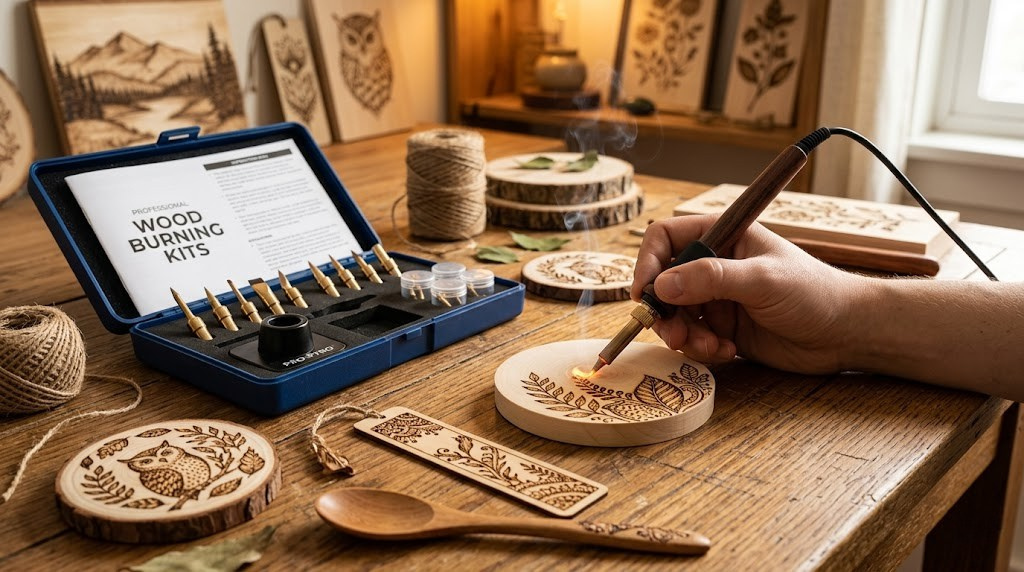
The Ultimate Guide to the Best Wood Burning Kits
Welcome to the definitive guide to finding the perfect wood burning kit. The art of pyrography — writing with fire — is a deeply rewarding hobby that transforms simple pieces of wood into personalized masterpieces. Whether you want to create meaningful handmade gifts for people in your life, decorate your home with custom art, or build a profitable side craft business, the right tool makes all the difference. With so many options on the market, choosing one can feel overwhelming.
Whether you’re a curious beginner ready to make your first mark or a seasoned artist looking for a professional-grade upgrade, we’ve analyzed the market to bring you the best wood burning kits for every skill level and budget. We’ve also expanded this guide to cover everything a serious pyrographer needs: the best woods to burn, tip types explained in depth, project ideas for every level, finishing techniques, selling your work, and a full troubleshooting section.
What to Look for in a Wood Burning Kit: A Complete Buyer’s Guide
Before we dive into the reviews, let’s establish what makes a great wood burning kit. Understanding these key features will empower you to make an informed decision — much like applying the habits of highly effective people to your buying decisions means doing the research first and acting with intention.
1. Burner Type: Solid-Point vs. Wire-Nib
- Solid-Point Burners: These are the most common type found in craft stores. They look like a soldering iron and have screw-in brass tips. They are durable, affordable, and excellent for beginners. Their main drawback is a slower heat-up and cool-down time — tip changes can take several minutes, which disrupts creative flow during complex projects.
- Wire-Nib Burners: These are professional-grade tools. They use a variable temperature power supply and a pen-like handpiece with interchangeable wire tips. They heat up and cool down in seconds, offering incredible precision and control, especially for detailed work like shading, feathering, and fine portraiture. They are more expensive, but the workflow difference is dramatic.
- Battery-Operated / Portable Burners: A niche category growing in popularity among outdoor crafters and hobbyists who want to burn on-the-go without a power outlet. Performance is more limited than corded tools, but they’re useful for light detail work and finishing at markets or fairs.
2. Variable Temperature Control — Why It’s Non-Negotiable
This is arguably the most crucial feature. The ability to adjust the heat is essential for working on different types of wood and creating different effects. Softer woods like basswood require lower temperatures, while harder woods like oak need more heat. A fixed-temperature tool offers very little versatility and often forces you to work either too slow (risking over-burning) or too fast (resulting in inconsistent lines). All of our top picks feature reliable temperature control.
Beyond wood type, temperature control allows you to:
- Create tonal range — from pale honey tones at low heat to deep espresso at high heat
- Work on heat-sensitive materials like leather or thin veneer without scorching
- Achieve smooth gradients and realistic shading in portrait and landscape work
- Adapt quickly when switching between projects on different wood species in a single session
3. Tip Variety and Quality — A Deep Dive
A good kit comes with a variety of tips for different tasks. Understanding what each tip shape does will transform how you approach every project.
- Universal / Ball Tip: The most common tip for beginners. It glides smoothly in any direction and is ideal for outlining, freehand drawing, and general-purpose burning. Think of it as the ballpoint pen of pyrography.
- Shading / Spoon Tip: A curved, spoon-shaped tip designed for covering large areas with an even tone. Essential for backgrounds, fur textures, sky gradients, and any large fill area. The curved edge means no harsh lines at the boundary of your stroke.
- Detail / Fine-Point Tip: A narrow tip for intricate line work — lettering, feather barbs, facial features, and delicate patterns. Requires precise temperature control; too hot and the tip drags the wood grain rather than cutting cleanly through it.
- Skew / Calligraphy Tip: An angled flat tip that creates variable-width lines depending on your stroke angle. Used for calligraphy, Celtic knotwork, and decorative borders. Highly versatile once mastered.
- Flow / Shader Tip (Wire-Nib): Exclusive to wire-nib systems. A broad, flat wire nib that allows extremely smooth, even shading over large areas with minimal streaking — far superior to any solid-point shading tip.
- Curved / Writing Tip (Wire-Nib): A curved wire nib that provides excellent line control for portraiture and fine botanical illustration. Many professional pyrographers use just this tip for 90% of their work.
- Stamp / Pattern Tips: Pre-shaped tips that imprint a repeating pattern (stars, diamonds, flowers, borders) with a single press. Great for decorative borders and texture fills. More common in solid-point craft kits.
Pro Tip: Even the best kit’s included tips are a starting point. As you advance, investing in individual replacement wire nibs from specialty suppliers (Razertip, Optima, Colwood) will dramatically improve your results. The quality difference between a generic kit nib and a precision-ground professional nib is substantial.
4. Ergonomics and Safety
You’ll be holding this tool for extended periods — pyrography sessions of 2–4 hours are common for serious hobbyists. Ergonomics matter as much as performance. Look for:
- A lightweight pen (heavier tools cause hand fatigue during long sessions)
- A heat-resistant grip that stays cool even after an hour of continuous use
- A cord long enough to give you free movement without tugging (at least 5 feet)
- A stable, weighted safety stand — this is non-negotiable. A tipped-over burning pen on your workspace or floor is a serious fire and burn hazard.
- Clear temperature markings or a digital readout (analog dials can be imprecise)
5. Price Tiers: What to Expect at Each Budget
Wood burning kits range from under $20 to over $300. Here’s a transparent breakdown — useful whether you’re tracking this as part of a zero-based budget or investing in a new side hustle:
| Budget | What You Get | Best For |
|---|---|---|
| Under $30 | Fixed or basic dial-control solid-point pen, 5–10 tips, no case | Absolute beginners, trying out the hobby |
| $30–$70 | Adjustable solid-point with digital display, 10–30+ tips, carrying case | Committed beginners and casual hobbyists |
| $70–$150 | Quality solid-point or entry wire-nib, broad tip selection, accessories bundle | Intermediate artists, regular crafters |
| $150–$300 | Professional wire-nib station, dual pen ports, digital control, wide temp range | Serious hobbyists, semi-professional artists |
| $300+ | Top-tier wire-nib stations (Razertip, Colwood), maximum precision, full accessory ecosystem | Professional pyrographers, selling work |
Our Top Wood Burning Kit Recommendations
After careful consideration of the factors above, we’ve selected the best kits currently available. These recommendations are based on performance, value, user feedback, and hands-on experience.

1. YIHUA 939D-II Dual Pen Station — Best for Professionals & Serious Hobbyists
For those who are serious about pyrography or who plan to work on large, continuous projects, the YIHUA 939D-II is an absolute game-changer. Its standout feature is the dual-pen capability, allowing you to have two different tips heated and ready to go simultaneously.
| Feature | Specification |
|---|---|
| Type | Wire-Nib Station |
| Power | 75W |
| Temperature | 250–750°C (482–1382°F) |
| Key Feature | Dual pen ports for simultaneous use |
The rapid heat-up time and precise digital temperature control make it a joy to use. Switching between a fine-line nib and a shading nib is as easy as picking up the other pen — a workflow efficiency you won’t fully appreciate until you’ve spent an hour swapping and waiting on a solid-point tool. The build quality is robust, designed for a workshop environment and hours of daily use.
Pros
- Dual pens drastically improve workflow
- Extremely fast heat-up and cool-down
- Precise digital temperature control
- Wide temperature range for various materials
- Professional-grade performance
Cons
- Higher price point
- Slightly bulkier than single-pen units

2. 116-Piece Wood Burning Kit — Best Value & Versatility
If you’re looking for the absolute most bang for your buck, this is it. This 116-piece kit is an incredible value proposition, bundling a capable solid-point burner with an enormous collection of tips, stencils, colored pencils, and wood slices. It’s a complete hobby-in-a-box that makes an exceptional gift for creative teens or anyone curious about crafting.
| Feature | Specification |
|---|---|
| Type | Solid-Point Pen |
| Power | 60W |
| Temperature | Adjustable 200–450°C (392–842°F) |
| Key Feature | Massive accessory bundle in a carrying case |
While it doesn’t have the refinement of a wire-nib system, the adjustable temperature dial is responsive enough for most beginner and intermediate projects. The sheer variety of tips encourages experimentation with patterns and textures. Everything packs neatly into the included carrying case, making it ideal for storage and portability.
Pros
- Unbeatable value for the price
- Huge assortment of tips and accessories
- Great for beginners wanting to try everything
- Includes a convenient carrying case
- Decent temperature control
Cons
- Slower heat-up/cool-down than wire-nibs
- Grip can get warm during long sessions

3. Digital Display Pyrography Pen Kit — Best for Beginners
This kit hits the sweet spot for any beginner who wants a quality tool without a significant investment. It takes the classic solid-point burner and adds a crucial modern feature: a digital temperature display. This removes the guesswork and helps you learn which temperatures work best for specific effects, building good habits from the very first session.
| Feature | Specification |
|---|---|
| Type | Solid-Point Pen |
| Power | 60W |
| Temperature | 180–500°C (356–932°F) |
| Key Feature | Clear digital LCD temperature display |
The pen is lightweight and has an ergonomic, anti-slip grip that remains comfortable through long sessions. It heats up relatively quickly for a solid-point model and maintains a consistent temperature. The included tips cover all the basics for outlining, shading, and lettering. It’s the perfect entry point into the world of pyrography.
Pros
- Affordable and great for beginners
- Digital display adds real precision
- Comfortable and lightweight design
- Heats up quickly for its class
- Good selection of starter tips
Cons
- Not ideal for hyper-detailed professional art
- Tip swapping requires a cool-down period
Quick Comparison: All Three Picks at a Glance
| Feature | YIHUA 939D-II | 116-Piece Kit | Digital Display Pen |
|---|---|---|---|
| Award | Best Professional | Best Value | Best for Beginners |
| Type | Wire-Nib Station | Solid-Point | Solid-Point |
| Dual pen ports | ✅ Yes | ❌ No | ❌ No |
| Digital display | ✅ Yes | ❌ Dial only | ✅ Yes |
| Tip variety | Moderate (wire nibs) | Huge (116 pieces) | Good starter set |
| Heat-up speed | Seconds | 2–3 minutes | 1–2 minutes |
| Best material | Any wood, leather | Softwoods, crafts | Softwoods, light craft |
| Carrying case | ❌ No | ✅ Yes | ✅ Yes |
| Skill level | Intermediate–Pro | Beginner–Intermediate | Beginner |
The Pyrographer’s Guide to Choosing the Right Wood
The wood you burn on matters as much as the tool you use. Different species react differently to heat — some char smoothly and evenly, others resist burning or create unpredictable grain interference. Here is a comprehensive guide to the most commonly used woods in pyrography, from beginner-friendly to advanced.
🌿 Basswood — Best for Beginners
The gold standard for new pyrographers. Pale, fine-grained, with minimal interference from the wood’s natural pattern. Burns smoothly and evenly at low-to-medium temperatures. Readily available as craft blanks in any size. Ideal temperature: 400–600°F.
🌲 Birch — Excellent All-Rounder
Slightly harder than basswood with a tight, consistent grain. Takes detail exceptionally well. Birch plywood is a popular choice for larger panels. Burns at a similar temperature range to basswood and has a slightly warmer tone. Ideal temperature: 450–650°F.
🌾 Poplar — Budget-Friendly Option
Inexpensive and widely available at lumber yards. Softer than birch and similar to basswood in burning characteristics. Can have greenish streaks in the grain that burn differently — test your piece before committing to a design. Ideal temperature: 400–600°F.
🍁 Maple — Intermediate Level
A hard, fine-grained wood that produces beautiful, high-contrast burns. The density requires higher temperatures and a slower hand. Best for artists who have mastered temperature control on softer woods. Ideal temperature: 550–750°F.
🌳 Cherry — Advanced Choice
Cherry’s warm reddish-brown tone creates stunning, rich compositions. A harder wood that demands patience and precise temperature management. The natural color variation in cherry adds character to finished pieces. Ideal temperature: 600–800°F.
🪵 Pine — Use With Caution
Widely available and inexpensive, but pine’s high resin content makes it unpredictable — the resin pockets burn at different rates than the surrounding wood, creating blotchy results. Not recommended for detailed work. Better suited for rustic, distressed aesthetics. Clean your tips frequently.
Woods to Avoid for Pyrography
Not every wood is safe or suitable for burning. The following should be avoided:
- MDF and Particle Board: These engineered products contain formaldehyde-based adhesives. Burning them releases highly toxic fumes — avoid completely.
- Pressure-Treated Lumber: Treated with chemical preservatives that produce dangerous fumes when burned. Never use in pyrography.
- Plywood with Unknown Adhesives: Some plywood uses glues that release toxic gases when heated. Only use plywood specifically marketed as pyrography-safe, or stick to solid wood.
- Painted or Stained Wood: Any finish on the wood’s surface will release fumes and create unpredictable burn results. Always burn on bare, unfinished wood.
- Very Dense Exotics: Woods like ebony or ironwood are so hard they require extremely high temperatures that exceed most standard kit ranges and can damage tips rapidly.
Getting Started: Your First Wood Burning Project
So you’ve chosen your kit — now what? Here’s a complete quick-start guide to making your first burn a success rather than a frustrating introduction.
- Choose Your Wood: Start with a soft, light-colored wood with a subtle grain. Basswood is the gold standard for beginners. Poplar and birch are also excellent choices. Pre-cut craft blanks (available at hobby stores and online) remove the need for any woodworking and let you focus entirely on burning.
- Prepare the Surface: Sand the wood surface with fine-grit sandpaper (220-grit is ideal) until it’s perfectly smooth. This allows the tip to glide effortlessly and prevents the grain from “catching” the tip. Wipe away all dust with a tack cloth or barely damp paper towel, then allow to dry completely.
- Transfer Your Design: You can draw your design freehand with a light pencil, or use carbon paper to trace an image. For digital artists, print your design, place a sheet of graphite transfer paper beneath it, and trace the lines with a ballpoint pen — the design transfers cleanly to the wood surface.
- Practice on Scrap First (Always): Always use a scrap piece of the same wood species to test your tips and temperature settings before touching your main project. Get a feel for how the pen moves, how the wood reacts, and what different temperature levels look like. This 10-minute practice session prevents irreversible mistakes on your real piece.
- Start Burning — Light Touch: Use a light touch. Let the heat do the work. It’s far better to build up color with multiple gentle passes than to press hard and create ugly scorch marks that can’t be sanded away completely.
- Work Light to Dark: Always build your tones from lightest to darkest. You can always add more darkness, but you cannot lighten a burn. Start with your lightest shaded areas, work through mid-tones, and finish with your darkest outlines and shadow accents.
- Ventilate Your Workspace: Even on non-toxic woods, wood smoke is an irritant. Open a window, use a small fan to direct smoke away from your face, or invest in a small smoke extractor designed for craft use.
Core Pyrography Techniques: From Beginner to Advanced
Line Work
Line work is the foundation of pyrography. Using a ball tip or fine-point tip, you create the outlines, contours, and structural lines of your design. The key variables are: speed of movement (faster = lighter line, slower = darker and wider), temperature, and tip angle. Practice drawing lines of consistent darkness by maintaining a constant, slow speed. The biggest beginner mistake is moving too fast, resulting in faint, inconsistent lines.
Shading Techniques
Shading is what transforms a flat outline into a three-dimensional image. There are several approaches:
- Circular Shading: Moving the tip in small, overlapping circles to build up an even tone. Excellent for smooth, gradual gradients. Best achieved with a ball tip at medium-low temperature.
- Straight-Line Shading: Drawing parallel lines close together. Used to create texture that implies direction — great for fur, hair, wood grain, and grass. The closer the lines, the darker the area reads from a distance.
- Crosshatching: Two or more sets of straight lines laid at angles to each other. Creates a very dense, dark fill quickly. Common in illustrative and graphic styles of pyrography.
- Scumbling: Random, multi-directional strokes that build an irregular, organic texture. Perfect for tree bark, rocky surfaces, and aged textures.
- Flow Shading (Wire-Nib): Using a broad flow tip, you move the nib in smooth, even sweeps like painting. This is how professional wire-nib artists achieve photorealistic gradients in animal portraiture.
Stippling
Stippling means creating tone and texture through individual dots rather than continuous strokes. Bring the tip down onto the wood in a quick, light tap, then lift immediately — the result is a small dot of burned wood. Pack dots closely together for dark areas, spread them apart for lighter tones. Stippling is time-consuming but produces a unique, graphic quality that’s instantly recognizable. It’s particularly effective for sand textures, stone, and animal hide.
Feathering
Feathering is the technique of creating extremely fine, tapered lines that blend seamlessly into the unburned wood at their tips. You start a stroke with the tip in full contact and gradually lift as you move, ending the stroke with almost no pressure — the burn naturally fades to nothing. This is the core technique for realistic fur, hair, grass, and feathers. It requires a wire-nib tool for best results; solid-point tips are too blunt to achieve the hairline finish consistently.
Background Techniques
Backgrounds are often the most overlooked element of beginner pyrography. Three approaches work well:
- Leave it natural: The unburned wood itself can be the background — light, minimal work often creates a more striking contrast with detailed foreground elements.
- Gradient burn: Shade the background with a smooth gradient, darkest at the edges and fading toward the center focal point. This creates a vignette effect that naturally draws attention to the subject.
- Texture fill: Fill the background with a repeating texture (crosshatch, stipple, circular pattern) at a consistent tone. Creates a graphic, illustrative aesthetic that complements bold subject designs.
Project Ideas for Every Skill Level
One of the most rewarding aspects of pyrography is that it scales perfectly from simple first projects to technically demanding fine art. Here’s a curated list of project ideas organized by difficulty. Many of these make outstanding personalized gifts — the kind of handcrafted presents that carry far more meaning than anything store-bought.
🌱 Beginner Projects
Simple geometric patterns and borders on basswood squares. Monogram initials on wooden spoons or keyrings. Basic mandala outlines traced from a template. Simple animal silhouettes (cat, dog, bird). Name signs for children’s rooms. Decorative coasters with simple leaf or floral borders.
🌿 Intermediate Projects
Celtic knotwork panels. Botanical illustrations — single leaf or flower with shading. Simple landscape scenes (treeline, mountain silhouette). Lettering and calligraphy quotes on wooden plaques. Realistic-looking feathers. Pet portrait outlines with flat shading. Decorative clock faces.
🌳 Advanced Projects
Photorealistic animal portraits using feathering and flow shading. Detailed landscape scenes with atmospheric perspective. Full human portraiture. Large-scale panels on birch plywood. Pyrography combined with color (acrylic wash or colored pencil layers on top of burns). Intricate map burning of cities or topography.
🎁 Gift-Specific Ideas
Custom wedding cutting boards with couple’s names and wedding date. Personalized guitar bodies or capos for musicians. Custom pet portrait ornaments. Family name signs for above the fireplace. Engraved wooden recipe boxes. Custom bookmarks for book lovers. Personalized wine or whisky barrel staves.
Safety is Paramount!
Always remember that you are working with a tool that gets extremely hot — up to 750°C on professional stations. The following safety rules are non-negotiable:
- Ventilation first: Work near an open window or use a small desk fan to direct smoke away from your breathing zone. Extended exposure to wood smoke is a genuine respiratory irritant.
- Always use the safety stand: When the pen is not in your hand — even for a few seconds — it goes on the stand. A rolling pen that falls onto carpet, fabric, or a wooden surface can cause a fire.
- Never touch the metal: The metal tip and any metal adjacent to the burning zone will cause instant, serious burns. Handle only the grip section.
- Keep flammable materials clear: Keep paper, fabric, curtains, and any other combustibles at least 12 inches from your active work area.
- Unplug when finished: Unplug the tool when taking a break longer than 5 minutes or when finishing a session. Wire-nib tips cool in seconds; solid-point tips take several minutes — they remain dangerously hot even when unplugged.
- Children and supervision: Even the most basic pyrography tool is not appropriate for unsupervised use by children under 14. Always supervise teenagers using any wood burning tool.
- Have a burn treatment kit nearby: Keep a small first aid kit within reach including burn gel, sterile gauze, and medical tape.
Finishing Your Pyrography: How to Protect and Preserve Your Work
Completing a burn is only the halfway point of a finished piece. Applying the right finish protects your work from moisture, UV fading, and handling wear — and dramatically affects the final appearance.
Sanding Before Finishing
Before applying any finish, lightly sand the burned surface with 400-grit sandpaper. This removes any raised wood fibers that the burning process creates (called “whiskers”) and smooths the surface for a more even finish application. Sand very lightly — you don’t want to sand away your burn. Wipe clean with a tack cloth.
Finish Options
- Raw Linseed Oil: The most traditional finish for pyrography. It deepens the tone of the wood and the burns, adding warmth and richness. Apply with a cloth in thin coats and allow to cure fully (24–48 hours per coat). Not food-safe in its raw form; use boiled linseed oil or a food-safe alternative for kitchen items.
- Danish Oil: A blend of oil and varnish that penetrates the wood while leaving a very subtle sheen. Easy to apply, fast-drying, and excellent for gift items. Enhances the depth of burns beautifully.
- Spray Lacquer (Matte): The fastest and most convenient finish. A few thin coats of matte spray lacquer provide excellent protection without changing the appearance of the burns significantly. Satin and gloss versions add more sheen and visually deepen the wood tone.
- Acrylic Varnish: Water-based, non-yellowing, and excellent for pieces that will incorporate color elements (watercolor, colored pencil, acrylic wash). Dries clear and resists moisture well.
- Beeswax Polish: For a completely natural, food-safe finish (ideal for cutting boards, wooden spoons, and kitchen items), a pure beeswax polish buffed into the wood provides gentle protection and a soft, natural sheen.
- No Finish: Some pyrographers prefer leaving their work unfinished to preserve the raw, natural quality of the wood. This is fine for decorative wall pieces that won’t be handled frequently, but unfinished pieces are vulnerable to moisture damage and fingerprint oils over time.
Color & Pyrography: Many artists combine pyrography with color using watercolor washes, colored pencils, or diluted acrylic paint applied after burning. The burned lines act as a natural resist and outline, much like the leading in stained glass. Apply color first, then seal with a matte varnish that locks both the burn and the color in place.
Maintaining Your Wood Burning Kit
A well-maintained pyrography tool performs better and lasts significantly longer. Here’s how to keep your kit in peak condition — good work habits apply to your tools just as much as your schedule.
Cleaning Solid-Point Tips
Carbon buildup on solid-point tips is normal and expected. A dirty tip drags and produces inconsistent, grayish lines. Clean your tips:
- After every session: allow the tip to cool completely, then gently buff the tip surface on a fine-grit leather strop loaded with honing compound. This removes carbon without abrading the tip’s shape.
- Alternatively: while the tip is still warm (not hot), you can gently wipe it on a folded piece of 400-grit sandpaper. Use minimal pressure.
- For heavy buildup: soak the cooled tip in acetone for 2–3 minutes, then buff with the strop. Do not use this method on wire nibs.
Cleaning Wire Nibs
Wire nibs are more delicate and require gentler care:
- While burning: keep a small brass brush on your work surface. Between strokes on complex projects, a quick light brush of the warm tip removes fresh carbon buildup before it hardens.
- After each session: allow full cooling, then use a dedicated wire-nib cleaning block (available from pyrography suppliers) or very gently buff on ultra-fine (600-grit) sandpaper.
- Never bend a wire nib to reshape it while cold — they snap easily. If reshaping is needed, warm the tip slightly and adjust with fine-nose pliers.
Station and Cord Maintenance
- Inspect the power cord before each use for any nicks, fraying, or damage. A damaged cord is a fire and electrocution hazard — replace immediately.
- Keep the station unit free from wood dust. A soft brush or can of compressed air every few sessions keeps ventilation slots clear.
- Store tips in a dedicated case or tip roll to prevent them from rolling around and bending. Many craft stores sell small zip-compartment cases ideal for tip storage.
- For long-term storage, wrap your complete kit in a cloth and store in a cool, dry location. Humidity can cause corrosion on metal tips over extended periods.
Turning Pyrography Into a Side Income
Pyrography is one of the craft disciplines that translates well into a genuine side income — the materials are affordable, the finished products are distinctive, and personalized wooden items command strong prices. If you’re looking for legitimate ways to earn extra income, a pyrography practice is a strong candidate to consider.
What Sells Best
- Pet portraits: Custom pyrography portraits of people’s dogs and cats consistently rank among the highest-converting items on craft marketplaces. People pay $50–$300+ for a quality original piece on wood.
- Personalized cutting boards: Wedding gifts, housewarming gifts, and family name cutting boards are perennial bestsellers. Simple personalization (name + date) on a quality birch cutting board can retail for $45–$120.
- Name signs and nursery art: Custom name plaques for children’s rooms sell particularly well on Etsy. A personalized piece with a child’s name and a simple woodland animal can command $35–$80.
- Ornaments and keepsakes: Wooden ornaments, keyrings, and small keepsake pieces have low material costs and sell well year-round, with a significant spike in Q4 leading into the holiday season.
- Custom pet memorials: Memorial pieces for recently passed pets are deeply meaningful purchases. These command premium prices and receive the most emotionally resonant reviews, building word-of-mouth referrals.
Pricing Your Work
One of the most common mistakes new pyrography sellers make is dramatically underpricing their work. A useful formula: (Material cost × 3) + (Hours worked × your hourly rate) = retail price. If you value your time at $15/hour and a cutting board takes 3 hours with $8 in materials, your minimum viable price is $69. Premium personalized items should be priced even higher — the personalization itself carries significant value to the buyer that transcends pure material and labor cost.
Where to Sell
- Etsy: The dominant marketplace for handmade goods. Build a cohesive shop aesthetic with quality photographs on a neutral background. SEO your listings with specific terms (“custom basswood pet portrait,” “personalized wedding cutting board”).
- Local craft markets: Farmers markets, Christmas markets, and craft fairs provide face-to-face selling opportunities with zero marketplace fees. Bring a range of price points — inexpensive items ($10–$20) drive foot traffic, while premium pieces ($50–$200+) drive revenue.
- Instagram and social media: Documenting your process — the wood preparation, the design transfer, the burning in progress — creates compelling content that builds an audience organically. Process videos perform exceptionally well on Instagram Reels and TikTok.
- Custom orders via your own website: Once you’ve built a portfolio and some social proof, a simple website with a contact form for custom orders removes the marketplace fees entirely and gives you full control over your brand.
Troubleshooting Common Pyrography Problems
Even experienced pyrographers encounter frustrating problems. Here’s a practical diagnostic guide for the most common issues.
The Tip Won’t Get Dark Enough
Causes: Temperature is too low; moving the pen too fast; dirty tip; working on a hard, dense wood without compensating heat-up. Solutions: Increase temperature in small increments; slow your stroke speed; clean the tip with a strop; test on a scrap first to calibrate for your specific wood.
Lines Are Inconsistent / Blotchy
Causes: Fluctuating hand speed; dirty or oxidized tip; wood has uneven grain or resin pockets; inconsistent pressure. Solutions: Practice consistent hand speed on scrap; clean the tip; avoid pine and knotty woods for detail work; maintain a consistent, light touch — never press down.
The Wood Is Burning Too Dark / Out of Control
Causes: Temperature set too high; moving too slowly; very soft or thin wood; burning in one spot too long. Solutions: Reduce temperature; increase hand speed; keep the pen moving at all times — a stationary tip at high temperature will burn through even thick wood rapidly.
The Tip Drags and Tears the Wood
Causes: Temperature too low for the wood; dirty tip with heavy carbon build-up; tip is damaged or bent; wood surface not sanded smooth enough. Solutions: Increase temperature; clean the tip; inspect and replace damaged tips; re-sand the working surface with 220-grit.
Fumes Are Excessive / Acrid Smell
Causes: Temperature too high for the wood; burning resinous wood like pine; wood may have a finish, treatment, or glue present. Solutions: Reduce temperature; switch to a non-resinous wood; check that your wood is bare, unfinished, and untreated. Stop immediately if the smell is chemical or plasticlike — this indicates a toxic material is present.
Frequently Asked Questions (FAQ)
While they look similar and both get hot, they are designed for fundamentally different purposes. A soldering iron is meant to melt metal solder and typically operates at one fixed, high temperature optimized for that purpose. A wood burning tool offers variable temperature control across a wide range and comes with a variety of tip shapes designed specifically for creating art on organic materials. Using a soldering iron for pyrography will yield poor, inconsistent results and can damage the wood surface unpredictably.
Yes, but with caution. Many pyrography tools can be used on leather, gourds, cork, and thick cardstock/cardboard. Leather burning (sometimes called “leather pyrography”) is a popular craft in its own right. You must use a lower temperature setting and a well-ventilated space, as the fumes from leather and other non-wood materials can be more noxious than wood smoke. Always test on a scrap piece first, and never burn synthetic leather or plastic-coated materials.
Carbon buildup on your tips is normal and should be addressed after every session. For solid-point tips, unplug the tool, allow it to cool completely, then gently buff the tip surface on a fine leather strop with honing compound or 400-grit sandpaper. For wire-nib tips, use a soft brass brush while the tip is warm (not hot) during your session for on-the-go cleaning, then finish with a dedicated nib cleaning block after cooling. A clean tip ensures clean, consistent, predictable lines.
There is no single best temperature — it depends on the wood species, the desired effect, and your hand speed. For soft woods like basswood, start around 450–650°F (230–340°C). For harder woods like maple or cherry, you may need 600–800°F (315–425°C). Lighter shading tones are achieved with lower temperatures and faster movement; darker burns require higher heat or slower strokes. The key rule: always calibrate on a scrap piece of the same wood before working on your actual project.
Pyrography is genuinely suitable for older children and teenagers with proper adult supervision. Most safety guidelines recommend age 14+ as a general starting point, though mature, responsible children under 14 can participate with close, hands-on adult supervision. Start with the lowest temperature settings, practice on easy basswood blanks, and spend as much time on safety habits (using the stand, never touching the tip) as on the actual art. It’s a tremendously rewarding hobby that builds patience, fine motor skills, and creative confidence.
Yes — burning photographic portraits and images onto wood is one of the most spectacular applications of pyrography. The process involves transferring a high-contrast or grayscale version of a photo onto the wood using carbon or graphite paper, then burning the tonal values by hand — dark photo areas become dark burns, light photo areas are left unburned or lightly shaded. This is an advanced technique that requires a wire-nib tool for realistic results, strong understanding of tonal value, and considerable practice. The results can be breathtaking and are highly sought after as custom portrait commissions.
This varies enormously based on complexity, size, and your experience level. A simple monogram on a keyring might take 20 minutes. A detailed animal portrait on an 8×10 inch birch panel could take 8–20 hours spread across multiple sessions. Large, photorealistic pieces on 16×20 inch panels can represent 40–60+ hours of work. Don’t rush — pyrography is inherently a slow, meditative art form, and the patience it demands is part of what makes the finished result so meaningful.
Several methods work reliably: (1) Carbon/graphite transfer paper — place under your printed design and trace firmly with a ballpoint pen; the graphite transfers cleanly and burns away naturally. (2) Pencil sketch directly on wood — sketch directly with a soft (2B) pencil, keeping lines light. Pencil marks burn away and disappear into the surrounding tone. (3) Saral transfer paper — available in multiple colors; the white version is ideal for seeing your lines clearly on light basswood. (4) Chalk transfer — coat the back of your design with chalk, tape to the wood, trace the lines; chalk transfers to the surface. (5) Projector — project your design image directly onto the wood and trace the projected lines with pencil. Excellent for large-scale pieces.
It depends on the intended use. For wall art that won’t be touched frequently, you can leave the piece unfinished if you prefer the raw natural look — though a light matte spray coat helps protect against dust and moisture over time. For any item that will be handled (cutting boards, boxes, keepsakes, ornaments), a protective finish is essential. Matte spray lacquer is the most convenient option; Danish oil or linseed oil deepens the visual warmth of the burns; beeswax is the go-to food-safe option for kitchen items. Never skip finishing on pieces that will be sold — buyers expect durability.
Building Your Pyrography Workspace: Essential Accessories
Beyond the burner itself, a productive pyrography practice is supported by a small ecosystem of tools and accessories. If you’re building out a dedicated craft space — perhaps as part of a broader home workspace upgrade — here’s what to prioritize:
- Adjustable desk lamp with daylight bulb: Pyrography relies on seeing subtle tonal differences in burned wood. Poor lighting flattens the contrast and makes shading calibration nearly impossible. A high-CRI daylight lamp (5000–6500K) positioned to eliminate shadows on your work surface is essential.
- Tip storage organizer: A small compartmentalized case keeps your tips organized, identifiable, and protected from bending. Clearly labeling each slot by tip type saves time mid-session.
- Leather strop and honing compound: For tip maintenance. A 2-inch strip of vegetable-tanned leather loaded with green honing compound is the standard tip-cleaning tool among serious pyrographers.
- Smoke extractor / fume absorber: A small desktop unit (similar to those used by tattoo artists and laser cutters) draws smoke away from your breathing zone. Particularly important if you burn for extended sessions or work indoors with limited ventilation.
- Graphite transfer paper: Reusable graphite paper for design transfer. Far more controllable and less messy than single-use carbon paper.
- Heat-resistant work surface: A ceramic tile, silicone mat, or dedicated craft mat under your work prevents accidental burns to your desk from a set-down tip or a falling piece.
- First aid burn treatment: Keep burn gel (hydrogel burn dressing), sterile gauze, and medical tape in your workspace. A minor tip contact burn is easily managed with immediate cool water and burn gel; more serious burns require medical attention.
- Magnifying lamp or loupe: For the finest detail work, a hands-free magnifying glass on a desk clamp allows you to see — and burn — lines finer than your normal vision can resolve. Used by many advanced portrait pyrographers.
Conclusion: Your Journey Into Pyrography Awaits
Choosing the right wood burning kit is the first and most important step in your pyrography journey. It’s an investment in your creativity, your patience, and your enjoyment of a craft that has been practiced for thousands of years across dozens of cultures. Like any skill worth developing, pyrography rewards consistent practice over time — and having the right tool in your hand from the beginning prevents the frustration that causes most beginners to quit too early.
For the ambitious artist or professional, the workflow efficiency of the YIHUA 939D-II Dual Pen Station is unmatched. For those who crave variety and an all-in-one creative solution, the 116-Piece Value Kit offers endless possibilities to explore. And for the discerning beginner, the Digital Display Pyrography Pen provides the perfect blend of modern precision and accessible price.
Whether you’re creating art for your own walls, crafting personalized gifts for the people you love, or building toward a pyrography side business, the fundamentals in this guide give you everything you need to start strong. If you’re setting up a dedicated creative workspace alongside your burner, also check out our guides on the best home workspace gadgets and desk accessories worth investing in.
Whichever path you choose, the magic lies in picking up the tool, heating it up, and making your first mark. Happy burning!