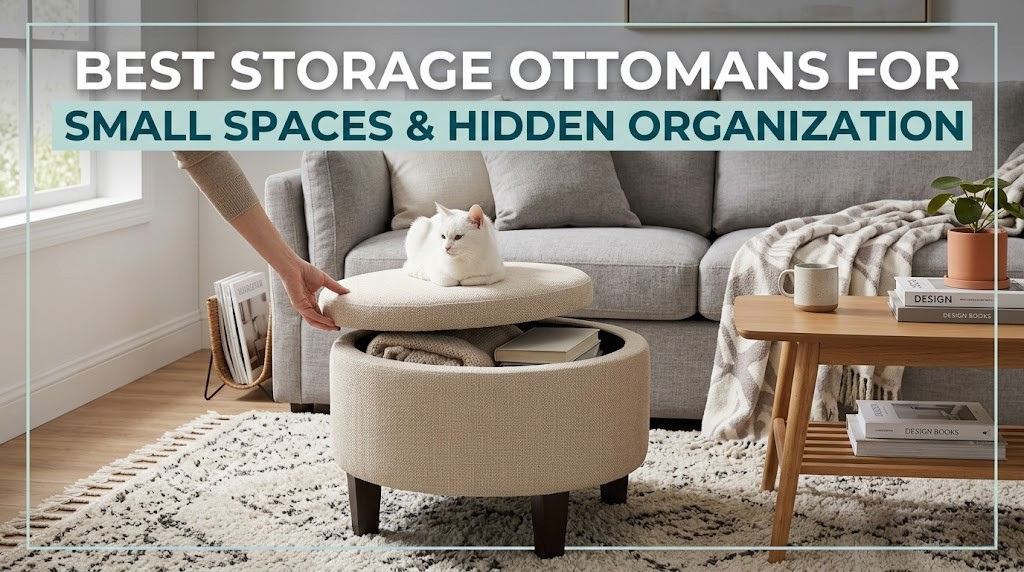
The Best Storage Ottomans: Style Meets Function
In the world of interior design, few pieces work harder than the storage ottoman. It’s the ultimate triple-threat: a comfortable footrest, a discreet storage powerhouse, and an impromptu seat for guests. A great ottoman doesn’t just add to a room; it multiplies its potential. If you’re looking to make your living room feel cozier, a well-chosen storage ottoman is one of the fastest and most affordable ways to do it.
But finding the right one requires a bit of know-how. From lift-top mechanisms to upholstery choices, we’ll break down everything you need to know to select the perfect storage ottoman for your space, needs, and aesthetic. We’ll also cover the keyword topics most guides skip: how to clean every fabric type, the best ottomans for specific rooms, how to use one as a full-time coffee table, budget breakdowns, and much more.
How to Choose the Perfect Storage Ottoman: A Complete Buyer’s Guide
An ottoman is more than just a box with a lid. Consider these key features to ensure your choice is a perfect fit for your home. We’ve expanded this section to answer every question a first-time buyer — or an experienced homeowner upgrading their space — might have.
1. Function & Mechanism
- Hinged Lift-Top: The most common type. The entire lid lifts up, revealing one large storage compartment. Look for soft-close or safety hinges, especially in homes with children, to prevent slammed lids.
- Removable Lid / Flip Top: The lid lifts off completely. Some clever designs feature a flat, wood-finished underside, allowing you to flip the lid and use it as a stable tray for drinks or snacks.
- Drawers or Cubbies: Less common but fantastic for organizing smaller items. These are often found in larger, bench-style ottomans designed for entryways.
- Sectioned Interiors: A handful of premium ottomans include internal dividers or removable trays, making them ideal for organizing smaller items like remote controls, charging cables, or board games alongside larger items like throws.
2. Upholstery & Material — A Deep Dive
The material defines the ottoman’s look, feel, and durability. This is the decision that will have the greatest impact on long-term satisfaction, so it deserves real consideration.
Fabric Ottomans
Fabric ottomans — covering linen, velvet, bouclé, chenille, and performance weaves — are the most popular category for living rooms and bedrooms. They offer unmatched variety in color and texture, and a well-chosen fabric can anchor an entire room’s aesthetic.
- Linen & Cotton Blends: These offer a classic, airy feel and photograph beautifully. Natural linens breathe well and work in both traditional and contemporary interiors. The trade-off is that they can wrinkle, show dirt, and are not inherently stain-resistant. Look for a tight weave count for better durability.
- Velvet: Velvet ottomans add instant luxury and are a staple of maximalist and Hollywood Regency design. Modern velvet is often a polyester or poly-blend, which makes it more durable and easier to clean than it looks. Use a soft-bristle brush to restore the pile after cleaning.
- Bouclé: The reigning trend in interior design, bouclé fabric has a loopy, textured weave that is warm and inviting. It pairs beautifully with natural wood furniture and mid-century modern pieces. The downside: the loops can snag on jewelry or pet claws, and cleaning requires gentle care to avoid distorting the weave.
- Performance Fabrics (Olefin, Solution-Dyed Acrylic): These are the smart choice for families. Performance fabrics are specifically engineered to resist stains, moisture, fading, and abrasion. Brands like Sunbrella originally developed these for outdoor use, but they’ve migrated indoors in a wide range of colors and textures. If you have kids or pets, prioritize this category.
Pro Tip: Before buying, check the fabric’s “rub count” (Martindale or Wyzenbeek rating). For a piece that will see daily use as a footrest or seating, look for a rub count of 25,000+ (Martindale) or 15,000+ (double rubs, Wyzenbeek). Most budget ottomans don’t list this, but premium brands will.
Leather & Faux Leather Ottomans
Leather is the durable powerhouse of ottoman upholstery. Its non-porous surface means spills bead up instead of soaking in, and regular conditioning keeps it supple for decades.
- Top-Grain Leather: The premium tier. Top-grain leather comes from the outermost layer of the hide, retaining the natural grain. It develops a beautiful patina with age. Expect to pay significantly more, but the longevity justifies it for a piece you plan to keep for 10+ years.
- Bonded Leather: Made from shredded leather scraps bonded with a polyurethane finish. It looks like real leather initially but tends to crack and peel within a few years, especially in high-use scenarios. Generally not recommended for a primary footrest.
- PU Faux Leather (Vegan Leather): Modern PU leather has come a long way. Quality PU leather is indistinguishable from genuine leather to casual observers, is completely animal-product-free, and is highly resistant to scratches and spills. It’s the best all-around choice if you want the leather look without the premium price or ethical concerns. Wipe it clean with a slightly damp cloth.
- Microfiber Suede: Ultra-soft and incredibly durable, microfiber suede (often sold as “Alcantara” or generic “microsuede”) is resistant to stains when treated. It has a suede-like texture but doesn’t require the same delicate care as genuine suede. Great for bedrooms and low-traffic living rooms.
Wood & Rattan Ottomans with Storage
Not all storage ottomans are upholstered. Solid wood ottomans (often with cushioned lids) and woven rattan ottomans are growing categories, particularly for bohemian, coastal, and Japandi-inspired interiors. Wood provides maximum durability, while rattan brings in natural texture and lightness. The trade-off is comfort — these materials are less forgiving as a bare footrest without an added cushion or tray on top.
3. Size, Shape & Placement
Measure your space! A general rule is to keep about 18 inches between your ottoman and sofa. The height should be the same as, or slightly lower than, your sofa’s seat cushions. Before you buy, use painter’s tape on your floor to mock up the footprint — it takes two minutes and saves a very heavy return trip.
- Rectangular (Bench): The most versatile shape. Works great as a coffee table alternative or at the foot of a bed. Long bench ottomans (48–60 inches) can seat two adults comfortably.
- Square: Perfect for sectional sofas or creating a central anchor point in a large room. A large square ottoman used as a coffee table should be at least 36×36 inches to feel proportional.
- Round: A stylish choice that softens the hard lines of other furniture and is great for traffic flow in smaller spaces. Round ottomans work particularly well in smaller rooms and apartment living rooms.
- Oversized / XXL: A growing trend is the “supersized” ottoman — a 60″+ square or rectangular piece that entirely replaces a traditional coffee table. These require a larger living room (at least 12×15 feet) to not feel cramped.
4. Internal Capacity: What Can You Actually Store?
Storage capacity is rarely listed prominently in product descriptions, but it’s one of the most important specs. Here’s a practical breakdown of what fits in ottomans of different sizes:
| Ottoman Size | Approx. Interior Volume | What Fits |
|---|---|---|
| Small Cube (15″x15″x15″) | ~1.5 cubic feet | 1–2 throw blankets, remote controls, kids’ toys, books |
| Medium Square (26″x26″x18″) | ~4.5 cubic feet | Multiple blankets, pillows, board games, laptop + charger |
| Large Bench (48″x18″x19″) | ~8 cubic feet | Full bedding set, seasonal clothing, yoga mats, bulky items |
| Oversized (60″x30″x18″) | ~18 cubic feet | Multiple sets of bedding, kids’ toy collection, holiday decor |
5. Frame Construction & Weight Capacity
The frame is the skeleton of your ottoman, and it largely determines how long the piece will last — especially if it doubles as seating. Here’s what to look for:
- Kiln-Dried Solid Hardwood: The gold standard. Kiln-drying removes moisture from the wood, preventing warping and cracking over time. Frames made of oak, beech, or poplar are built to last.
- Engineered Wood (MDF/Plywood): Common in mid-range ottomans. High-quality, thick plywood (18mm+) is actually quite strong and resistant to cracking. MDF is heavier and more prone to damage at edges. Not ideal for a piece that will be moved frequently.
- Metal Frame: Rare in ottomans but very durable. Often found in more industrial or contemporary designs. Metal frames are immune to moisture damage and won’t warp.
- No Frame (Folding/Collapsible): Budget cubes use a cardboard or thin wood board internal structure that collapses for storage. These are lightweight and convenient but should not be used for regular seating of adults.
Important: Always check the manufacturer’s stated weight limit before allowing multiple adults to sit on an ottoman simultaneously. Most solid-frame ottomans support 250–350 lbs for seated use. Collapsible cubes typically max out at 200 lbs.
6. Price Tiers: What to Expect at Each Budget
Storage ottomans range from under $30 to over $1,500. Here’s a transparent breakdown of what your money buys at each tier — useful context if you’re also thinking through your household budget:
- Under $50: Collapsible fabric or faux leather cubes. Lightweight, functional, no frills. Great for kids’ rooms, dorm rooms, or as a secondary piece. Frame life is typically 2–4 years with regular use.
- $50–$150: Entry-level bench and square ottomans with wood frames. Upholstery quality varies significantly at this price point. Read reviews carefully for reports of staples popping or fabric tearing within the first year.
- $150–$350: The sweet spot for most buyers. You’ll find solid construction, better upholstery, and thoughtful design details (safety hinges, rubberized feet, reinforced corners). Most of our top picks fall here.
- $350–$700: Premium ottomans with hardwood frames, top-tier performance fabrics, and designer-level aesthetics. These are “buy it for life” pieces for most households.
- $700+: Luxury and designer pieces (CB2, Restoration Hardware, Mitchell Gold). Genuine leather, custom upholstery options, exceptional craftsmanship. Worth it if you’re designing a forever home.
Our Top Storage Ottoman Picks
We’ve curated this list to highlight the best options on the market, balancing style, durability, and practical features.

1. Simpli Home Harrison Tufted Bench — Best Overall
The Simpli Home Harrison is the quintessential storage ottoman. It’s large, beautifully constructed, and incredibly versatile. The classic tufted top adds a layer of sophistication, making it look far more expensive than it is. It’s the perfect size to double as a coffee table or sit elegantly at the foot of a queen or king-sized bed.
| Feature | Specification |
|---|---|
| Dimensions | ~ 48″ W x 18″ D x 19″ H |
| Material | Faux Leather or various Fabrics |
| Mechanism | Hinged Lift-Top with Safety Hinge |
| Best For | Living Rooms, Bedrooms, Entryways |
The interior storage space is massive, easily swallowing blankets, board games, or pillows. The child safety hinge is a crucial feature, preventing the heavy lid from slamming shut. It comes in a wide variety of colors and fabrics to match nearly any decor.
Pros
- Huge storage capacity
- High-end look with detailed tufting
- Child safety hinge is a major plus
- Available in many colors/materials
- Sturdy solid wood frame
Cons
- Can be heavy to move
- Tufting can trap crumbs

2. SONGMICS Collapsible Cube — Best Budget Pick
Sometimes you just need a simple, effective, and affordable solution. This collapsible cube from SONGMICS is a marvel of practicality. It sets up in seconds, can hold a surprising amount of weight (both inside and on top), and can be folded flat for storage when not in use.
| Feature | Specification |
|---|---|
| Dimensions | ~ 15″ W x 15″ D x 15″ H |
| Material | Faux Leather or Linen Fabric |
| Mechanism | Removable Lid |
| Best For | Dorm rooms, small apartments, playrooms |
The faux leather is durable and wipes clean in an instant, making it perfect for a child’s room or as a discreet spot to hide pet toys. While it won’t be the centerpiece of your living room, its utility-to-price ratio is off the charts. Buy a pair to tuck under a console table for quick-access seating.
Pros
- Extremely affordable
- Folds flat for easy storage
- Surprisingly sturdy and strong
- Easy to clean
- Lightweight and easy to move
Cons
- Basic aesthetic
- No safety hinge

3. Convenience Concepts Round Ottoman — Best for Style & Small Spaces
This round ottoman is the definition of chic functionality. Its compact, circular shape is perfect for adding a soft edge to a room full of linear furniture. The standout feature is the reversible lid: one side is upholstered for seating, while the other is a finished wood tray, instantly creating a stable surface for a cup of tea or a book.
| Feature | Specification |
|---|---|
| Dimensions | ~ 17″ Diameter x 18″ H |
| Material | Various Fabrics |
| Mechanism | Removable, Reversible Lid/Tray |
| Best For | Living rooms, bedrooms, accent piece |
This piece is ideal for smaller apartments or as a stylish companion to an armchair. While the storage capacity isn’t as vast as a large bench, it’s perfect for stashing a single throw blanket, remote controls, or magazines. It’s a statement piece that pulls its weight in utility.
Pros
- Stylish and modern design
- Reversible lid-to-tray feature is brilliant
- Great for small spaces and traffic flow
- Adds a soft, curvilinear element to a room
- Comes fully assembled
Cons
- Limited storage space
- Not large enough to be a primary footrest for a large sofa
The Room-by-Room Storage Ottoman Guide
Choosing the right ottoman isn’t just about picking a style you like — it’s about matching the piece to the specific functional demands of each room in your home. Here’s exactly what to prioritize in each space.
🛋️ Living Room
The living room ottoman needs to do the most work. Prioritize: a flat, stable lid surface (or flip-tray design) if it will replace a coffee table; a weight capacity of 300+ lbs if it doubles as seating; and a fabric that matches your sofa within one or two tones. A large square or rectangular bench works best here.
🛏️ Bedroom
At the foot of the bed, a bench-style ottoman is ideal. Use it to store extra bedding, seasonal clothing, or pillows. Height is important — it should be level with or just below your mattress height so you can sit on it comfortably. Soft velvet or bouclé fabrics work beautifully here.
🚪 Entryway / Hallway
The entryway demands durability above all else — this is the most trafficked spot in your home. Faux leather or performance fabric is a must. A narrow bench with internal storage for shoes, umbrellas, or reusable bags is perfect. Look for one with non-slip feet to prevent sliding on tile or hardwood.
🧸 Kids’ Room / Playroom
In a playroom, the ottoman’s primary job is toy containment. Choose a collapsible cube that’s easy for children to open themselves, in a wipe-clean faux leather. Avoid tufted designs (crumbs!) and choose a bright, fun color or a neutral that won’t show stains. Safety hinges are non-negotiable here.
🏠 Home Office
A small ottoman under your desk can serve as a footrest to improve posture during long work sessions. Use the storage for charging cables, stationery, or tech accessories. A firm, flat-topped cube at desk height works best — this is one scenario where the collapsible cube actually shines.
🛁 Bathroom / Dressing Room
A small, moisture-resistant ottoman (faux leather or treated fabric) near a vanity or in a bathroom provides seating while getting ready. Store hair tools, skincare products, or towels inside. Look for water-resistant upholstery and rubberized feet designed for slick tile floors.
Using a Storage Ottoman as a Coffee Table: Everything You Need to Know
One of the most popular uses for a large storage ottoman is replacing a traditional coffee table entirely. This trend has exploded in interior design circles because it offers the same functional surface while eliminating hard, painful corners and dramatically increasing storage. If you’re trying to organize your space more effectively, this swap is one of the highest-impact changes you can make.
Advantages of the Ottoman-as-Coffee-Table Swap
- Child and pet safety: No sharp corners means no bruised shins and no hazards for toddlers learning to walk.
- Flexible seating: When guests arrive, you instantly have extra seating for 2–4 people without pulling in chairs from another room.
- Hidden storage: Everything that normally clutters a coffee table — remotes, coasters, magazines, charging cables — disappears inside.
- Softer aesthetic: A large upholstered ottoman warms up a living room and makes it feel more relaxed and inviting than a hard glass or wood coffee table.
Disadvantages to Consider
- No stable surface by default: You’ll almost certainly need a large tray (ideally 18–24 inches) to create a stable place for drinks, books, and decor. A tray is not optional — it’s a requirement.
- Surface feels soft: Setting down a glass on an upholstered surface without a tray will leave ring marks and may cause spills. With a quality tray, this is a non-issue.
- Not ideal for eating: If you regularly eat meals in front of the TV, an ottoman surface (even with a tray) is slightly less stable than a solid table. Consider a hybrid approach — ottoman for everyday use, folding tray tables for meal times.
How to Style an Ottoman as a Coffee Table
The key to making an ottoman work as a coffee table is the styling on top of it. Think of the tray as your “coffee table surface” and style it as you would a traditional table:
- Choose a large, sturdy tray — wooden, rattan, or lacquered trays all work well. Aim for something at least 16 inches across to feel substantial.
- Add a low centerpiece — a small succulent, a stack of coffee table books, or a decorative object. Keep the height under 8 inches so it doesn’t block sightlines.
- Include a functional element — a coaster set, a small candle, or a catch-all dish. Ottomans styled this way look intentional and curated, not just “a couch cushion on the floor.”
- Keep one corner of the tray clear — this is where drinks and the TV remote live. Resist the urge to fully cover every inch of the tray with decor.
How to Clean & Maintain Your Storage Ottoman
Every upholstered piece in your home has a cleaning code on its tag. Finding and reading this tag before you have an emergency spill is one of the most underrated maintenance habits a homeowner can develop. Pair this with a regular home maintenance routine to keep everything looking its best year-round.
Decoding Upholstery Cleaning Codes
- W (Water-based cleaner): Safe to use water-based cleaning solutions or foam upholstery cleaner. Most fabric ottomans fall here.
- S (Solvent-based cleaner): Water will cause staining or ring marks. Use dry-cleaning solvents only. Velvet and microfiber often carry this code.
- W/S: Either water-based or solvent cleaners are safe. The most forgiving code.
- X: Vacuum only. No liquids of any kind. Rare, but important to know — using water on an X-coded fabric can permanently damage it.
Cleaning Guide by Material Type
Fabric Ottomans (Code W or W/S)
- Vacuum the entire surface weekly using an upholstery attachment, paying special attention to tufting, seams, and buttons where crumbs accumulate.
- For spills, blot immediately with a clean white cloth. Never rub — rubbing spreads the stain and works it deeper into the fibers. Blot from the outside of the stain inward.
- Mix one tablespoon of dish soap with two cups of cold water. Apply with a clean cloth, blotting gently. Follow with a cloth dampened with plain cold water to remove soap residue.
- Allow to air dry completely before sitting on it. Use a fan to speed drying and prevent musty odors.
- For set-in stains, a small amount of white vinegar (50/50 diluted with water) can help lift organic stains. Test in a hidden area first.
Leather & Faux Leather Ottomans
- Wipe down weekly with a dry or very lightly damp microfiber cloth.
- For spills, wipe immediately with a dry cloth. Leather is naturally water-resistant, so most spills won’t penetrate if addressed quickly.
- Condition genuine leather every 6–12 months with a dedicated leather conditioner. This prevents the material from drying out and cracking.
- For faux leather, avoid harsh chemical cleaners — isopropyl alcohol can strip the PU coating over time. A mild soap solution is sufficient.
- Keep leather ottomans out of direct sunlight to prevent fading and drying.
Velvet Ottomans (Code S or W/S)
- Brush in one direction with a soft-bristle upholstery brush weekly to maintain the pile and prevent crushing.
- For water-safe velvet (check the code!), use a barely damp cloth for spot cleaning, then brush the pile back into place and allow to dry.
- For solvent-coded velvet, use a dry foam upholstery cleaner only.
- Steam can restore crushed velvet pile — hold a clothes steamer 6 inches from the fabric and brush simultaneously.
Preventing Long-Term Wear
- Rotate use — if your ottoman takes weight primarily on one side (e.g., always the same seat position), rotate it 180° every month to distribute wear evenly.
- Use felt pads on legs — the provided feet on many ottomans are basic plastic discs. Replacing them with adhesive felt pads protects hardwood floors and reduces scratching.
- Avoid direct sunlight — UV rays degrade all upholstery materials over time. Use curtains or UV-filtering window film in rooms where your ottoman gets direct afternoon sun. This is also excellent advice for general living room care.
- Use a tray consistently — if your ottoman doubles as a coffee table, always use a tray. Direct contact with wet glasses, food, or oils will eventually stain even the most durable upholstery.
The Best Storage Ottomans for Specific Needs
Best Storage Ottoman for Pets
Pet owners have unique needs: scratch resistance, easy fur removal, and ability to survive the occasional muddy paw print. For households with dogs and cats, the ideal ottoman has:
- A tightly woven performance fabric (olefin or solution-dyed acrylic) that resists scratching and is easy to vacuum
- A dark or heathered color that hides fur between cleanings
- A faux leather or PU alternative, which resists pet dander and can be wiped clean in seconds
- Avoid: velvet (attracts fur intensely), bouclé (loops snag on claws), and light solid colors (shows dirt immediately)
If you have a cat that insists on scratching upholstered furniture, consider a double-sided microfiber design — the texture is less appealing to most cats than plush velvet or woven fabric. You might also pair your ottoman care with broader strategies for managing a pet-friendly living room aesthetic.
Best Storage Ottoman for Small Apartments
In a studio or one-bedroom apartment, every piece of furniture must earn its place. The priorities for small-space ottoman selection are:
- Proportional sizing: A 48-inch bench will overwhelm a small living room. Aim for 24–36 inch ottomans in compact spaces. Measure the room with tape before ordering.
- Multi-functional design: The round flip-tray ottoman (like our #3 pick) is ideal because it serves as footrest, tray table, and storage in one small footprint.
- Stackable or nestable: Some ottoman sets include a large and small ottoman that nest together — great for apartment dwellers who need flexible seating for guests.
- Legs vs. no legs: Ottomans with legs feel lighter and create the illusion of more floor space. Legless “foundation” style ottomans feel heavier visually but provide more internal storage.
Best Storage Ottoman for a Home Office
Working from home has dramatically changed how we use furniture throughout the house. A well-chosen ottoman near your home office setup can serve as:
- An ergonomic footrest that elevates your feet slightly, reducing lower back pressure during long sitting sessions
- Extra seating for when a colleague or client visits
- Storage for tech accessories, cables, notebooks, or a backup laptop
- A surface for spreading out documents or working from the couch
For the home office, choose a firm-topped ottoman (memory foam fills give too much and are unstable as a work surface) in a neutral, professional color that won’t clash with video call backgrounds. A medium square (20–26 inches) is the most versatile size here.
Best Storage Ottoman for Kids
In a child’s room or playroom, the storage ottoman’s mission is simple: make tidying up as easy as possible. Features to prioritize:
- Safety hinge (mandatory): A heavy lid without a safety hinge is a pinched-finger waiting to happen. This is the single most important safety feature to look for.
- Easy-open lid: Children need to be able to open and close the ottoman themselves. Test this in-store if possible, or look for reviewers who specifically mention ease of use for kids.
- Wipe-clean surface: Faux leather or laminated fabric is the only practical choice for a children’s room. Fabric will stain within weeks.
- Reinforced corners: Kids jump on furniture. Full stop. Choose an ottoman with reinforced corner blocking in the frame.
- Non-toxic materials: Look for certifications like Oeko-Tex Standard 100 on the fabric if you have young children who may chew on or frequently contact the surface.
Storage Ottoman vs. Coffee Table: Which Is Right for You?
This is one of the most common dilemmas when furnishing a living room. Here’s a side-by-side comparison to help you decide:
| Criteria | Storage Ottoman | Coffee Table |
|---|---|---|
| Extra seating | ✅ Yes — seats 2–4 people | ❌ No |
| Hidden storage | ✅ Yes — large capacity | ❌ Usually none (or small shelf) |
| Hard surface for drinks | ⚠️ Only with a tray | ✅ Yes — solid surface |
| Child/pet safety | ✅ No sharp corners | ⚠️ Glass/wood corners are hazardous |
| Display space | ⚠️ Limited without tray | ✅ Full flat display surface |
| Foot comfort | ✅ Cushioned, very comfortable | ❌ Hard surface |
| Aesthetic versatility | ✅ Very high — fabric, color, shape options | ✅ High — wood, glass, metal options |
| Price range | $30 – $1,500+ | $50 – $3,000+ |
Our verdict: For families with young children or pets, the storage ottoman wins decisively. For adults who entertain frequently and want a dramatic display surface, a coffee table or a combination of both (a small accent ottoman + coffee table) may work better. For small apartments, the ottoman almost always wins on versatility per square foot.
How to Integrate a Storage Ottoman Into Every Design Style
One of the biggest fears buyers have is choosing an ottoman that clashes with their existing furniture. Here’s a style-by-style guide to making the right choice. Being intentional about this is part of what separates a well-designed space from a randomly assembled one — much like being intentional about habits separates effective people from reactive ones.
Mid-Century Modern
Mid-century modern interiors celebrate clean lines, organic shapes, tapered legs, and a warm, earthy palette. For this style:
- Choose an ottoman with tapered wooden legs (walnut stain is ideal)
- Round or oval shapes work particularly well with the organic MCM aesthetic
- Colors: mustard yellow, burnt orange, avocado green, camel, or teal
- Fabrics: textured boucle, woven fabric, or genuine leather in warm tones
- Avoid: heavily tufted designs (too traditional) or stark white/gray (too contemporary)
Scandinavian / Japandi
Scandinavian design emphasizes simplicity, natural materials, and a “hygge” coziness. Japandi blends Scandinavian minimalism with Japanese wabi-sabi. For these styles:
- Natural linen, undyed cotton, or bouclé fabric in off-white, cream, or light gray
- Simple, unadorned silhouettes — no tufting, no fringe, no ornate details
- Low-profile designs that don’t crowd the visual space
- Light-toned wooden legs (natural birch, ash, or blonde oak)
- For true Japandi: consider a rattan or woven seagrass ottoman with a cushion top
Maximalist / Eclectic
Maximalist interiors thrive on pattern, color, and layering. Your ottoman can be a star of the room rather than a supporting player:
- Jewel-toned velvet (emerald, sapphire, amethyst, ruby) in a round or square shape
- Embroidered, printed, or patterned upholstery is encouraged
- Don’t be afraid of tufting, nail-head trim, or fringe edging
- Mix metal leg finishes (brass legs with jewel velvet is a classic maximalist combination)
Farmhouse / Rustic
Farmhouse interiors blend comfort and practicality with nods to rural American heritage:
- Buffalo check, plaid, or natural linen fabrics in cream, navy, or sage green
- Chunky, substantial proportions — this is not the place for a delicate round accent piece
- Reclaimed wood elements (a bench ottoman with a wood tray insert is perfect here)
- Nail-head trim adds a touch of character without being fussy
Modern / Contemporary
Contemporary interiors favor clean geometry, neutral palettes, and quality materials without decorative excess:
- Solid colors in the greige-gray-white spectrum, or architectural accents in black
- Square or rectangular shapes with clean, uninterrupted lines
- Leather (genuine or quality faux) reinforces the sophisticated, minimal aesthetic
- Low legs or a foundation base (no legs) keeps the silhouette sleek
Pro Tips for Styling Your Ottoman
- As a Coffee Table: Place a large decorative tray on top to corral remotes, coasters, and a small vase. This creates a stable, stylish surface. Choose a tray that covers at least 60% of the ottoman’s top area.
- At the Foot of a Bed: Use it to store extra bedding or seasonal clothing. You can drape a decorative throw over one corner for a layered look. This is a fantastic way to get more from your bedroom storage without adding another dresser or closet organizer.
- In an Entryway: This is the perfect spot to sit and put on shoes. Store guest slippers, reusable shopping bags, or winter hats and gloves inside.
- Layering with Rugs: Place your ottoman on an area rug that is large enough for the rug to extend at least 12 inches beyond the ottoman on all sides. This grounds the piece and defines the seating zone.
- Using Two Ottomans: Pairing two smaller ottomans (instead of one large one) gives you more flexibility — push them together for a large surface, or separate them to flank a sofa for individual footrests. This also makes them easier to move when rearranging.
How to Get the Most Value When Shopping for a Storage Ottoman
Shopping for furniture is one of the most significant discretionary purchases many households make. With that in mind, here are strategies for getting the best possible piece at any budget — skills that complement any solid money management approach.
Shop for Ottomans During Peak Sales Periods
Furniture retailers run their deepest discounts during predictable windows. If you’re not in a hurry, timing your purchase can save 20–40%:
- Labor Day & Memorial Day weekends — the two biggest furniture sale events of the year in the US
- Black Friday / Cyber Monday — online furniture retailers offer significant discounts, though shipping lead times may extend significantly
- End of season — retailers clear floor models in January and July to make room for new inventory. Floor models often have small cosmetic imperfections but are structurally sound and may be 30–50% off
- Amazon Prime Day — furniture and home goods are consistently among the strongest Prime Day deal categories
Evaluate Reviews Strategically
Not all reviews are created equal. When reading Ottoman reviews, here’s what to actually look for:
- Filter for verified purchase reviews with photos — photos are the best evidence of real-world appearance and quality
- Sort by “most helpful” then read the 1-star reviews — look for patterns (multiple complaints about the same issue signal a real problem, not a one-off bad experience)
- Search for reviews mentioning “6 months later” or “one year later” — these tell you about long-term durability, which early reviews can’t
- Pay attention to assembly complexity reviews — some ottomans require significant assembly; if you live alone or have mobility issues, this is important to know
Consider the Total Cost of Ownership
A $60 ottoman that lasts 18 months before the hinge breaks or the fabric tears costs more per year than a $180 ottoman with a solid wood frame and quality upholstery that lasts 8 years. Before buying purely on price, calculate the rough cost-per-year of each option and factor in your lifestyle demands (pets, kids, frequent use).
Measure Your Space Three Times
Returns are expensive, time-consuming, and sometimes not possible (large furniture items often have restocking fees of 15–25%). Measure your available space, account for the ottoman lid opening clearance (you need 8–12 inches of clearance above the lift-top to open it fully), and use painter’s tape on the floor to visualize the footprint before ordering.
Extending the Life of Your Ottoman: A Long-Term Care Calendar
Most quality ottomans will last 7–15 years with proper care. Here’s a simple maintenance calendar to follow:
| Frequency | Task |
|---|---|
| Weekly | Vacuum upholstery with soft attachment; brush velvet to restore pile; wipe leather with dry microfiber cloth |
| Monthly | Rotate 180° for even wear; check hinge hardware and tighten if loose; check feet for damage and replace felt pads if worn |
| Every 3 Months | Deep clean upholstery per the fabric’s cleaning code; treat performance fabrics with fabric protector spray if desired |
| Every 6 Months | Condition genuine leather with dedicated conditioner; inspect frame joints and re-glue if any wobble is detected early |
| Annually | Professional upholstery cleaning for heavily used ottomans; evaluate whether the internal storage organization system still meets your needs |
Frequently Asked Questions (FAQ)
This varies greatly by model. A well-built, solid-wood-frame ottoman like the Simpli Home bench can often support 250–300 lbs or more for seating. Smaller, collapsible models might be rated for 200 lbs. Always check the manufacturer’s specifications before allowing multiple people to sit on one.
Faux leather or genuine leather are top choices. They are non-porous, so spills can be wiped up easily, and they don’t attract pet hair the way fabrics do. If you prefer fabric, look for “performance fabrics” that are specifically treated for stain resistance, or choose a tightly woven fabric in a darker or heathered color to hide minor stains and wear.
Always check the cleaning code on the tag first (W, S, W/S, X). For most, regular vacuuming with an upholstery attachment is key. For spills on fabric, blot immediately (don’t rub!) with a clean, dry cloth. For leather, simply wipe with a damp cloth. Avoid harsh chemical cleaners unless specified by the manufacturer.
Absolutely — and many interior designers now recommend this swap for families. The key is to use a large, stable tray on top of the ottoman as your “hard surface” for drinks and decor. Choose an ottoman that is at least 36 inches wide if it’s your primary coffee table, and make sure it’s firm enough to not wobble when someone sets a glass on the tray.
As a general rule, your ottoman should be about two-thirds the length of your sofa. So if you have an 84-inch sofa, a 48–56-inch ottoman is ideal. Leave 18 inches of clearance between the ottoman and the sofa to allow comfortable walking space. The ottoman height should be within 2 inches of the sofa seat cushion height for comfortable footrest use.
Storage ottomans are excellent for small living rooms precisely because they perform multiple functions in a compact footprint. A 24–30 inch round ottoman, for example, can serve as footrest, extra seating for one guest, and storage for throws or remotes — three functions that would otherwise require three separate pieces. In small spaces, choose ottomans with legs (they visually “float” and make the room feel larger) and avoid oversized rectangular benches that will dominate the space.
Most ottomans come with basic plastic feet that can scratch hardwood and tile over time, especially when the ottoman is moved. Replace these with self-adhesive felt pads (available at any hardware store for under $5). For heavy ottomans that are rarely moved, furniture cups or rubber feet discs offer even more protection. Check and replace felt pads every 6–12 months, as they compress and lose effectiveness over time.
Yes, unequivocally — especially if you have children. A safety hinge (also called a soft-close hinge) prevents the lid from slamming shut suddenly, which can cause serious finger injuries in young children. Some adult-only ottomans skip this feature to save costs, but for any household with children under 8, a safety hinge should be considered mandatory. It’s also gentler on the hinge mechanism overall, extending the life of the ottoman.
Standard indoor ottomans are not designed for outdoor use. Moisture, UV rays, and temperature fluctuations will rapidly damage the upholstery, frame, and hardware of an indoor ottoman used outdoors. If you want an ottoman for a covered patio or porch, look specifically for ottomans marketed as “indoor/outdoor” with Sunbrella or other weather-resistant fabric and a weatherproofed frame. These will survive humid environments far better than repurposed indoor pieces.
The most common and practical items to store in a living room ottoman include: throw blankets and accent pillows, TV remotes and universal remote controls, charging cables and small tech accessories, board games and card games, kids’ toys for the living room (LEGOs, coloring books), magazines and coffee table books, and seasonal items like holiday cards or decorations. Organize the interior with a fabric bin or simple cardboard box inserts to create sections for different categories.
Quick Comparison: All Three Picks at a Glance
| Feature | Simpli Home Harrison | SONGMICS Cube | Convenience Concepts Round |
|---|---|---|---|
| Award | Best Overall | Best Budget | Best for Small Spaces |
| Shape | Rectangular bench | Square cube | Round |
| Size | 48″W x 18″D x 19″H | 15″x15″x15″ | 17″ diameter x 18″H |
| Mechanism | Hinged lift-top | Removable lid | Reversible flip lid/tray |
| Safety hinge | ✅ Yes | ❌ No | N/A (removable lid) |
| Storage capacity | Very large (~8 cu ft) | Small (~1.5 cu ft) | Small (~1.5 cu ft) |
| Best material | Faux leather / fabric | Faux leather / linen | Various fabrics |
| Child-friendly | ✅ Yes | ⚠️ Check weight limit | ✅ Yes |
| Coffee table use | ✅ Excellent (with tray) | ❌ Too small | ⚠️ Only for one person |
| Assembly required | Minimal | None | None (ships assembled) |
Sustainability & Responsible Buying
As consumers become more conscious of the environmental impact of their purchases, the furniture industry is evolving — but not always quickly. Here’s what to look for if sustainability matters to your buying decision:
- Certified wood frames: Look for FSC (Forest Stewardship Council) certification, which ensures wood is sourced from responsibly managed forests.
- Oeko-Tex fabric certification: Oeko-Tex Standard 100 certifies that a fabric has been tested for harmful substances and is safe for human contact. This is particularly important for children’s furniture.
- Vegan / animal-free upholstery: High-quality PU faux leather and performance fabrics eliminate the need for animal hides without sacrificing durability.
- Avoiding cheap bonded leather: Bonded leather peels and flakes into microplastics. Choosing genuine leather or quality faux alternatives is actually more environmentally responsible, as it doesn’t end up in landfill after 2–3 years.
- Local manufacturing: Buying from brands that manufacture domestically reduces the carbon footprint associated with shipping, and typically improves quality control.
- Buy once, buy well: The most sustainable purchase is the one you don’t have to repeat. A well-constructed ottoman purchased at a higher price point and maintained properly is more environmentally responsible than cycling through three budget ottomans over the same period.
Conclusion: The Ultimate Decluttering Tool
A storage ottoman is more than just furniture; it’s a solution. It’s the answer to the question of where to put the extra blankets, how to add more seating without clutter, and how to create a polished, organized home. Whether you’re tackling a major home transformation project or simply looking to squeeze more functionality from your current space, a great storage ottoman delivers outsized value.
The best storage ottoman for your home is the one that’s sized correctly for your space, upholstered in a material that matches your lifestyle, and built with a frame solid enough to earn a permanent spot in your room. Armed with the buying guide, material deep-dives, room-by-room recommendations, and care instructions in this guide, you have everything you need to make a confident, informed decision.
Whether you need the expansive, elegant storage of the Simpli Home Harrison Bench, the clever versatility of the Convenience Concepts Round Ottoman, or the unbeatable practicality of the SONGMICS Cube, there is a perfect option waiting to transform your space. If you’re investing in your home this season, also consider reading our guides on kitchen upgrades that are worth the money and must-have home office gadgets to make every room in your home work harder for you.
Choose wisely, maintain well, and enjoy a tidier, more stylish home.