The 5 Best USB-C Car Chargers: Your Ultimate Guide to Power on the Go
Affiliate Disclosure: This post contains affiliate links. If you make a purchase through these links, we may earn a commission at no extra cost to you. We only recommend products we’ve personally used or thoroughly researched. Our goal is to provide honest, expert-driven advice to help you make the best choice.
In today’s hyper-connected world, your car isn’t just a mode of transportation; it’s your mobile command center. You’re navigating with Waze, streaming your favorite podcast, taking important calls, and maybe even keeping the kids entertained with a tablet in the back. All this tech has one crucial, non-negotiable need: power. And the slow, flimsy gas station charger you’ve had for years just isn’t cutting it anymore.
The transition to USB-C has been a game-changer for charging speed and versatility. Modern devices, from the latest iPhones and Android flagships to iPads, Nintendo Switches, and even powerful laptops, now rely on this powerful standard. A high-quality USB-C car charger isn’t a luxury; it’s an essential tool. It’s the difference between arriving at your destination with a 7% battery warning and a full 100%, ready for whatever’s next. If you’re putting together a road trip essentials checklist, a fast USB-C car charger should be at the very top.
But the market is flooded with options, all claiming to be the “fastest” or “most powerful.” How do you separate the marketing hype from real-world performance? That’s where we come in. We’ve spent countless hours researching, analyzing specifications, and poring over user feedback to identify the absolute best USB-C car chargers available today. We’re looking at power output (watts), charging protocols (like Power Delivery and PPS), build quality, safety features, and overall value. Whether you’re commuting daily, heading out on a long road trip, or simply want to make sure your devices are always powered up, this is your definitive guide.
Our Top Picks for Best USB-C Car Chargers
For those in a hurry, here’s a quick rundown of our top selections. Each of these chargers excels in a specific category, ensuring there’s a perfect match for every type of driver and device user.
| Charger | Total Power | Best For | Check Price |
|---|---|---|---|
| 1. UGREEN 130W USB C Car Charger | 130W | Ultimate Power & Laptop Charging | View on Amazon |
| 2. Anker 521 Car Charger (40W) | 40W | Compact Design & iPhone Users | View on Amazon |
| 3. Spigen 75W Dual USB C Car Charger | 75W | Power & Value Balance | View on Amazon |
| 4. Baseus 160W USB C Car Charger | 160W | Multi-Device Families & Road Trips | View on Amazon |
| 5. AINOPE 60W Flush Fit Car Charger | 60W | Minimalist Look & Sleek Interiors | View on Amazon |
1. UGREEN 130W USB C Car Charger: The Ultimate Powerhouse

Our Experience
Right out of the box, the UGREEN 130W charger feels substantial. It has a premium, durable feel with a sleek metallic gray finish that blends well with modern car interiors. This isn’t just a charger; it’s a mobile power station. We plugged in a MacBook Pro 14-inch and a Samsung S25 Ultra simultaneously, and it didn’t even break a sweat. The MacBook immediately registered a high-wattage charge, and the Samsung phone activated its “Super Fast Charging 2.0” mode, thanks to the charger’s PPS support. For the power user, the road warrior, or anyone who needs to charge a laptop in their vehicle, this is, without a doubt, the new king. If you’re the kind of driver who uses their car as a mobile office, pairing this with one of the best apps every driver should use will transform your daily commute into a productivity powerhouse.
Deep Dive: Performance & Features
The magic of this charger lies in its intelligent power distribution. The top USB-C port is a beast, capable of delivering a full 100W on its own. This is enough to charge most high-end laptops, including the MacBook Pro, at near-full speed. The second USB-C port offers a respectable 30W, perfect for fast-charging iPads, iPhones, and flagship Android devices. The addition of a 22.5W USB-A port provides backward compatibility for older gadgets or accessories.
When you use multiple ports, the power is distributed intelligently. For example, using both USB-C ports simultaneously will give you 100W and 30W, respectively. The charger incorporates advanced safety features, including protection against overheating, over-current, and short-circuiting. Throughout our testing, even when pushing it with a laptop and phone, the unit remained remarkably cool to the touch, a testament to its excellent thermal design. This level of safe driving habits extends to your tech too — choosing quality accessories that don’t overheat or cause electrical issues is just as important as good behavior behind the wheel.
| Total Output | 130W |
|---|---|
| Port 1 (USB-C) | 100W Max (PD 3.0, PPS) |
| Port 2 (USB-C) | 30W Max (PD 3.0) |
| Port 3 (USB-A) | 22.5W Max (QC 4.0) |
| Key Protocols | Power Delivery 3.0, PPS, Quick Charge 4.0 |
| Material | Aluminum Alloy & PC |
Pros
- Incredible 100W single-port output for laptops
- PPS support for Samsung Super Fast Charging
- Three ports to charge multiple devices
- Premium build quality and heat dissipation
- Wide compatibility with virtually any device
Cons
- Larger than most chargers
- Higher price point (but worth it for the power)
Who Is This For?
This charger is for the uncompromising power user. If you’re a remote worker, a real estate agent, or a consultant who uses their car as an office, the ability to charge your laptop at full speed is non-negotiable. It’s also perfect for tech-heavy families on long road trips, ensuring every device — from laptops to phones to gaming consoles — stays topped up. Combine it with a solid set of budget car gadgets for the biggest overall upgrade to your driving experience without breaking the bank.
2. Anker 521 Car Charger (40W): Compact Power for Daily Drives

Our Experience
Anker is a name synonymous with reliable charging, and the 521 Car Charger (also known as the PowerDrive III Duo) lives up to that reputation. What struck us first was its incredibly small size. It’s impressively compact for a dual-port charger, sitting nearly flush in the 12V socket. This is fantastic for maintaining a clean, uncluttered dashboard. We tested it with an iPhone 15 Pro and a Google Pixel 8 Pro. Both devices started fast-charging immediately, with each port delivering a consistent 20W. It’s the perfect “set it and forget it” charger for smartphone users who want reliable power without any fuss. For drivers who commute daily, this pairs beautifully with having the best Bluetooth FM transmitter set up alongside it, so your music, podcasts, and navigation audio come through crystal clear all day long.
Deep Dive: Performance & Features
The Anker 521 is designed for simplicity and efficiency. It features two USB-C Power Delivery ports, each capable of putting out 20W. This is the ideal wattage for fast-charging the latest iPhones, which max out at around 20-27W. When you plug in two phones, it doesn’t split a small pool of power; it delivers a solid 20W to each device simultaneously for a total of 40W. This independent power delivery is a key feature often missed in cheaper dual-port chargers.
Anker’s renowned MultiProtect safety system is built-in, offering temperature control, overvoltage protection, and more. The soft blue LED ring around the ports is a nice touch, making it easy to find in the dark without being a distracting glare while driving. The all-metal construction not only looks premium but also aids in heat dissipation, keeping the charger cool and efficient.
A tidy car interior just feels better and can even contribute to better focus while driving. While this charger keeps your cables neat, you can go a step further by using one of the best car gap fillers to prevent your phone, keys, or other items from disappearing into the abyss between your seats. And while you’re at it, investing in stylish car accessories is a great way to elevate the entire interior aesthetic, not just the tech side of things.
| Total Output | 40W |
|---|---|
| Port 1 (USB-C) | 20W Max (PD 3.0) |
| Port 2 (USB-C) | 20W Max (PD 3.0) |
| Key Protocols | Power Delivery 3.0 |
| Material | Metal Alloy |
Pros
- Ultra-compact and sleek design
- Simultaneous 20W fast charging for two devices
- Anker’s trusted reliability and safety features
- Excellent build quality with a metal body
- Perfect wattage for iPhones and other smartphones
Cons
- Not powerful enough for laptops or tablets at full speed
- No PPS support for Samsung’s fastest charging speeds
Who Is This For?
This is the ideal daily driver charger for any iPhone user or couple/passenger duo with modern smartphones. Its compact size, reliable power delivery, and trusted brand name make it a no-brainer for anyone who primarily needs to keep their phones topped up quickly and safely during commutes and daily errands. If you frequently drive with passengers, pairing this with orthopedic car neck pillows will make long journeys comfortable for everyone, keeping both their comfort and their battery levels high.
3. Spigen 75W Dual USB C Car Charger: The Perfect Mid-Range All-Rounder

Our Experience
Spigen is well-known for their excellent phone cases, but they’ve been quietly building a reputation for high-quality charging accessories too. The Spigen ArcStation 75W charger hits a sweet spot. It feels robust, with a carbon fiber-esque texture that gives it a modern, techy look. When we plugged it in, we were immediately impressed by its versatility. The 45W port was powerful enough to charge a Dell XPS 13 or a MacBook Air, while the 30W port handled an iPad Pro with ease. For its price, the power and features — especially PPS support — are hard to beat. If you’re looking to build out a truly capable in-car tech setup, this charger is an ideal centerpiece alongside other car accessories used daily.
Deep Dive: Performance & Features
This charger’s strength is its intelligent power allocation and broad protocol support. The top port can deliver up to 45W, making it suitable for smaller ultrabooks and tablets. The second port provides up to 30W. Crucially, when both ports are in use, it delivers 45W and 30W simultaneously for a total of 75W, which is impressive for this price class.
The inclusion of PPS (Programmable Power Supply) on the 45W port is a huge bonus. This allows it to dynamically adjust voltage and current, enabling Super Fast Charging for compatible Samsung Galaxy devices. So whether you’re an Apple or Android user, this charger has you covered. It also features Spigen’s “QuantumBoost” technology, which is their branding for ensuring the fastest, safest charge for the connected device. The build quality feels solid, and it manages heat well, even under a full 75W load. For anyone thinking about overall vehicle safety and preparedness, it’s also worth reading up on how to build a car safety kit covering tires, battery, and first aid — your gadgets should always be paired with practical readiness on the road.
| Total Output | 75W |
|---|---|
| Port 1 (USB-C) | 45W Max (PD 3.0, PPS) |
| Port 2 (USB-C) | 30W Max (PD 3.0) |
| Key Protocols | Power Delivery 3.0, PPS |
| Material | PC with Carbon Fiber texture |
Pros
- Excellent balance of power and price
- 45W port is powerful enough for ultrabooks
- PPS support is a huge win for Samsung users
- Intelligent Power Diffusion maintains speeds with two devices
- Stylish and durable design
Cons
- 45W may not be enough for larger, power-hungry laptops
- Slightly larger than compact models
Who Is This For?
This is the perfect charger for the user who needs more than just phone charging but doesn’t require a full 100W laptop charger. It’s ideal for owners of ultrabooks (like a MacBook Air or Dell XPS), tablets, and modern smartphones (especially Samsung). It offers fantastic versatility and future-proofing at a very competitive price point, making it our top pick for the best overall value. Drivers who enjoy monitoring their vehicle’s health alongside their tech should also consider picking up one of the top OBD2 scan tools for real-time sensor monitoring — knowing your car is as well-maintained as your devices fully charged is a winning combination.
4. Baseus 160W USB C Car Charger: The Road Trip Family Champion

Our Experience
The Baseus 160W charger is an absolute monster of mobile power, and we mean that in the best way possible. From the moment you see it, you can tell it’s built for serious business. It includes a high-quality 100W USB-C to USB-C cable in the box, which is a fantastic value-add. We loaded it up with a Lenovo Legion gaming laptop, an iPhone 15 Pro Max, and a pair of wireless headphones via the USB-A port. The Baseus didn’t flinch. The laptop drew its maximum 100W, the iPhone fast-charged, and the headphones topped up. The transparent design with the subtle ambient light gives it a unique, futuristic aesthetic. For families heading out on long drives, being properly prepared goes beyond just charging — take some time to review essential road trip safety tips to make sure everyone arrives safely as well as fully charged.
Deep Dive: Performance & Features
This charger’s headline feature is its massive 160W total output, distributed across three ports. The first USB-C port can output a full 100W, making it a direct competitor to the UGREEN for laptop charging. The second USB-C port offers 30W, and the USB-A port also delivers 30W. The power distribution is incredibly flexible. For instance, using the two USB-C ports together will give you 100W + 30W. Using all three gives you 100W + 30W + 30W. This level of sustained power across all ports is what sets it apart.
Baseus has incorporated its BPS II (Baseus Power Split) technology for intelligent power allocation, ensuring each device gets the optimal charge. The included cable is rated for 100W, so you don’t have to worry about buying a separate one to unlock the charger’s full potential. Creating a pleasant and high-tech cabin environment goes beyond just charging — a premium charger like this pairs perfectly with an advanced motion sensor air freshener for your car, completing the modern, automated experience. And for those who love keeping every inch of the cabin pristine, pairing this setup with a reliable car cleaning kit means your interior will look as good as your tech performs.
| Total Output | 160W |
|---|---|
| Port 1 (USB-C) | 100W Max (PD 3.0) |
| Port 2 (USB-C) | 30W Max (PD 3.0) |
| Port 3 (USB-A) | 30W Max (QC 5.0) |
| Key Protocols | Power Delivery 3.0, Quick Charge 5.0 |
| Material | Polycarbonate |
Pros
- Massive 160W total power output
- Simultaneously charges a laptop and two other devices at high speed
- Includes a 100W USB-C cable
- Advanced cooling technology
- Great value for the power and included accessories
Cons
- No PPS support for Samsung’s very fastest charging
- Very large and may obstruct some dash layouts
Who Is This For?
This is the ultimate solution for families, rideshare drivers, or anyone who needs to charge three powerful devices at once without compromising speed. If your typical car journey involves a laptop, a tablet, and a phone all needing power, this is the charger for you. The combination of raw power, three ports, and an included high-spec cable makes it an unbeatable package for the most demanding users. If you’re heading on a multi-day adventure, make sure to also check out our guide on eliminating road trip risks before departure — it’s a smart pre-trip checklist that covers everything from tire checks to tech readiness.
5. AINOPE 60W Flush Fit Car Charger: Sleek, Stealthy, and Surprisingly Strong
Our Experience
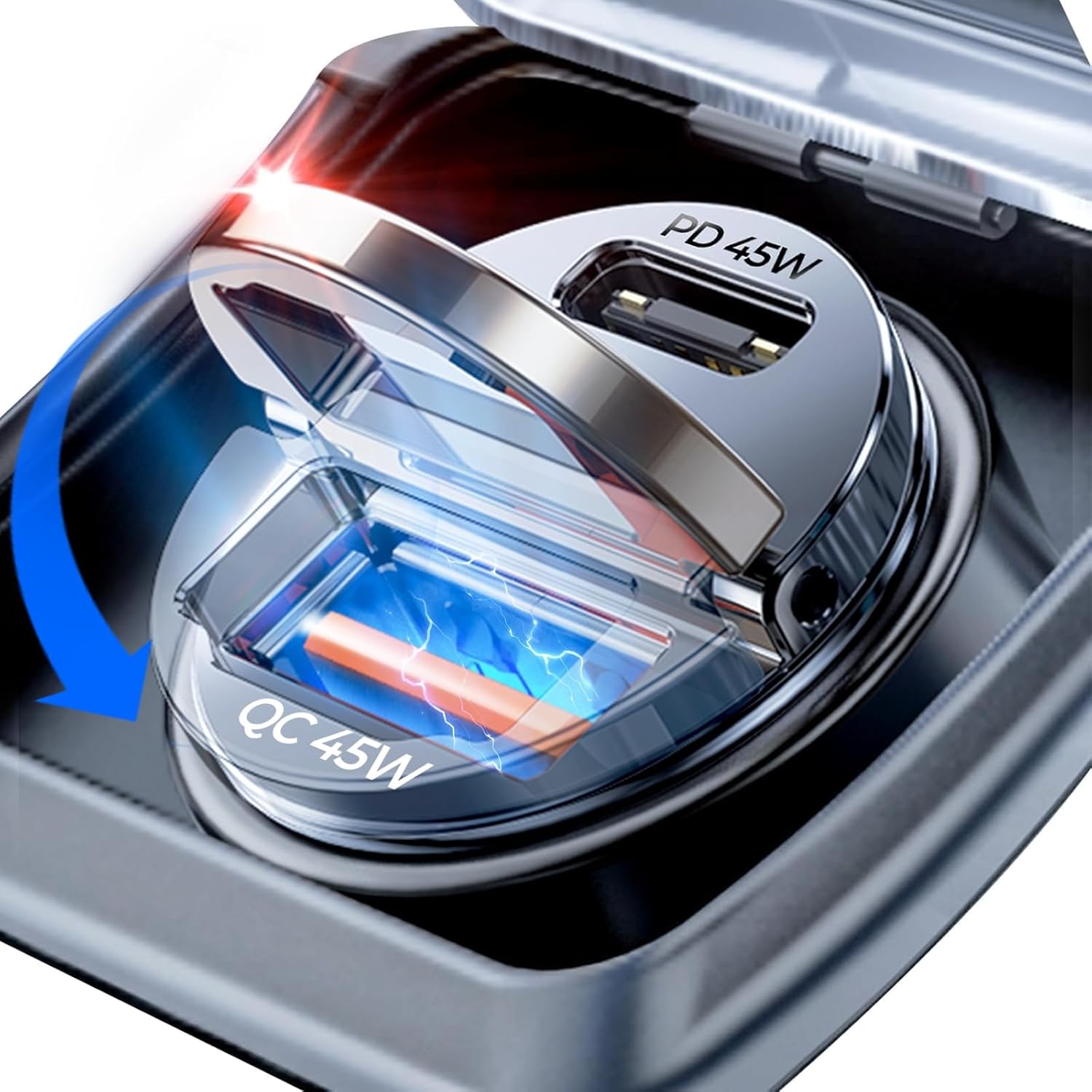
For the automotive enthusiast who loves a clean, factory-look interior, the AINOPE flush fit charger is a dream come true. When we say it’s tiny, we mean it. It sits so flush with the 12V socket that it almost looks like it was installed at the factory. The clever little folding pull-ring is a genius design choice, making it easy to remove without having to pry it out. Despite its minuscule size, it packs a serious punch. We charged an iPad Air and a Pixel phone simultaneously, and it delivered impressive speeds to both, feeling every bit as powerful as its 60W rating suggests. This low-profile approach to car tech pairs perfectly with a 4K dash cam for night driving — two minimalist but highly capable upgrades that keep your cabin looking sharp while delivering serious performance.
Deep Dive: Performance & Features
The AINOPE’s primary selling point is its form factor, but its performance is not to be underestimated. It provides two ports: a 30W USB-C PD port and a 30W USB-A QC 4.0 port. This combination is incredibly versatile. The USB-C port can fast-charge iPhones and Androids, while the USB-A port can rapid-charge older devices or even another modern phone. When used together, they deliver their full rated power simultaneously.
The all-zinc alloy body is not just for looks; it’s crucial for heat dissipation in such a compact device. Cheaper plastic chargers of this size would overheat quickly, but the AINOPE stays impressively cool. This focus on thermal management is key to its safety and longevity. It’s the perfect accessory for maintaining a pristine vehicle interior. Speaking of maintenance, keeping your car’s interior spotless is a breeze with one of the best car vacuum cleaners, ensuring your tech and your upholstery always look their best. For those who drive in challenging conditions, it’s also worth reviewing night driving safety tips covering headlights, glare, and fatigue — the cleaner and more organized your cabin, the easier nighttime driving becomes.
| Total Output | 60W |
|---|---|
| Port 1 (USB-C) | 30W Max (PD 3.0) |
| Port 2 (USB-A) | 30W Max (QC 4.0) |
| Key Protocols | Power Delivery 3.0, Quick Charge 4.0 |
| Material | Zinc Alloy |
Pros
- Incredibly compact, flush-fit design
- Clever pull-ring for easy removal
- Powerful 30W PD and 30W QC ports
- Full metal body for superior heat dissipation
- Excellent value for a stylish and powerful charger
Cons
- Not powerful enough for most laptops
- Pull-ring can be a bit stiff initially
Who Is This For?
This charger is for the minimalist. It’s for the driver who values a clean, OEM look and hates clutter. It’s perfect for anyone who wants a powerful charger for their phone and another device but doesn’t want a bulky accessory protruding from their dashboard. It provides ample power for daily needs in a package that is practically invisible. If you’re passionate about a clean cabin, you’ll love pairing it with easy-install non-slip steering wheel covers — another subtle upgrade that elevates both the look and feel of your car without any drama.
The Ultimate Car Charger Buying Guide
Choosing the right charger involves more than just picking the one with the highest number on the box. Understanding the technology will empower you to make a choice that’s perfect for your specific devices and needs. Let’s break down the key factors. And while you’re upgrading your in-car accessories, don’t forget to check out our roundup of the top high-end driving gifts for car enthusiasts — there are some incredible options that complement a fast charger perfectly.
Power Explained: Watts, Volts, and Amps
Think of it like water in a pipe. Voltage (V) is the water pressure, and Amperage (A) is the pipe’s width. Wattage (W) is the total amount of water flowing through. Watts = Volts x Amps. Higher wattage means faster charging. Your device will only draw the power it needs, so you can’t “overpower” it, but a charger that’s too weak will charge it very slowly.
- Smartphones (iPhone, Android): Need 20W-30W for maximum fast charging.
- Tablets (iPad, Galaxy Tab): Benefit from 30W-45W.
- Ultrabooks (MacBook Air, Dell XPS 13): Require 45W-65W.
- High-Performance Laptops (MacBook Pro, Gaming Laptops): Need 65W-100W or more.
The Alphabet Soup of Charging: PD 3.0 and PPS
Power Delivery (PD): This is the universal fast-charging standard for USB-C. PD 3.0 is the current version, allowing for high-wattage charging up to 100W (and beyond in newer specs). If a charger has a USB-C port, it almost certainly supports PD. This is what enables you to charge laptops, tablets, and phones at high speed.
Programmable Power Supply (PPS): This is an addition to the PD 3.0 standard. It allows the charger and the device to communicate and make small, real-time adjustments to the voltage and current. Why does this matter? It’s more efficient, generates less heat, and is required for the fastest charging modes on many modern Android phones, particularly Samsung’s “Super Fast Charging 2.0.” If you have a high-end Samsung phone, a charger with PPS is a must-have.
Ports: How Many and What Kind?
Consider what you’ll be charging regularly.
- Dual USB-C: The most future-proof option. Ideal for charging two modern devices like a phone and a tablet.
- USB-C + USB-A: A versatile choice if you still have older devices, accessories (like some wireless earbuds cases), or cables that use the older USB-A standard.
- Three+ Ports: Best for families, carpools, or power users who need to charge everything at once.
Look for chargers that can supply high power to all ports simultaneously, not just split a small amount of power between them. This is especially important if you regularly drive with passengers or have kids who need their devices powered during long car rides.
Build Quality and Safety Certifications
You’re plugging this into your car’s electrical system; safety is paramount.
- Materials: Chargers with metal (aluminum or zinc alloy) bodies dissipate heat better than plastic ones, which leads to better efficiency and a longer lifespan.
- Certifications: Look for certifications like UL, ETL, FCC, and CE. These mean the product has been independently tested to meet strict safety standards for electrical devices. Reputable brands like Anker, UGREEN, and Spigen always have these.
- Safety Systems: Modern chargers have built-in microchips that protect against over-charging, over-heating, over-voltage, and short circuits. This protects both your car and your expensive devices.
Taking care of your car’s tech is just as important as its appearance and mechanical health. If you want to stay on top of every aspect of vehicle performance, learning about defensive driving habits that reduce collision risk is one of the smartest investments you can make as a driver — no gadget can replace good judgment on the road. Equally, if you ever find yourself doing minor touch-ups or maintenance, using one of the best car fender covers is a pro-level move to protect your paint job from scratches and spills.
Compatibility With Your Devices
Before buying, make a quick list of all the devices you plan to charge regularly. The fastest charging for your specific phone may require a specific protocol — iPhones need USB Power Delivery, Samsung phones benefit greatly from PPS, and older Android devices may use Qualcomm Quick Charge. Checking compatibility takes two minutes and ensures you actually get the advertised speeds. If you rely heavily on your phone while driving for navigation, communication, or streaming, you might also want to explore using blind spot mirrors to keep eyes on the road more and on your phone screen less — a smarter, safer way to stay connected and aware simultaneously.
Frequently Asked Questions About USB-C Car Chargers
1. Can a powerful car charger drain my car’s battery?
When your car is running, the charger draws power from the alternator, not the battery. Therefore, it has no risk of draining your battery. When the car is off, most 12V sockets in modern cars also turn off. Even if your car’s socket stays on (which is rare), a quality charger has a standby power draw that is so minuscule it would take weeks or even months to have any noticeable effect on a healthy car battery. If you’re concerned about your battery’s overall health, it’s worth reading up on load testers vs. conductance testers to understand how to properly evaluate your car battery’s condition before it fails unexpectedly.
2. Will a 100W charger damage my iPhone that only needs 20W?
No, absolutely not. This is a common myth. Thanks to the “handshake” process in USB Power Delivery, the charger and your device communicate. The charger says, “I can offer up to 100W,” and your iPhone says, “Thanks, but I can only handle 20W, so I’ll only draw that much.” The device is always in control. Using a more powerful charger is perfectly safe and is a great way to future-proof your purchase.
3. What’s the difference between Power Delivery (PD) and Quick Charge (QC)?
They are competing fast-charging standards. Power Delivery (PD) is the universal standard for USB-C, adopted by Apple, Google, laptop manufacturers, and most of the industry. Quick Charge (QC) is a proprietary standard developed by Qualcomm, primarily used by some Android phone manufacturers. Most modern high-power chargers focus on PD, but many also include QC on their USB-A ports for backward compatibility.
4. Do I really need a special cable for fast charging?
Yes, the cable is just as important as the charger. For charging up to 60W, any quality USB-C to USB-C (or USB-C to Lightning) cable will work. However, for charging above 60W (like the 100W needed for laptops), you MUST use a cable that is specifically rated for 100W or higher. These cables have a special “E-Marker” chip inside that tells the charger it’s safe to deliver that much power. The UGREEN and Baseus chargers we reviewed are great because they often bundle a compatible 100W cable.
5. Are cheap, unbranded car chargers from a gas station safe?
We strongly advise against them. While they might work in a pinch, they often lack the critical safety certifications (like UL) and the advanced circuitry needed to protect against overheating, power surges, and short circuits. Investing an extra $10-$20 in a charger from a reputable brand is cheap insurance to protect your $1000+ smartphone and your vehicle’s electronics. Think of it the same way you’d think about choosing the right car fire extinguisher — the cost of quality safety equipment is always worth it compared to the alternative.
6. How do I know if my car’s 12V socket can handle a high-wattage charger?
Most modern car 12V sockets (cigarette lighter ports) are fused at 10-20 amps, which at 12V translates to roughly 120-240 watts of available power. A 160W charger running at full load is well within this range for most vehicles. However, very old vehicles or those with aging electrical systems may have lower tolerances. If you’re ever in doubt, consult your owner’s manual or have a mechanic check your vehicle’s electrical system. Staying on top of your car’s electrical health is part of good pre-road-trip safety preparation, and it’s a step that many drivers overlook until something goes wrong.
Conclusion: Powering Your Journey Ahead
Upgrading your car charger is one of the most impactful and affordable tech upgrades you can make for your vehicle. It eliminates the anxiety of a low battery and transforms your car into a reliable hub for all your devices. Whether you need the raw, laptop-charging power of the UGREEN 130W, the sleek, invisible design of the AINOPE Flush Fit, or the balanced value of the Spigen 75W, there is a perfect option on this list for you.
By investing in a quality USB-C charger, you’re not just buying a piece of plastic and metal; you’re buying convenience, safety, and the peace of mind that comes with knowing you’ll always have the power you need, wherever you’re headed. For a complete driving toolkit, pair your new charger with a set of polarized driving sunglasses for glare reduction, a well-stocked winter car emergency kit, and you’ll be prepared for practically anything the road throws at you. Safe travels, and stay charged.