The Ultimate Study Schedule Template Guide: Build a Weekly Planner That Actually Works
Three free, printable study schedule templates — classic, sunset-themed, and forest-themed — plus expert tips to help you study smarter, not harder.
What Is a Study Schedule Template?
A study schedule template is a pre-designed weekly planner that carves your day into organized time blocks, giving each subject, assignment, or revision session a dedicated home. Think of it as the architectural blueprint of your academic life — before you build anything meaningful, you need a plan you can actually see.
Unlike a blank notebook where pages stare back at you with no structure, a well-designed study schedule template answers a simple but powerful question: When exactly am I going to study what? That question sounds deceptively simple. In practice, answering it the right way can be the difference between a GPA you’re proud of and a semester spent playing catch-up.
Study schedule templates come in many forms. Some are purely digital — apps like Notion, Google Calendar, or specialized study tools. Others are paper-based printables, and the best ones are flexible enough to work both ways. What every effective template shares, regardless of format, is a clear weekly structure that maps your hours against your goals.
The three templates we’re sharing in this guide are designed to be printed directly from your browser. Each one covers a full week (Monday through Sunday), includes hourly slots from 6 AM to 9 PM, builds in natural break periods, and gives you space for weekly goals, color-coded subject tracking, and priority lists. Whether you’re a high school student managing six subjects, a university student juggling coursework and a part-time job, or a professional studying for a certification exam, there is a template here that fits.
The Three Core Elements of Every Great Study Template
Before we dive into the templates themselves, it’s worth understanding what separates a good study schedule from a great one. Research in educational psychology points to three foundational elements:
Visibility. You can’t follow a plan you can’t see. Printed schedules placed on a desk, pinned to a wall, or tucked inside your study notebook have a physical presence that digital calendars often lack. Visibility creates commitment.
Flexibility. Rigid schedules that account for nothing but study time collapse quickly when life happens — an unexpected social obligation, a subject that takes longer than expected, or simply a bad day. The best templates leave breathing room.
Goal integration. A schedule that isn’t connected to real goals is just a grid of boxes. The templates in this guide each include a dedicated goals section precisely because research shows that students who write down specific weekly objectives before the week begins are significantly more likely to achieve them.
Why a Study Schedule Template Matters for Your Grades
There’s a body of cognitive science behind why structured study schedules work. The most relevant concept is distributed practice — also known as the spacing effect. Psychologist Hermann Ebbinghaus first documented this in the late 1800s, and decades of research have confirmed it: spreading your study sessions across multiple shorter blocks leads to significantly better long-term retention than massing all your studying into one long session (commonly known as cramming).
A study schedule template makes distributed practice automatic. When you’ve already written “Chemistry — 4:00 to 5:00 PM” in Monday’s slot, Tuesday’s slot, and Thursday’s slot, you’re not relying on willpower or motivation each day to get yourself to the desk. The decision has already been made. You just follow the plan.
Beyond academic performance, structured scheduling has measurable mental health benefits for students. A 2019 study published in Frontiers in Psychology found that students who used structured weekly schedules reported lower levels of academic anxiety and higher feelings of control over their workload — even when the workload itself didn’t change. The act of scheduling created the psychological experience of manageability.
The Connection Between Time Management and Academic Success
Time management has been one of the most consistently studied predictors of academic success. A meta-analysis of over 150 studies found that time management behaviors (specifically: goal-setting, planning, and prioritization) predicted GPA as reliably as intelligence test scores in many populations. The students who build the habit of weekly scheduling early in their academic careers consistently outperform their equally intelligent but less organized peers.
If you want to go deeper on building the kind of habits that underpin great time management, this guide on 5 morning routine checklists for success is an excellent companion read — morning routines and study schedules work as a system, not in isolation. Similarly, pairing your study schedule with a solid approach to time blocking will amplify your results significantly.
Who Benefits Most from a Printed Study Schedule?
Almost everyone benefits from having a study schedule, but certain profiles tend to see the most dramatic improvements:
Procrastinators. If you consistently put off studying until the night before, a printed schedule that you fill in at the start of each week creates the commitment structure needed to start earlier. The physical act of writing in your study blocks makes them feel like appointments you can’t easily cancel.
Multitaskers and multi-subject students. Students juggling five or more subjects at once — especially in the final year of high school or during university — need a visual system to ensure every subject gets adequate attention. Without a schedule, it’s easy to over-study favorite subjects and neglect weaker ones.
Students with ADHD or attention challenges. External structure is particularly valuable for students with attention difficulties. A printed schedule provides a concrete, unambiguous answer to “what should I be doing right now?” — reducing the cognitive load of decision-making during study sessions. Our guide on the best paper planner for ADHD brains with time blocking is also worth exploring if this applies to you.
High-achieving students who want an edge. Even students who manage their time adequately often discover that moving from “good enough” to excellent scheduling is what pushes them from a B-average to an A-average. The gains from better time allocation can be substantial.

Pair Your Template with a Quality Study Planner
A premium academic planner alongside your printed templates creates a complete study system. Highly rated by students on Amazon.
View Top-Rated Study Planners on Amazon →Template 1: Classic Black & White Study Schedule
The Classic Black & White template is the most versatile of the three. It uses a clean, minimal aesthetic that makes it ideal for photocopying (no color ink required), printing multiple times through a semester, and working with any highlighter or colored pen system you already own. The design is intentionally understated — the structure does the work, not the decoration.
This template is particularly popular with students who prefer function over form, with teachers who want to distribute a schedule to an entire class, and with anyone working with a limited printer budget. It prints cleanly on both laser and inkjet printers and looks equally good on A4 and US Letter paper.
Features of the Classic Template
The Classic template includes weekly goals (four slots), an hourly grid from 6 AM to 9 PM across all seven days, clearly marked lunch and short break periods, a five-subject color key at the bottom, and a dual-panel footer with notes/reminders and a priority list. The time column is right-aligned with a subtle vertical rule to keep the eye moving horizontally across days.
When to Choose the Classic Template
Choose the Classic template when you want something you can print repeatedly without worrying about ink costs, when you plan to fill it in with your own colored pens or highlighters, or when you’re distributing it to others (students, study group members, younger siblings) and need something universally accessible. Its neutral design also makes it the most flexible for laminating — print one, laminate it, and use it every week with a dry-erase marker.
✅ Pros
- Printer-ink friendly — no color required
- Works with any pen, pencil, or highlighter
- Ideal for laminating and reusing
- Clean, distraction-free design
- Easy to photocopy for groups or classes
❌ Cons
- Less visually motivating than themed templates
- Requires your own color system to differentiate subjects
- May feel plain for students who respond to visual cues
Template 2: Sunset Warm Study Schedule
The Sunset Warm template brings a cozy, energetic personality to your study planning. Built around a coral-to-gold gradient palette inspired by late afternoon light, this template feels motivating without being distracting. It’s particularly popular with students who find that aesthetics play a meaningful role in their motivation — when your planner looks good, you’re more likely to use it consistently.
Beyond its visual appeal, the Sunset template introduces a few structural upgrades over the Classic. The header is a full-width gradient band that includes both the title and your name/week fields, giving it a more polished, “designed” look. The break rows use a warm tan fill rather than flat grey, and the alternating row background uses a subtle warm cream (#FFFBF5) that reduces eye fatigue during long planning sessions.
Features of the Sunset Template
The Sunset template features the same 7-day, 6 AM–9 PM hourly grid as the Classic, but adds several refinements: a full-bleed gradient header with your name field integrated, four individual goal cards with double writing lines each, a three-panel footer with color key, notes, and a priority list with color-coded priority dots, and table rows with warm-tinted alternating backgrounds. The time column uses deep bark-brown text on a warm parchment background for high contrast and visual warmth simultaneously.
The Psychology of Warm Colors in Study Environments
Color psychology research suggests that warm tones — oranges, ambers, and golds — tend to evoke energy, creativity, and optimism. For students who study in the late afternoon and early evening (the classic “homework hours”), a warm-toned planner can help maintain energy and positive association with the study process. The Sunset template is also designed to look beautiful photographed and shared — it makes for an excellent study aesthetic on social media or a study journal.
✅ Pros
- Visually motivating and aesthetically pleasing
- Warm color palette reduces perceived fatigue
- Goal cards with double lines give more writing space
- Beautiful for journaling or study aesthetics
- Three-panel footer with separate color key section
❌ Cons
- Requires color printing for full effect
- May not suit minimalist preferences
- Slightly heavier on ink if printed frequently

Upgrade Your Color Coding System
A quality set of fine-tip markers or highlighters transforms your printed schedule into a visual masterpiece — and helps your brain process information through color.
Shop Color Coding Sets on Amazon →Template 3: Forest Green Study Schedule
The Forest Green template is the most refined of the three — a sophisticated, nature-inspired design built around a deep green palette that evokes calm, focus, and natural harmony. If the Classic template is the clean workhorse and the Sunset template is the energetic motivator, the Forest Green is the focused achiever. It’s the template you reach for when you’re serious about buckling down.
Green has a deep association with concentration and calm in color psychology literature. Many professional environments and productivity tools (including several premium task managers) lean on green for this reason. The Forest Green template brings that energy to your study desk.
What Makes the Forest Template Unique
The Forest template introduces a structural innovation not found in the other two: a Daily Check-in tracker in the footer. Seven small circles — one for each day of the week — let you physically mark off each day you completed your planned study sessions. This tiny addition has a surprisingly powerful psychological effect. Research on habit tracking consistently shows that the act of physically marking completion (the “don’t break the chain” method) increases follow-through significantly.
The header design is also unique: instead of a full-bleed band, it uses a thin vertical accent stripe on the left edge that fades through three shades of forest green — creating a sophisticated, editorial look more akin to a well-designed journal than a utilitarian planner.
✅ Pros
- Calming, focus-oriented green palette
- Unique daily habit tracker built in
- Sophisticated editorial header design
- Excellent for long-term exam preparation
- Three-column footer maximizes usable space
❌ Cons
- Best printed in color to achieve full effect
- Three-column footer may be cramped on A4 small printers
- Lighter in ink than Classic but still uses color
How to Fill In Your Study Schedule Template
Having a beautiful template is only the beginning. How you fill it in — and the decisions you make before putting pen to paper — determines whether it actually changes your study habits. Here’s a systematic process for filling in your weekly study schedule that’s grounded in what actually works.
Step 1: Audit Your Fixed Commitments First
Before you write a single study block, mark every non-negotiable commitment you already have. This means: school or university timetabled classes, any paid work hours, recurring sports or extracurricular activities, regular family commitments, and any appointments already in your diary. These are immovable rocks. They fill first.
Only after mapping your fixed commitments can you see your true discretionary time — the hours genuinely available for studying, rest, and everything else. Students who skip this step routinely over-schedule themselves, experience the schedule collapsing by Wednesday, and give up on planning entirely. Don’t skip it.
Step 2: Calculate How Much Study Time You Actually Need
A widely used rule of thumb for university students is to spend two hours studying for every one hour of class time. A 15-credit semester with 15 hours of classes per week suggests 30 hours of study per week — roughly 4.3 hours per day. High school students typically need one to two hours of study per school day during normal term, rising to three to five hours during exam preparation periods.
Be honest with yourself here. The common mistake is planning for the ideal student you wish you were rather than the actual student you are. Start with what feels achievable this week — even 45 minutes per day is a start — and build from there.
Step 3: Assign Subjects to Slots with Intention
Don’t just write “study” in blocks. Write the specific subject and what you’re going to do: “Chemistry — Chapter 7 revision” or “English — practice essay #2.” Specificity is everything. Vague intentions create vague action. Specific plans create specific action.
A few assignment principles worth following: study your hardest or least-liked subject first, when willpower and focus are freshest. Schedule subjects you find easier for later time slots when energy naturally dips. Try not to schedule the same subject more than two days in a row — spacing it out activates the retrieval practice effect. And always schedule your review sessions (going over previously studied material) separately from your new-content sessions.
Step 4: Build in Breaks as Non-Negotiable Appointments
The templates all include marked lunch and short break periods for a reason. Breaks are not a reward for when you’ve finished studying — they are a cognitive requirement for sustained performance. The research on the Pomodoro Technique and its variants consistently shows that planned 5–15 minute breaks every 45–90 minutes improve both focus during study blocks and total retention over the course of a session.
Fill your short breaks with activities that genuinely rest your brain: a short walk, a snack, stretching, or simply sitting away from your screen. Scrolling social media does not count as a break — research shows it can actually impair the cognitive consolidation process that happens during genuine rest periods.
Step 5: Write Your Weekly Goals Before Anything Else
All three templates include a goals section at the top for a deliberate reason. Before you plan when you’re going to study, you need to know what you’re trying to achieve by the end of the week. Your goals inform the priority and intensity of each study block. “Finish chapters 8–10 of Biology” is a goal. “Study Biology” is not.
Keep your weekly goals specific, concrete, and genuinely achievable in five to seven days. The sweet spot is four goals: two major academic goals, one minor academic goal, and one personal or organizational goal (like “organize my notes from last month” or “reach out to a classmate about forming a study group”).
Time Blocking for Students: The Method Behind the Template
Time blocking is the scheduling philosophy that underlies every effective study schedule template. Rather than keeping a to-do list and hoping you’ll get to things, time blocking assigns every task to a specific, protected time period. Your schedule becomes a sequence of appointments with yourself — appointments you keep as reliably as you’d keep a dentist appointment or a job interview.
Cal Newport, a computer science professor and bestselling author of Deep Work, popularized the concept of “time block planning” as the cornerstone of high-level cognitive performance. Newport’s research into how deeply productive people actually spend their time consistently found that protected, uninterrupted work blocks — not long hours of fragmented effort — were the common thread.
For a deep dive into implementing time blocking as a student, we strongly recommend reading our comprehensive guide on time blocking step-by-step — it pairs perfectly with any of the three templates in this article.
The Difference Between Time Blocking and a To-Do List
A to-do list tells you what needs to be done. A time-blocked schedule tells you when each thing will be done. This distinction matters enormously in practice. To-do lists are infinite — you can always add more to them. A weekly schedule, by contrast, has a finite number of available hours. When you block time, you confront the reality of your capacity directly. You can’t schedule 30 hours of study into 20 available hours. The constraint forces prioritization.
Students who switch from to-do lists to time-blocked schedules typically report one of two initial reactions: either they’re relieved to discover they have more time than they thought, or they’re alarmed to discover they have less. Either way, the information is valuable. The alarm is useful — it prompts either a reduction in commitments or an honest renegotiation of what can actually be accomplished this week.
Themed Study Blocks: A Technique Worth Adopting
One of the most effective applications of time blocking for students with multiple subjects is themed study blocks. Rather than mixing subjects within a single study session, assign entire blocks to a single subject or category. Monday afternoon is Biology. Tuesday morning is Mathematics. Wednesday evening is Languages.
The benefit is reduced context-switching cost. Every time your brain moves from one subject to a different one, it incurs a “transition tax” — a few minutes of reduced efficiency as it reorients. By minimizing transitions within a session (studying one subject per block rather than three), you reclaim that lost time across the week. Students who use themed blocks typically report that their three-hour study sessions feel less exhausting and produce more retained material than equivalent time spent jumping between subjects.
Subject Color Coding: Turning Your Schedule into a Visual System
Color coding subjects in your study schedule is one of the simplest and most evidence-backed techniques for improving organizational clarity and memory. When each subject has a consistent visual identity — a color that your brain associates with that subject — navigating your schedule becomes faster, pattern recognition becomes easier, and the overall balance of your study time becomes immediately visible at a glance.
All three of our templates include a color key section precisely because color coding is most effective when it’s systematic rather than spontaneous. Deciding on Tuesday that you’ll use blue for Biology and then forgetting by Thursday doesn’t work. Writing it in the color key and sticking to it does.
Building Your Personal Color System
There are no universally “correct” subject colors, but there are principles worth following when you build your system. First, use colors that are meaningfully distinct from each other — not just “light blue” and “dark blue” for two different subjects. The brain’s ability to rapidly distinguish and categorize depends on clear color differentiation. Second, if you have a natural association between a color and a subject, use it. Many students naturally associate red with Mathematics (perhaps because of marking in school), green with Biology, and blue with History or Geography. Working with existing associations reduces the cognitive load of remembering your system. Third, reserve your brightest, most attention-grabbing color for your most important or most neglected subject — the one you need to ensure gets adequate time each week.
Recommended Color Assignments by Subject Type
| Subject Type | Recommended Color | Why It Works |
|---|---|---|
| Sciences (Biology, Chemistry, Physics) | Green family | Associated with nature, organisms, growth |
| Mathematics & Statistics | Blue family | Associated with logic, precision, clarity |
| Humanities (History, Geography) | Brown / Amber | Associated with the past, earthy, grounded |
| Languages (English, French, etc.) | Purple / Lavender | Associated with creativity, communication |
| Arts / Design / Music | Orange / Coral | Associated with creativity, energy, expression |
| Review / Revision sessions | Yellow | Associated with attention, alertness, memory |
| Break / Personal time | Light grey | Neutral — visually rests the eye |
Once your color system is established, it should remain consistent across all your study materials — your printed schedule, your notebook tabs, your digital folders, even your highlighters for textbook annotations. A consistent visual system reduces the mental friction of organizing and navigating study materials to near zero over time.
Comparing the Three Templates: Which One Is Right for You?
Each template solves a slightly different problem and appeals to a slightly different student. Here’s a direct comparison to help you make the right choice for your situation, learning style, and printer setup.
| Feature | Classic B&W | Sunset Warm | Forest Green |
|---|---|---|---|
| Color printing required? | No | Yes (for full effect) | Yes (for full effect) |
| Daily habit tracker? | No | No | Yes ✓ |
| Color psychology | Neutral / focus | Energetic / warm | Calm / focused |
| Goal cards | 4 (single-line) | 4 (double-line) | 4 (double-line) |
| Footer layout | 2-column | 3-column | 3-column |
| Best for | Minimalists, groups, laminating | Visual learners, motivation | Focus, exam prep, habit building |
| Ideal printer ink usage | Minimal | Moderate | Moderate |
| Best aesthetic vibe | Clean, utilitarian | Cozy, energetic | Sophisticated, grounded |
If you’re still unsure, the most common recommendation from educators and students who use all three is to start with the Classic for your day-to-day term schedule, switch to the Forest Green during exam revision periods (the habit tracker is particularly valuable when consistency is critical), and use the Sunset Warm during periods when you need a motivational boost — like the start of a new term or after a discouraging result.
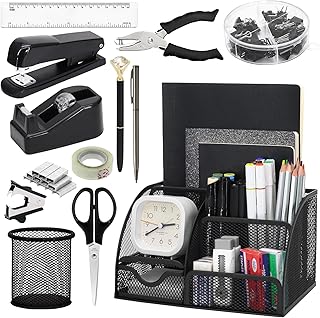
Build the Complete Study Desk Setup
Your printed study schedule works best when your desk environment supports focus. Check out highly rated desk organizers and study accessories on Amazon.
Shop Study Desk Accessories →Study Habits That Work: What the Research Actually Says
Having a study schedule template is necessary but not sufficient. The habits you bring to your scheduled study blocks determine whether those hours translate into learning, or just look productive from the outside. Here are the study habits with the strongest evidence base behind them.
Retrieval Practice: Test Yourself More Than You Review Notes
Of all the study techniques evaluated in cognitive science research, retrieval practice — actively recalling information from memory rather than passively re-reading it — is consistently the most effective. A landmark study by Roediger and Karpicke (2006) found that students who studied by taking practice tests retained 50% more material after a week than students who spent the same time re-reading notes. Fifty percent. On the same amount of study time. That is an extraordinary effect size.
The practical implication: when you sit down for your scheduled study block, close your notes and actively recall what you know about the topic first. Write it down. Then check your notes and identify gaps. This retrieval-first approach is more cognitively demanding than re-reading, but the effort is precisely why it works — the brain strengthens memories it has to work to retrieve.
Interleaving: Mix Up Your Practice
Another counterintuitive finding from cognitive science is the benefit of interleaving — mixing different types of problems or topics within a practice session, rather than doing “blocked” practice (all of one type, then all of another). Studies in mathematics education found that students who practiced interleaved problem sets scored significantly higher on final tests than students who used blocked practice, even though the blocked-practice students reported feeling more confident during studying.
The lesson: don’t just do all of Chapter 5’s problems, then all of Chapter 6’s problems. Mix them up. The confusion you feel during interleaved practice is genuine learning — your brain working harder to identify which strategy applies to which problem. That harder work builds deeper understanding.
Elaborative Interrogation: Ask “Why?” and “How?”
One of the most underused study techniques is elaborative interrogation — generating explanations for why facts are true. Rather than simply noting that “the mitochondria is the powerhouse of the cell,” ask yourself: Why is it the powerhouse? How does it actually produce energy? What would happen if it didn’t? These “why” and “how” questions force you to connect new information to existing knowledge, dramatically improving retention and understanding.
Building elaborative interrogation into your scheduled study blocks is straightforward: after every major concept or fact, pause and write one “why” or “how” question about it, then answer it in your own words. This takes longer than passive reading but produces far superior understanding.
For a broader view of the habits that underpin long-term academic and professional success, this article on the top 5 habits of highly effective people offers important broader context — many of the same principles apply in the study context.
The Sleep-Memory Connection: Your Schedule Must Include Sleep
No discussion of study habits is complete without addressing sleep. Memory consolidation — the process by which short-term memories are converted into long-term ones — happens predominantly during sleep, particularly during slow-wave sleep (deep sleep) and REM sleep. Studying late into the night and sacrificing sleep to maximize study hours is, from a neuroscience perspective, directly counterproductive. You are studying more and remembering less.
The research is unambiguous: students who get seven to nine hours of sleep per night consistently outperform students who sleep five to six hours on measures of both academic performance and cognitive function, regardless of how many hours they study. Your study schedule should protect your sleep hours as fiercely as it protects your study hours.
Digital vs. Paper Study Schedules: The Honest Comparison
The rise of digital planning tools has made the choice between paper and digital schedules a genuine decision rather than a foregone conclusion. There are real benefits on both sides, and the honest answer depends on your personal study psychology more than any objective measure of one format’s superiority.
The Case for Paper (Printed Templates)
Paper schedules have one decisive advantage over digital ones: they are always visible without a screen. A printed schedule pinned to the wall above your desk is present in your field of vision during every study session, during every distracted moment, and during every motivational dip. It doesn’t require unlocking a phone, opening an app, or surviving the gauntlet of notifications that comes with any digital device.
Research on the “generation effect” in memory also suggests that handwriting information (including writing subjects into schedule blocks) produces better memory encoding than typing the same information. The physical act of filling in a paper schedule may itself be a mild form of the elaborative processing that improves retention.
Paper schedules are also infinitely flexible for visual thinkers. You can highlight, add symbols, draw arrows, use stickers, and personalize your template in ways that even the most sophisticated digital tool struggles to replicate intuitively. And they never run out of battery.
The Case for Digital Schedules
Digital schedules offer synchronization (available on every device), easy editing (no crossed-out blocks or messy corrections), recurring event automation (blocks repeat automatically week to week), and integration with other productivity tools like task managers, timers, and reminder systems. For students who live primarily on their phones and laptops, a digital schedule that lives in their existing workflow may have better follow-through than a paper one that gets left at home.
If you lean toward digital tools, it’s worth exploring the best productivity apps and goal tracking apps that pair well with a digital scheduling approach.
The Hybrid Approach: Best of Both Worlds
Many high-performing students use a hybrid approach: a digital calendar (Google Calendar or Notion) for long-term planning and appointment tracking, combined with a printed weekly study schedule template for the current week. The digital system holds the big picture; the printed template sits on the desk and governs the actual week.
This hybrid approach resolves the core tension: the digital system handles the complexity and flexibility of a full semester, while the printed schedule handles the daily reality of actually sitting down and studying. They serve different cognitive functions and complement each other beautifully.
| Factor | Paper Template | Digital Schedule |
|---|---|---|
| Always visible? | ✅ Yes (if pinned up) | ❌ Requires opening app |
| Easy to edit? | ❌ Requires correction | ✅ Instant editing |
| Memory encoding | ✅ Stronger (writing) | ❌ Weaker (typing) |
| Device-free? | ✅ Yes | ❌ Requires device |
| Recurring events | ❌ Must re-draw weekly | ✅ Automatic |
| Customizable visually | ✅ Unlimited | ⚠️ Tool-dependent |
| Notification distractions | ✅ None | ❌ Possible |
| Cost | ✅ Free (print and use) | ⚠️ Some tools are paid |
Common Mistakes Students Make with Study Schedule Templates
The students who fail to benefit from study schedule templates almost always make one or more of the following predictable mistakes. Knowing them in advance is half the battle.
Mistake 1: Over-Scheduling from Day One
The most common mistake, and the one that kills more new schedules than anything else. Fired up with motivation, a student sits down on Sunday evening and fills in every available hour with study blocks. By Wednesday, the schedule is impossible to follow, and the student abandons it entirely — along with any plans to try scheduling again.
The solution is to schedule conservatively in your first week — perhaps 60-70% of your available study time. Leave gaps. Leave buffer time between blocks. Leave Sunday afternoon deliberately empty. The empty space isn’t wasted — it absorbs the inevitable overruns, unexpected tasks, and low-energy periods that every real week contains. A schedule you can actually follow beats an ideal schedule you can’t.
Mistake 2: Confusing “Busyness” with Productivity
A fully-colored, densely-scheduled study template feels productive. It can even look impressive to others. But a schedule that fills every hour with “studying” without differentiating between deep-focus retrieval practice and passive re-reading is confusing activity for learning. Students can spend six hours “studying” while barely engaging their memory at all.
The antidote: annotate your blocks not just with subjects but with methods. “Chemistry — retrieval practice: Chapter 7 key terms” is a different entry from “Chemistry — re-read Chapter 7.” The specific technique you’re planning to use should be visible in the block. This forces intentionality and makes your schedule genuinely predictive of learning outcomes rather than just time investment.
Mistake 3: Ignoring Energy Levels in Block Placement
Not all hours of the day are equal for cognitive performance. Most people experience their sharpest focus in the morning (typically 9–11 AM), a secondary peak in the late afternoon (around 3–5 PM), and a trough after lunch (approximately 1–3 PM). Scheduling your most demanding subjects during your personal cognitive peaks and lighter tasks or review during your troughs is one of the highest-leverage schedule optimizations available.
The difficulty is that this requires self-knowledge. Spend the first week of using a new schedule tracking when you actually feel sharp and when you feel sluggish. Most students have a rough sense already, but the explicit exercise of tracking it often reveals surprises. A student who believes they’re a “night person” may discover that they’re actually most focused between 8–10 AM before the day’s social and digital stimulation erodes their concentration.
Mistake 4: Not Reviewing and Adjusting Weekly
A study schedule is not a static document — it’s a living tool that should evolve week to week based on what worked, what didn’t, what upcoming deadlines demand, and how the semester is progressing. Students who fill in a schedule once and then never revisit it end up with a schedule that’s increasingly misaligned with reality.
Build a 10-minute weekly review into your schedule (Sunday evening is classic, or Friday afternoon before the weekend). During the review, ask: Which blocks did I actually complete? Which did I skip, and why? What subject needs more time next week? What can I drop? This reflection loop is what separates students who use scheduling as a genuine system from students who use it as a wishful-thinking exercise.
Mistake 5: Treating the Template as Decoration
Finally, some students fill out their templates beautifully — meticulous handwriting, perfect color coding, no empty cells — and then don’t actually follow it. The schedule becomes a performance of organization rather than actual organization. If you catch yourself spending more time making your template look good than following it, redirect that energy. A messy, scribbled-over schedule that you actually use beats a pristine one that you don’t.
One practical trick: fold the printed template in half and tuck it into your most-used notebook or textbook rather than pinning it on a wall. Taking it out at the start of each study session, checking the current block, and putting it away again creates a ritual that reinforces usage rather than just decoration.

Create Your Ideal Study Environment
Noise-cancelling headphones are one of the highest-impact study investments available. Eliminating background noise can dramatically improve focus during your scheduled study blocks.
Find Top Study Headphones on Amazon →Frequently Asked Questions
Conclusion: Your Schedule Is Your First Step
A study schedule template won’t study for you. It won’t make a hard subject easier or a deadline less stressful. But what it will do — if you use it honestly and consistently — is give every hour of your study time a purpose, a place, and a direction. In a world designed to fragment your attention across an infinite stream of competing demands, the simple act of writing down “this hour belongs to Biology” is a small act of academic sovereignty.
The three templates in this guide represent three different approaches to the same fundamental problem: how do you turn good intentions into consistent action? The Classic works through simplicity and flexibility. The Sunset works through aesthetic motivation and warmth. The Forest Green works through habit tracking and calm focus. None of them is objectively the best — the best one is the one you’ll actually print, fill in, and follow.
Start this Sunday. Pick the template that speaks to you, print it out, and spend fifteen minutes filling in your blocks for next week. Then put it somewhere you’ll see it every time you sit down to study. That’s all the complexity this needs to be.
For more ways to build the systems that support great academic performance, explore our guides on morning routines for success, beating procrastination, and the complete guide to time blocking. Your study schedule is the foundation — everything else builds on top of it.