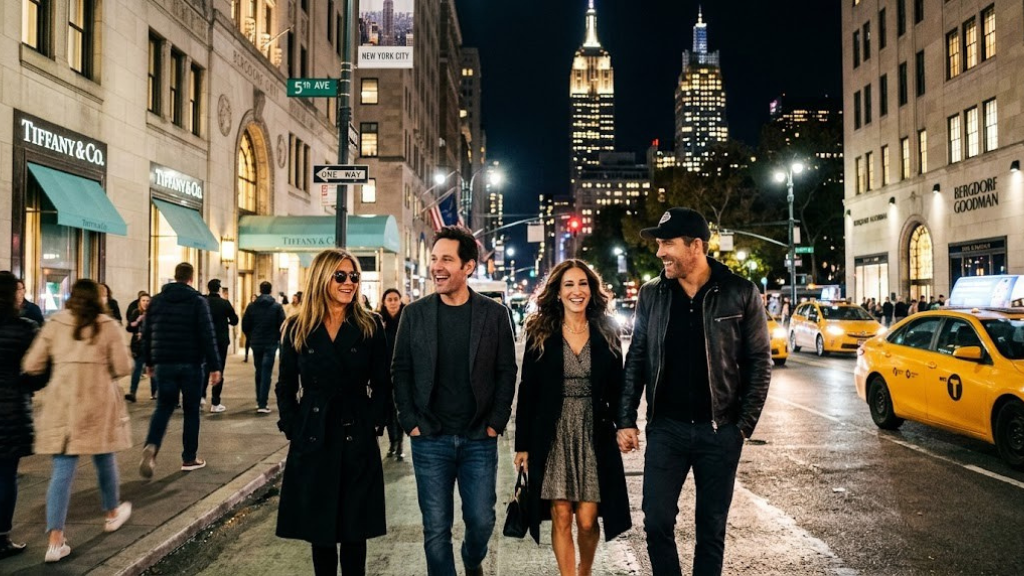
Stars, Penthouses, and Cobblestone Streets: Which Celebrities Call New York City Home in 2026
From Jay-Z’s Tribeca townhouse to Taylor Swift’s Greenwich Village brownstone — the definitive guide to where A-listers actually live in the city that never sleeps.
New York City has always had a complicated relationship with fame. It is the only city in the world where you can share a subway car with a Grammy-winner, buy coffee from a deli where A-list actors are regulars, and walk past a building that houses more Tony Awards than most small countries have ever awarded. The city’s density means that celebrity encounters — genuinely unscripted, genuinely urban — are practically a civic amenity.
But where, exactly, do they actually live? The answer is more specific than most people realise, and more interesting. Celebrity residency in New York is not spread evenly across five boroughs — it clusters in specific neighbourhoods for very specific reasons, each with its own character, its own price tag, and its own unwritten rules about how you treat the famous person in line ahead of you at the farmers’ market.
This guide maps the full celebrity geography of New York in 2026, neighbourhood by neighbourhood, with detail on who lives where, what kind of properties they occupy, and why New York continues to attract and retain stars even as Los Angeles remains the entertainment industry’s nominal headquarters.
Why Celebrities Choose New York City Over Everywhere Else
The decision to live in New York — as opposed to Los Angeles, Miami, London, or any of the other cities that compete for celebrity residency — is rarely accidental. It reflects a specific set of priorities that certain kinds of fame produce more reliably than others.
The Culture and Career Argument
New York is the centre of gravity for theatre, fashion, finance, publishing, and the music industry’s business side. Actors who split their time between film and Broadway — a career path increasingly common among A-listers who view stage work as artistically sustaining rather than commercially necessary — need a New York base. Fashion figures whose professional lives orbit around the industry’s biannual calendar. Music executives and artists whose labels, managers, and publishing deals are headquartered in Midtown. The city provides geographic proximity to work for a category of celebrity whose career does not centre on being filmed in daylight in Southern California.
Anonymity at Scale
There is a paradox in New York celebrity life: the city’s sheer density and pace creates a kind of anonymity that nowhere else can replicate. When everyone is in a hurry and everyone is interesting, a recognisable face receives exactly the level of acknowledgment the city’s social contract permits — a glance, maybe a nod — and nothing more. The paparazzi culture that defines public life in West Hollywood and Malibu is genuinely less aggressive in New York; the logistics of the city (underground subway, cabs, doorman buildings, high-rise residences without visible street frontage) make systematic surveillance significantly harder.
The Quality of Life Question
Counterintuitively, New York scores well on celebrity quality of life metrics that Los Angeles does not. World-class restaurants within walking distance. Cultural institutions — the Metropolitan Museum, Lincoln Center, Carnegie Hall, the Brooklyn Museum — that provide genuine off-duty enrichment rather than just industry-adjacent activities. A walkability and density that, paradoxically, provides more freedom of movement than the car-dependent, paparazzi-surveilled sprawl of the Hollywood Hills or Bel Air. The city also provides access to genuine seasons — something that surprises first-time celebrity arrivals from LA who had not realised how much they missed actual autumn.
The Master List: Which Celebrities Live in New York City
Before diving into neighbourhoods, here is the comprehensive roster of confirmed New York City residents among the celebrity population — those with verified primary or well-documented secondary residences in the five boroughs.
| Celebrity | Neighborhood | Known Property | Industry |
|---|---|---|---|
| Taylor Swift | Greenwich Village / Tribeca | Multiple NYC properties | Music |
| Jay-Z & Beyoncé | Tribeca | Townhouse compound | Music / Business |
| Robert De Niro | Tribeca | Long-term resident | Film |
| Meryl Streep | Upper West Side | Classic pre-war apartment | Film |
| John Mulaney | West Village | Brownstone | Comedy |
| Jerry Seinfeld | Upper West Side | Multiple buildings | Comedy / TV |
| Sarah Jessica Parker | West Village | Townhouse | TV / Film |
| Rihanna | Tribeca | Luxury loft | Music / Fashion |
| Jake Gyllenhaal | Tribeca / West Village | Multiple properties | Film |
| Leonardo DiCaprio | Greenwich Village | Long-time NYC base | Film |
| Nicki Minaj | Queens (grew up) / Manhattan | Various | Music |
| Alicia Keys | Harlem (grew up) / Sutton Place | Multiple NYC residences | Music |
| Anderson Cooper | West Village | Converted firehouse | Journalism |
| Whoopi Goldberg | Upper West Side | Long-time resident | TV / Film |
| Cardi B | Bronx (grew up) / Manhattan | Secondary NYC residence | Music |
This roster represents only the most publicly documented residents — New York’s celebrity population is substantially larger and includes many figures who maintain a lower profile about their specific addresses.
Tribeca: New York’s Most Celebrity-Dense Neighbourhood
If you had to choose one neighbourhood that most perfectly encapsulates celebrity New York, Tribeca would win — and it would not be particularly close. The Triangle Below Canal Street has transformed since the 1980s from a former industrial zone into perhaps the most celebrity-dense residential square mile in the United States. The combination of cast-iron loft buildings with generous square footage, converted warehouses with the kind of open layouts that do not exist in traditional Manhattan apartments, and a relatively quiet, residential street character (compared to the tourist-heavy parts of Manhattan) makes Tribeca uniquely suited to A-list life.
Jay-Z and Beyoncé
The most significant celebrity real estate story in Tribeca history is Jay-Z and Beyoncé’s compound — a collection of connected townhouses on a prime Tribeca street that the couple assembled over multiple transactions and renovations into a single family compound. The scale of the property is unusual even by celebrity standards: multiple floors, private outdoor space, a staff wing, and the kind of security infrastructure that transforms a residential block into something resembling a private estate in the middle of downtown Manhattan.
Robert De Niro
De Niro is, in a meaningful sense, the patron saint of celebrity Tribeca. His connection to the neighbourhood runs deeper than residential choice — he co-founded the Tribeca Film Festival in 2002 in the aftermath of September 11, an act of civic love that helped catalyse Tribeca’s transformation into the neighbourhood it is today. His residence here is not incidental; it reflects a decades-long relationship with a neighbourhood he helped define.
Taylor Swift’s Tribeca Connection
Taylor Swift’s relationship with Tribeca is one of the more discussed celebrity real estate situations in New York. Swift purchased a pair of adjacent townhouses on Franklin Street in 2017, combining them into a single, expansive residence that provides the privacy and footprint that a global pop star’s security requirements demand while maintaining the authentically residential character of the neighbourhood. Her presence in Tribeca has become a genuine cultural landmark — fans make pilgrimages to the street, and local businesses have learned to be protective of their famous neighbours.
Rihanna
Rihanna maintains a Tribeca luxury loft that reflects the neighbourhood’s characteristic aesthetic: exposed brick, timber beams, significant ceiling height, and the kind of open-plan layout that a converted industrial building naturally provides. Her primary residency oscillates between London and New York depending on her business schedule, but the Tribeca property serves as her New York anchor point for both personal visits and professional obligations in the city.
The Upper East Side: Old Money, New Fame
The Upper East Side’s relationship with celebrity is different in kind from Tribeca’s. Where Tribeca attracts the entertainment and music industries, the Upper East Side draws a specific category of celebrity: those whose fame is older, more institutional, and more comfortable with the neighbourhood’s traditionally formal character. The pre-war co-op buildings of Park and Fifth Avenues — notoriously difficult to get into even for the extraordinarily wealthy, with co-op boards that have historically rejected applicants as famous as Madonna and Barbra Streisand — create a filtering effect that results in a distinctive celebrity population.
Famous Upper East Side Residents
The Upper East Side’s celebrity culture is characterised less by paparazzi encounters and more by running into the famous at the Met Gala benefit committee meeting or at a dinner at Bemelmans Bar. Fame here is embedded in the institutional fabric of the neighbourhood rather than celebrated on the street.
The Upper West Side: Where the Artists Actually Live
The Upper West Side has a reputation, not entirely fair, as the Upper East Side’s more bohemian sibling. In practice, it is one of the most consistently celebrity-populated neighbourhoods in Manhattan — home to an extraordinary concentration of entertainment figures who value proximity to Lincoln Center, Central Park, and the kind of neighbourhood character that rewards long-term residency over conspicuous consumption.
Meryl Streep
Meryl Streep’s association with the Upper West Side is the kind of neighbourhood loyalty that deserves its own chapter in the story of celebrity New York. She has maintained a home in the neighbourhood through the full arc of her career — from her breakthrough in the late 1970s through her extraordinary run of the 1980s and 1990s to her continued presence as one of the most acclaimed actresses in the history of cinema. The neighbourhood suits her in a way that she has articulated in interviews: intellectually alive, culturally serious, less interested in fame performance than in actual life.
Jerry Seinfeld
Seinfeld’s Upper West Side identity is so complete that it practically defines the neighbourhood’s celebrity character. His television show placed the neighbourhood in the cultural consciousness of the 1990s in a way that shaped a generation’s understanding of New York life — the famous soup vendor, the Monk’s diner stand-in, the apartment building with the demanding neighbour. His real-life Upper West Side residence continues a connection to the neighbourhood that predates his television fame and reflects his genuine relationship with the city.
Whoopi Goldberg
Whoopi Goldberg has been an Upper West Side fixture for decades, a presence in the neighbourhood that extends well beyond her residential address to include her broader engagement with the cultural institutions that make the neighbourhood what it is. Her long-term residency reflects a pattern common among the Upper West Side’s celebrity contingent: these are not people who chose the neighbourhood for its lifestyle cache but for its genuine character as a place to live a serious life in the city.
Greenwich Village and the West Village: Creative Freedom Below 14th
The West Village and Greenwich Village occupy a unique position in New York celebrity geography: they attract a specific kind of creative-class fame that neither the institutional grandeur of the Upper East Side nor the industrial-chic loft culture of Tribeca quite captures. The brownstone-lined streets, the human scale of the buildings, the genuine bohemian history, and the extraordinary quality of the neighbourhood’s streetscape make it the most consistently appealing destination for celebrities whose professional identities are centred on creative work.
Sarah Jessica Parker and Matthew Broderick
Sarah Jessica Parker and Matthew Broderick’s West Village brownstone is among the most famous celebrity residences in New York — not because of its architectural grandeur (it is a lovely but not extraordinary townhouse on West 11th Street) but because Parker’s identification with New York through Sex and the City made the residence a genuine cultural landmark. The pair have lived in the neighbourhood for decades, and their presence is genuinely embedded in the community rather than merely residential.
Anderson Cooper
Anderson Cooper’s converted firehouse in the West Village is one of the most talked-about celebrity properties in the neighbourhood — a full-floor conversion of a former fire station that provides the open-plan space and height that the neighbourhood’s traditional brownstocks cannot. Cooper’s choice of the neighbourhood reflects its character as a place where creative and intellectual New York life overlaps with genuine residential community.
Leonardo DiCaprio
DiCaprio’s connection to Greenwich Village represents the neighbourhood’s strongest pull for young Hollywood: it is the part of New York that feels most like a city for people who have interesting lives rather than for people who have impressive addresses. DiCaprio has maintained a New York presence in the neighbourhood for years, a connection that reflects his genuine engagement with New York’s cultural and social scene rather than a secondary residence maintained for logistical convenience. It is worth noting that DiCaprio’s lifestyle choices — his environmental advocacy, his selective approach to public appearances, his long-running romantic relationships — fit the Village’s character better than any other Manhattan neighbourhood would. For those curious about his current relationship, our profile of Leonardo DiCaprio and Vittoria Ceretti’s age-gap relationship covers the story in full detail.
John Mulaney
Comedian and writer John Mulaney’s West Village residence reflects the neighbourhood’s identity as the natural habitat for a specific kind of New York creative — intellectually serious, culturally engaged, genuinely committed to the city as a place of artistic production rather than merely as a backdrop for celebrity life. His presence in the neighbourhood, and the way he has engaged with it publicly, reflects the authentic community character that distinguishes the Village from the more transactional celebrity geography of Tribeca.
SoHo, NoLiTa, and Lower Manhattan: Fashion’s Natural Habitat
SoHo’s celebrity population reflects its status as the centre of gravity for the fashion world’s New York operation. The neighbourhood that once housed the city’s working artists — before the galleries moved and the boutiques arrived — now accommodates a specific type of celebrity whose professional life is intertwined with fashion’s industry calendar: models, designers, fashion-adjacent musicians, and the category of fame produced specifically by the overlap between entertainment and luxury goods.
Fashion Industry Celebrities in SoHo
SoHo’s celebrity residents are less likely to be household names recognisable from film or television and more likely to be figures within the fashion industry whose names are intimately familiar to anyone who follows the industry closely — creative directors, top-tier models, stylists whose client lists read like an Oscar invitation. The neighbourhood serves these figures well: the showroom culture, the retail landscape, the restaurant scene, and the European character of its cast-iron architecture all contribute to an aesthetic environment that the fashion world specifically requires.
Midtown and Sutton Place: Power, Penthouse, and Old New York
Midtown is not primarily a residential neighbourhood for celebrities in the way that Tribeca or the West Village are. Its celebrity geography is more specific: the grand Park Avenue towers, the Sutton Place enclave on the East River, and the kind of glass-and-steel penthouse towers that attract a specific combination of ultra-high-net-worth individuals and entertainment figures for whom proximity to midtown business infrastructure is professionally essential.
Alicia Keys and Swizz Beatz
Alicia Keys’s relationship with New York is one of the most authentically biographical in celebrity music history. She grew up in Hell’s Kitchen, the daughter of a flight attendant mother, and her musical identity — the piano-driven, vocally generous soul-R&B that she developed across her early albums — is deeply New York in its character and reference points. Her adult residency in New York reflects a homecoming rather than a career choice. Together with her husband Swizz Beatz, she maintains a significant Manhattan presence that reflects both her roots and her current status as one of the most commercially and critically successful musicians of the 21st century.
Sutton Place: The Discreet Alternative
Sutton Place — a small, elegant enclave along the East River between 53rd and 59th Streets — represents the most discreet celebrity geography in Manhattan. Its white-glove buildings, private cul-de-sac character, and extraordinary East River views attract figures who want Manhattan address without Manhattan exposure. Several high-profile entertainment and media figures maintain residences here precisely because its low tourist profile and excellent private building infrastructure provide genuine day-to-day privacy.
Brooklyn’s Celebrity Scene: Park Slope, DUMBO, and the Borough’s New Prestige
Brooklyn’s celebrity geography has transformed dramatically over the past two decades. What was once a largely celebrity-free alternative to Manhattan — chosen by the artistically committed but financially stretched — has become a genuine prestige address for a specific category of New York-oriented fame that explicitly values the borough’s community character and rejects Manhattan’s more transactional celebrity culture.
Park Slope and Prospect Heights
Park Slope’s brownstone-lined streets, Prospect Park adjacency, and exceptionally strong school district make it the natural habitat for celebrity families — specifically those whose priorities include genuine neighbourhood community, access to quality public institutions, and the authentic Brooklyn character that cannot be manufactured in Manhattan. The neighbourhood attracts celebrities who are specifically choosing not to be in Tribeca or the West Village, and that choice communicates something specific about their values and priorities.
Notable Brooklyn Celebrities
DUMBO: The New Celebrity Frontier
DUMBO — Down Under the Manhattan Bridge Overpass — has emerged as Brooklyn’s most expensive and design-conscious neighbourhood, with repurposed warehouse buildings and waterfront residences attracting a creative-industry celebrity population that wants Brooklyn’s character with Manhattan-level amenities. The neighbourhood’s extraordinary views of the Manhattan skyline and its relatively small geographic footprint create an intimate community despite the extraordinary real estate values.
Harlem and Washington Heights: The Cultural Roots of New York’s Musical Fame
Harlem’s relationship with celebrity is categorically different from any other Manhattan neighbourhood’s. Rather than being a place where celebrities choose to live, Harlem is where many of New York’s most significant cultural figures are from — and where a meaningful number of them have returned, or maintained roots, despite the economic pressures that have reshaped the neighbourhood’s demographics over the past three decades.
The neighbourhood’s significance in American music — jazz, bebop, the Harlem Renaissance, hip-hop’s deep Bronx-to-Harlem cultural arc — creates a historical density of cultural celebrity that no other single neighbourhood can match. Duke Ellington, Ella Fitzgerald, Billie Holiday — these are not just famous people who happened to live in Harlem; they are figures whose work was produced by and for the community they lived in, in ways that make their Harlem residency inseparable from their artistic legacy.
Contemporary Harlem and Washington Heights Connections
Contemporary Harlem maintains celebrity connections that reflect both the neighbourhood’s cultural legacy and its changing demographics. Several significant music figures maintain ties to the neighbourhood through family connections, community investment, or secondary residences that reflect cultural allegiance rather than merely real estate strategy. Alicia Keys’s Harlem childhood and her ongoing connection to the neighbourhood is among the most publicly articulated of these relationships — she has spoken extensively about how growing up in Harlem shaped both her musical voice and her understanding of her role as a public figure.
Washington Heights — the Dominican-influenced neighbourhood just north of Harlem — has its own celebrity geography shaped significantly by its Dominican-American cultural character. The neighbourhood’s most famous creative product is Lin-Manuel Miranda, whose musical In the Heights was explicitly a love letter to the Washington Heights community that raised him. Miranda’s continued connection to the neighbourhood — through family ties, community investment, and public advocacy — exemplifies the category of celebrity relationship with a New York neighbourhood that goes beyond residential choice to genuine community membership.
What It Actually Costs to Live Like a Celebrity in New York City
Understanding celebrity New York real estate requires confronting numbers that, for most readers, are practically theoretical. The properties occupied by the city’s celebrity population represent the extreme upper end of a market that is itself among the most expensive on earth — and even for extraordinary earners, the costs involved make celebrity-tier New York residency a genuine financial commitment rather than a casual lifestyle choice.
| Property Type | Neighbourhood | Typical Price Range | Annual Carrying Costs | Who Lives There |
|---|---|---|---|---|
| Tribeca loft (full floor) | Tribeca | $8M–$30M+ | $200K–$500K+ | Music / Film A-listers |
| Park Ave pre-war co-op | Upper East Side | $5M–$25M | $150K–$400K | Institutional celebrity |
| West Village brownstone | West Village | $7M–$20M | $200K–$350K | Creative-class A-listers |
| UWS pre-war apartment | Upper West Side | $3M–$15M | $80K–$250K | Film / Theatre veterans |
| Park Slope brownstone | Brooklyn | $2M–$8M | $60K–$150K | Creative-family celebrities |
| Penthouse tower unit | Midtown / Hudson Yards | $20M–$100M+ | $500K–$1M+ | Finance / Global superstar |
The Real Cost Calculation
Purchase price is only the beginning of the celebrity New York real estate calculation. Property taxes, building maintenance and common charges, co-op maintenance fees, security infrastructure, staff (concierge buildings, doormen, personal security), and the carrying costs of properties that may be secondary residences used only part of the year all add significantly to the actual annual cost of celebrity-tier New York living. For a $20 million Tribeca loft, the all-in annual cost of ownership — inclusive of financing, taxes, maintenance, and operating expenses — can easily exceed $1 million per year before a single piece of furniture is moved in.
This context helps explain why, for instance, Jennifer Lopez’s Hidden Hills estate purchase attracted significant commentary about the relative cost of celebrity real estate in Los Angeles compared to New York — both cities demand extraordinary resources for celebrity-tier properties, but the specific characteristics of what those resources purchase differ significantly.
How Celebrities Maintain Privacy in the World’s Most Public City
The question of how a globally recognised face maintains any semblance of private life in a city of 8 million people — in a neighbourhood like Tribeca or the West Village where foot traffic is constant and the streets are narrow — is one that has produced a genuine set of strategies and solutions over the decades that New York celebrity culture has existed.
Building Selection as Privacy Infrastructure
The first and most fundamental privacy decision a celebrity makes in New York is building selection. The distinction between a traditional doorman building (where a uniformed doorman screens visitors in a visible lobby) and a white-glove building with a staffed service entrance, private parking garage, freight elevator, and staff quarters provides a completely different level of privacy infrastructure. Buildings with private rear exits, roof terraces, and internal circulation that does not require street-level exposure are specifically valued by celebrity buyers whose security requirements demand more than a friendly lobby attendant.
The Cultural Contract
New York’s unwritten celebrity etiquette is perhaps the most effective privacy tool the city offers. The social contract that governs New York street interactions — broadly, that everyone is too busy and too interesting themselves to stop and gawk — creates an environment where a recognisable face can move through the city with a freedom that is genuinely impossible in Los Angeles or London. The city’s density makes sustained paparazzi surveillance logistically difficult; the chaotic nature of Manhattan street life makes predictable celebrity routine nearly impossible to exploit photographically.
This is also why comparing celebrity real estate choices in New York to those in other cities — like the adjacent question of what celebrities live in the Palisades — reveals such different priorities and property types. The privacy strategy that works in a gated New Jersey enclave is entirely different from the one that works in a West Village brownstone, and celebrities who inhabit both worlds often maintain properties in multiple geographies precisely to match privacy strategy to specific life situations.
The Technology Layer
Contemporary celebrity privacy in New York also operates through a sophisticated technology layer: biometric building access systems, private elevator codes, security camera monitoring, and the kind of GPS and location management infrastructure that has become standard for A-list security details. The combination of physical building design, cultural social contract, and technology infrastructure creates a privacy environment that is genuinely functional for the city’s highest-profile residents — not perfect, but workable in ways that surprise most people who have never spent time in New York celebrity circles.
New York vs. Los Angeles: Why Stars Choose One City, Both, or Neither
The New York-Los Angeles binary is one of the oldest and most persistent frameworks in American celebrity culture, and like most persistent frameworks, it contains genuine truth alongside significant oversimplification. The reality of contemporary celebrity geography is more nuanced than the traditional narrative of actors in LA and musicians in New York — the streaming era, the globalisation of entertainment production, and the dramatic increase in celebrity net worth that followed social media monetisation have all changed the calculus significantly.
| Category | New York | Los Angeles | Who Tends to Prefer |
|---|---|---|---|
| Climate | Four distinct seasons, harsh winters | Year-round mild weather | LA wins for climate preference |
| Privacy on the street | Strong — density + cultural norms | Moderate — car culture + paparazzi | NYC for walkable privacy |
| Cultural life | World-class theatre, music, museums | Strong film industry, galleries | NYC for high culture depth |
| Neighbourhood character | Dense, walkable, genuinely urban | Sprawling, car-dependent, suburban feel | NYC for city-lovers |
| Film/TV production | Growing but still LA-secondary | Industry headquarters | LA for production proximity |
| Fashion industry | Industry HQ — biannual Fashion Week | Strong but LA-secondary | NYC for fashion professionals |
| Real estate value | $3M–$30M+ for celebrity tier | $5M–$50M+ for celebrity tier | Comparable at top tier |
The Both-Cities Reality
For many A-list celebrities, the answer to “New York or LA?” is simply “both” — and increasingly, “plus London, plus the Hamptons, plus at least one international property.” The combination of extraordinary income and relatively straightforward travel logistics makes a two-city lifestyle not just possible but practical for celebrities whose work schedules require flexibility across geographies. Taylor Swift’s real estate portfolio — which spans Manhattan, Nashville, various coastal properties, and international residences — represents the most extreme version of a pattern that is common among the top tier of celebrity net worth.
The New York component of this multi-city lifestyle tends to serve specific functions: the Broadway connection for theatre-oriented celebrities, the fashion industry proximity for music and film figures who have crossed into fashion, the genuine cultural immersion that New York provides in ways that no other American city can replicate. If you are curious about how your own personality might align with celebrity choices of city and lifestyle, our celebrity personality quiz offers an entertaining take on the question.
The New Arrivals: Who Is Moving to NYC in 2026
The celebrity geography of New York is not static. 2026 has seen a notable wave of entertainment figures establishing or strengthening their New York presence — driven partly by the city’s recovered post-pandemic cultural vitality, partly by the continued growth of New York-based streaming production, and partly by the city’s reinvigorated fashion and entertainment calendar. Several major names who were primarily LA-based have added significant New York real estate to their portfolio, reflecting both the city’s appeal and the increasing flexibility of entertainment industry work that no longer requires physical proximity to a specific studio system.
Where Celebrities Actually Spend Time in New York: The Restaurants, Parks, and Hidden Haunts
Celebrity geography in New York is not just about where people sleep — it is about where they eat, work out, shop, socialise, and experience the city’s culture. Understanding the day-to-day geography of celebrity New York reveals a map that is simultaneously more ordinary and more interesting than the real estate narrative suggests.
The Restaurant Circuit
New York’s celebrity restaurant scene operates on a well-understood logic: certain restaurants provide privacy infrastructure (back rooms, private entrances, staff who genuinely do not treat famous diners differently), while others function as deliberate celebrity showcase venues where being seen is part of the visit’s purpose. The West Village’s intimate scale has produced a dense concentration of the first category — restaurants like Via Carota, Buvette, and the Spotted Pig (and its successors) that provide excellent food in settings where the priority is the experience rather than the audience. Tribeca’s restaurant scene — including De Niro’s own Nobu partnership ventures and the cluster of serious dining establishments that have grown up around the neighbourhood’s celebrity residential population — serves similar functions at a somewhat more elevated price point.
The uptown celebrity restaurant circuit, centred on the Upper East and Upper West Sides, reflects those neighbourhoods’ more institutional character: Bemelmans Bar at the Carlyle, Sette Mezzo on Lexington Avenue, and the roster of serious European-style restaurants that have served the cultural establishment for decades. These are places where the famous can be the second most interesting person in the room — a quality that New York’s best celebrity restaurants understand and deliver.
Central Park: The Great Equaliser
Central Park occupies a unique place in celebrity New York geography as one of the few genuinely shared public spaces where famous and non-famous New Yorkers occupy the same ground under something approaching equal conditions. The park’s scale — 843 acres — provides enough space for celebrities to run, walk their dogs, and spend time with their children without the concentrated surveillance that a smaller public space would create. The park’s cultural norms — developed over 150 years of democratic use — include a powerful implicit rule about leaving other park users alone regardless of their fame level. Dog walkers, runners, and parents with strollers on the park’s interior paths are rarely approached by strangers; the park’s democratic design, which provides multiple entry points and routes, makes predictable celebrity interception logistically complex.
The Cultural Institution Circuit
New York’s cultural institutions — the Metropolitan Museum of Art, MoMA, Lincoln Center, Carnegie Hall, the Brooklyn Academy of Music, the various Broadway houses — see more celebrity foot traffic than almost any other category of public venue, partly because celebrities genuinely attend these institutions for their own cultural enrichment and partly because the social infrastructure of these institutions (benefit galas, opening nights, patron events) is a genuine centre of gravity for the city’s cultural celebrity class. These are events and venues where being seen is a socially endorsed, institutionally supported activity — where the combination of formal occasion and cultural purpose makes celebrity visibility feel appropriate rather than intrusive.
Seasonal Celebrity Migration: When New York’s Famous Residents Leave and Return
New York celebrity geography is not static across the calendar year. The city’s celebrity population expands and contracts with a rhythm shaped by the entertainment industry’s production calendar, the social season’s traditional rhythms, and the simple fact of New York’s winter — still capable of driving even the most committed urbanist toward a warmer geography for several weeks each year.
Summer: The Hamptons Exodus
The Memorial Day through Labor Day period produces the most dramatic celebrity migration out of the city to the Hamptons — the string of seaside towns at the eastern end of Long Island that has functioned as New York’s celebrity summer destination since the 1960s. East Hampton, Southampton, Bridgehampton, and Sagaponack host a substantial portion of Manhattan’s celebrity population during summer weekends and, for those with sufficient schedule flexibility, for extended summer periods. The Hamptons’ proximity to New York — close enough to commute, far enough to feel like escape — makes it the natural seasonal complement to a Tribeca or West Village primary residence.
Awards Season: The Return of the Westbound
The January through March awards season — encompassing the Golden Globes, Screen Actors Guild Awards, and Academy Awards, all based in Los Angeles — produces a reliable eastward-to-westward flow of the entertainment-industry celebrity population. New York’s film and television actors with Los Angeles awards commitments spend significant portions of this period in LA, temporarily depopulating certain West Village brownstones and Tribeca lofts of their famous inhabitants. The New York Film Critics Circle and other New York-based awards organisations provide counterprogramming events that retain some celebrity presence in the city through January.
Fashion Week: New York’s Celebrity Peak
New York Fashion Week — held twice yearly in February and September — produces the highest celebrity density event of the year in the city. The combination of shows, presentations, parties, and branded events associated with Fashion Week concentrates the entertainment-meets-fashion celebrity population in Manhattan’s Meatpacking District, SoHo, and the Hudson Yards event spaces to a degree that no other annual occasion replicates. During Fashion Week, even celebrities who are primarily Los Angeles-based maintain New York schedules; the fashion industry’s event calendar effectively nationalises New York celebrity geography for one intense week twice a year.
Frequently Asked Questions: Celebrities in New York City
What neighbourhood in New York has the most celebrities?
Tribeca is widely considered the most celebrity-dense neighbourhood in New York City, and by some measures, in the United States. Its combination of spacious converted industrial lofts, quiet residential streets, excellent privacy infrastructure, and proximity to lower Manhattan makes it the preferred address for the highest tier of entertainment celebrity. Jay-Z and Beyoncé, Robert De Niro, Taylor Swift, Rihanna, and numerous others maintain or have maintained Tribeca addresses. The West Village comes second in terms of celebrity density, with a somewhat different celebrity profile — more creative-class and comedy-oriented, less music-industry focused.
Does Taylor Swift live in New York City?
Yes. Taylor Swift maintains multiple properties in New York City, most notably a pair of combined townhouses on Franklin Street in Tribeca. She purchased the adjacent properties in 2017 and renovated them into a single spacious residence. She also previously owned a penthouse in the West Village and has maintained a significant New York presence throughout her career. New York is one of her primary residences alongside Nashville, where she grew up.
Where does Jay-Z live in New York?
Jay-Z and Beyoncé are long-time Tribeca residents. The couple assembled a townhouse compound in the neighbourhood over multiple transactions — a collection of connected properties that provides the scale and privacy appropriate to their combined status as two of the highest-profile entertainers in the world. Jay-Z has deep personal and professional connections to the New York area, having grown up in the Marcy Houses in Bedford-Stuyvesant, Brooklyn, and building his early career in the city.
What celebrities live in Brooklyn?
Brooklyn has a substantial celebrity population centred primarily in Park Slope, Brooklyn Heights, DUMBO, Fort Greene, and Cobble Hill. Notable residents include Spike Lee (Fort Greene), Michelle Williams (Brooklyn Heights), Maggie Gyllenhaal (Park Slope), and numerous entertainment-adjacent creative figures. The borough attracts celebrities who specifically value its neighbourhood character, community schools, and the cultural distinction from Manhattan celebrity culture that Brooklyn residence confers.
Do celebrities use the NYC subway?
Some do, occasionally. The New York subway provides a degree of anonymity (through speed, the directional focus of other passengers on their own destinations, and the general noise and pace of underground travel) that celebrities have historically exploited. Reports of celebrity subway sightings — particularly in Manhattan — are a consistent genre of New York social media. However, most A-list celebrities with full security details use private vehicles for daily transportation. The subway is more commonly used by celebrities during off-peak hours, on specific routes, or in moments of deliberate normalcy.
Why do so many musicians live in New York rather than LA?
The music industry’s business infrastructure — major labels, publishing companies, management firms, concert booking agencies — has historically been centred in New York alongside Los Angeles. For musicians whose careers are primarily live-performance-oriented, New York provides the best domestic touring base. The city’s musical culture — from its jazz history to its hip-hop birthplace status to its contemporary pop and indie scenes — also provides a creative environment that many musicians find more generative than Los Angeles. Additionally, the cultural diversity and density of New York provides inspiration and community that the more spread-out geography of LA cannot replicate.
What is the most expensive celebrity home in New York City?
The record for the most expensive residential sale in New York City history has traded hands multiple times. As of 2026, the highest echelon of celebrity real estate in the city includes several properties above $50 million — principally in Midtown super-luxury towers like 220 Central Park South and the Steinway Tower, as well as historic mansion properties on the Upper East Side. The most expensive celebrity-specific transactions involve assembled townhouse compounds in Tribeca and the West Village that, when combined, reach valuations in the $40–$70 million range.
Which celebrities grew up in New York but moved away?
Many of the entertainment industry’s most significant figures grew up in New York before their careers took them to Los Angeles or other major cities. Notable examples include: Lady Gaga (grew up in Yonkers and the Upper West Side, maintains New York connections), Jennifer Lopez (Bronx, maintains strong New York ties), Cardi B (Bronx), Nicki Minaj (grew up in Queens), Lin-Manuel Miranda (Washington Heights), Jerry Seinfeld (Brooklyn, now primarily UWS), and many others. The city’s extraordinary cultural output in the 20th century means that a significant proportion of American celebrity culture traces its roots to the five boroughs.
Is it common for celebrities to live year-round in New York?
Year-round New York residency is actually relatively rare even among the celebrity population with significant New York properties. The entertainment industry’s production schedule — which centres primarily on Los Angeles — and the summer and winter patterns of New York social life (the Hamptons for summer, various international destinations for winter holidays) mean that many celebrity “New York residents” are present for approximately 6–8 months of the year. True year-round celebrity residents tend to be those whose careers are primarily New York-based: Broadway actors, fashion industry figures, financial media personalities, and the specific category of comedian and writer whose professional community is centred in the city.
What neighbourhoods are celebrities avoiding in New York?
Celebrity real estate concentration in New York is highly clustered — the reverse is also true, with most of the city’s geography largely free of significant celebrity presence. The tourist-heavy areas of Midtown (between 42nd and 57th Streets west of Lexington Avenue) see minimal celebrity residency due to their primarily commercial character. The outer boroughs beyond Brooklyn’s celebrity-favoured neighbourhoods — the Bronx, Staten Island, most of Queens — have very limited celebrity residential presence despite being the birthplace of many significant cultural figures. The newest ultra-luxury towers in Hudson Yards attract wealthy international buyers but have not yet established a celebrity residential culture comparable to Tribeca or the West Village.
New York: Still the World’s Most Interesting Celebrity Address
From the cobblestone streets of Tribeca to the brownstones of Park Slope, New York’s celebrity geography tells the story of what different kinds of fame need from a city — and what the city offers that nowhere else quite can. Whether you are curious about who lives in your favourite neighbourhood, planning a very optimistic real estate purchase, or simply want to understand why so many of the world’s most famous people choose this particular collection of islands and peninsulas as their home, the answer keeps coming back to the same place: New York is still, irreducibly and unapologetically, the most interesting city in the world to be famous in.
Which Celebrity Are You? Take the Quiz →