- 01 — Your Brain While Listening
- 02 — Reading vs. Listening Debate
- 03 — Comprehension & Retention
- 04 — Memory Enhancement
- 05 — Focus & Attention
- 06 — Language & Vocabulary
- 07 — Emotional Intelligence
- 08 — Mental Health & Stress
- 09 — Sleep & the Brain
- 10 — Aging & Cognitive Decline
- 11 — Speed Listening Science
- 12 — Maximize the Brain Benefits
- FAQs
- Conclusion
Is Listening to Audiobooks Good for Your Brain? What the Science Actually Says
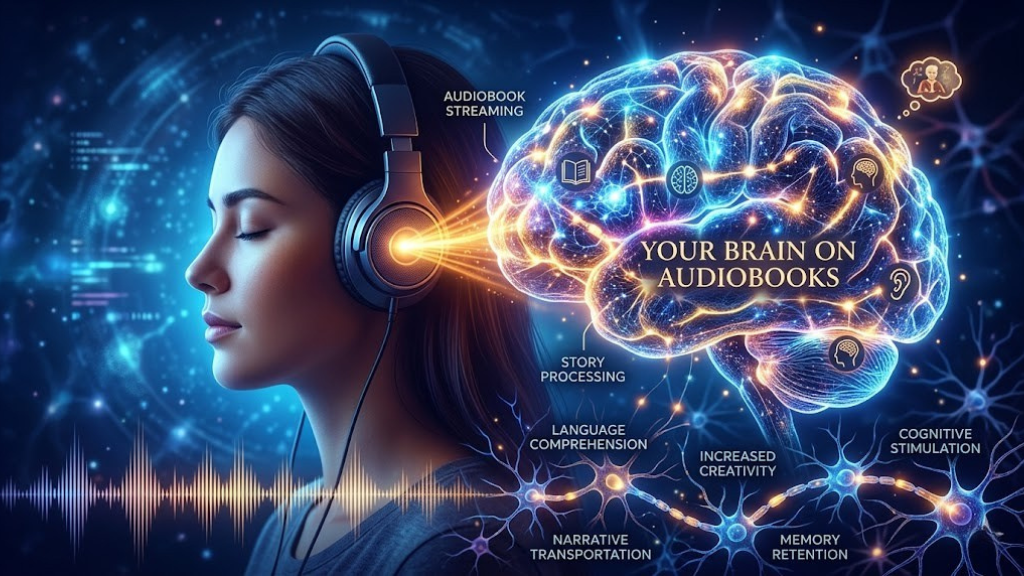
Your Brain on Audiobooks: What’s Actually Happening
The popular assumption is that audiobooks are passive — that you’re absorbing information the way you absorb television, without much cognitive effort. Neuroscience tells a different story. When you listen to a well-narrated audiobook, a remarkable number of brain systems fire simultaneously in ways that challenge and strengthen your mind.
Functional MRI studies have shown that listening to narrative speech activates not just the auditory cortex, but also visual cortex regions (you mentally picture what’s being described), motor cortex (action sequences described trigger movement-related neural firing), and prefrontal areas associated with reasoning, prediction, and social cognition. This isn’t passive reception — it’s a whole-brain workout.
A landmark 2019 study from UC Berkeley’s Gallant Lab used fMRI to map how the brain represents language meaning during listening. They found that stories heard aloud activated a “semantic atlas” — a distributed network of regions each representing different categories of meaning (people, actions, emotions, places, time) that spans much of the cortex. This same network is activated when reading silently. The overlap is striking.
What’s unique to the listening experience is the additional activation of prosodic processing centers — the regions that decode emotional tone, rhythm, emphasis, and the meaning carried by how something is said rather than just what is said. A narrator who slows down during a tense scene, or whose voice cracks slightly during a grief passage, activates brain regions that pure text simply cannot reach. This emotional bandwidth is real and measurable.
The Predictive Brain and Story Comprehension
One of the most interesting recent findings in cognitive neuroscience is that the brain is fundamentally a prediction machine. Rather than passively waiting for input, your brain constantly generates predictions about what’s coming next — in language, in narrative, in social situations. Audiobooks are an extraordinary workout for this predictive system.
As you follow a plot, your brain is continuously modeling characters’ intentions, predicting narrative outcomes, updating its model of the story world, and revising when surprised. This constant prediction-and-revision cycle engages the prefrontal cortex, the temporal-parietal junction, and the default mode network in sustained, demanding ways. The emotional satisfaction of a well-constructed plot twist is, in part, the neurological reward for your brain’s prediction system being elegantly fooled.
The Reading vs. Listening Debate: What Research Actually Shows
Few questions generate more opinion in the audiobook world than this one: is listening “as good as” reading? The answer, as with most questions worth asking, is nuanced. The research is clearer than the debate usually reflects.
The 2019 UC Berkeley Study
The most comprehensive brain-imaging comparison to date found that reading and listening activate substantially overlapping brain regions for the same content. The semantic networks engaged were nearly identical — the same regions representing character, place, time, and emotion were active regardless of the delivery mode. From a neurological standpoint, the content, not the channel, determines most of what happens in the brain.
Where Differences Emerge
Behavioral research — measuring what people actually remember and understand — reveals a more qualified picture. Studies consistently find that comprehension and retention are broadly comparable for narrative material (fiction, narrative non-fiction, biography). For dense, technical, or information-heavy material — textbooks, scientific papers, legal documents — print reading tends to yield better retention. The leading hypothesis is that readers can more easily slow down, re-read, and manage their own pacing with print, which benefits complex information processing.
The Bimodal Advantage
Research on bimodal reading — following along with text while listening to audio — suggests this combined approach can outperform either mode alone for some learners, particularly those with dyslexia or working memory challenges. Bimodal reading and Whispersync for neurodivergent retention is a topic that deserves its own attention — the cognitive advantages are real and well-documented.
| Cognitive Dimension | Print Reading | Audiobooks | Bimodal |
|---|---|---|---|
| Narrative comprehension | Strong | Strong | Strong+ |
| Technical material retention | Stronger | Moderate | Strong |
| Emotional engagement | Moderate | Stronger | Strong |
| Vocabulary acquisition | Strong | Strong | Strong+ |
| Prosodic/tonal understanding | Absent | Strong | Strong |
| Multitasking compatibility | Low | High | Low |
| Accessibility (dyslexia, low vision) | Moderate | High | High |
| Reader-controlled pacing | Full control | Limited | Limited |
The honest takeaway is that neither reading nor listening is categorically superior. They’re different cognitive experiences with overlapping outcomes. Choosing between them based on your content type, your goals, and your circumstances is far more productive than declaring one inherently better than the other.
The Framing Problem
Much of the “reading vs. listening” debate suffers from a flawed premise: that the goal is always maximum information retention. In reality, most people read fiction for enjoyment, emotional engagement, and perspective-broadening — goals that audiobooks serve at least as well as print. Judging audiobooks by the standards of technical study materials is like comparing a live concert performance to a printed score.
Comprehension and Retention: The Nuanced Picture
Comprehension — how well you understand what you’re consuming — and retention — how much you remember afterward — are related but distinct cognitive processes. Audiobooks interact with each in ways that depend on a surprisingly large number of variables: your attention level, the difficulty of the content, the quality of the narration, whether you’re doing other tasks simultaneously, and even your personal learning style.
Active vs. Passive Listening
The single biggest factor in audiobook comprehension is whether you’re listening actively or passively. Active listening — giving the book your primary attention — produces comprehension and retention comparable to active reading. Passive listening — audiobooks as background sound while you do something demanding — is cognitively similar to having the television on: you hear words but encode very little. This isn’t a problem with audiobooks; it’s a problem with divided attention, and it applies equally to reading while distracted.
The Role of Prior Knowledge
Comprehension of any text — spoken or written — depends heavily on your existing knowledge base. When you encounter unfamiliar concepts, the brain has nowhere to anchor new information. This is why listening to advanced academic content on an unfamiliar topic tends to yield poor retention regardless of how carefully you listen. The same person reading about a familiar subject comprehends at a dramatically higher rate. This matters for choosing content wisely.
How Narration Quality Affects Comprehension
An underappreciated factor in audiobook comprehension is narrator quality. A skilled narrator doesn’t just read — they communicate meaning through timing, emphasis, and emotional coloring that actually aids comprehension. Research on prosodic processing shows that sentence stress, pausing, and intonation patterns carry semantic information that helps listeners parse complex syntax. A monotone or poorly paced narrator can actually impede comprehension of the same text that a skilled narrator makes accessible.
This is one reason why extraordinarily gifted narrators like Ray Porter bring something genuinely cognitive to their performances — the listening experience with them is measurably different from the text alone. The performance-driven narrative authority of Ray Porter isn’t just entertainment value; it’s cognitive scaffolding for the listener.
Memory: How Audiobooks Strengthen What You Know and What You Feel
Memory is not a single system. Neuroscientists distinguish between semantic memory (general knowledge and concepts), episodic memory (personal experiences and events), procedural memory (skills and habits), and emotional memory (experiences charged with feeling). Audiobooks engage several of these systems in ways that can strengthen long-term retention.
The Emotional Memory Advantage
One of the most consistent findings in memory research is that emotional arousal dramatically strengthens encoding. When you encounter information — or a story moment — that triggers a strong emotional response, the amygdala signals the hippocampus to consolidate that memory more deeply. This is why you can remember where you were during a major emotional event decades later, but struggle to recall what you had for lunch yesterday.
Audiobooks, through the emotional performance of skilled narrators, can induce stronger emotional responses than silent reading for many listeners. This isn’t subjective — it’s measurable. Which means that stories heard can be better remembered because they were more emotionally engaging, not less. A character death narrated with a breaking voice can imprint more deeply than the same passage read silently.
Working Memory and Narrative Following
Following an audiobook requires robust working memory — the cognitive workspace that holds and manipulates current information. You must remember characters’ names, track their motivations, follow the plot’s causal chain, and hold the story world’s rules in mind, all without a visual page to glance back at. This sustained demand on working memory is exercising exactly the system that cognitive training programs try to strengthen.
Sleep, Memory Consolidation, and the Audiobook Habit
Memory consolidation — the process of transferring information from short-term to long-term storage — happens primarily during sleep, particularly during slow-wave and REM sleep stages. People who listen to audiobooks regularly and then sleep soon afterward may benefit from this consolidation window, similar to the spacing effect in learning. Listening to an informative or narrative-rich book in the evening, followed by a good night’s sleep, is a surprisingly effective combination for retention.
Focus and Attention: Training Your Brain to Stay Present
We live in an era of fragmented attention. The average person switches tasks or checks a device every few minutes. Against this backdrop, the question of whether audiobooks help or harm attention is genuinely important — and the answer is more interesting than you might expect.
The Attention Training Effect
Following an audiobook for an extended period is an act of sustained attention. The narrative structure provides both motivation (you want to find out what happens) and continuous cognitive engagement (keeping the story model updated). Regular practice of this sustained focus has been linked, in several studies, to improvements in attentional control more broadly — the ability to maintain focus on a chosen target and resist distraction.
This is particularly notable because sustained attention is the same skill trained by mindfulness meditation — a practice with a robust research base for improving focus, reducing mind-wandering, and decreasing symptoms of anxiety. Audiobooks aren’t a substitute for meditation, but they recruit overlapping attentional systems in a more engaging way for many people.
ADHD and External Pacing
For people with ADHD, audiobooks offer a structural advantage over print reading: external pacing. When reading text, the mind can wander and the eye can jump around; the book waits silently for you to return. An audiobook keeps moving. This external pacing structure can actually help ADHD listeners maintain engagement by giving the attentional system less opportunity to drift. The ongoing audio stream functions as an attentional anchor.
This isn’t to suggest that audiobooks cure or even fully compensate for attentional difficulties — but the behavioral evidence from ADHD communities consistently reports that many individuals find audiobooks more accessible than print for exactly this reason. Understanding this cognitive mechanism helps explain why, not just that, the effect occurs.
When Audiobooks Can Undermine Focus
The flip side is worth acknowledging. Using audiobooks as perpetual background sound — always listening during every possible moment of the day — can become a way of avoiding silence and the discomfort of an unoccupied mind. Some cognitive scientists argue that the “brain at rest” (the default mode network) performs essential functions during quiet moments: consolidating memories, solving problems incubating in the background, processing emotions, and generating creative insights. Constant audio input may reduce the time available for this restorative mental activity.
Language, Vocabulary, and the Audiobook Effect
Language acquisition research consistently points to one of the most compelling cases for audiobook listening: vocabulary development. The way we acquire new words — not in isolation but in rich, meaningful context — is precisely what audiobooks provide, and they provide it with an additional layer that text alone cannot: pronunciation.
Vocabulary in Context
Encountering a new word while reading text gives you spelling and syntactic context. Encountering that same word in a narrated audiobook gives you all of that plus pronunciation, stress pattern, and the emotional/contextual tone in which a skilled speaker naturally deploys it. This multi-channel encoding creates a richer, more durable memory trace for new vocabulary. Research on incidental vocabulary learning — picking up new words through exposure rather than study — consistently favors rich contextual exposure over isolated definition learning.
Benefits for Children: Above-Grade-Level Exposure
For children specifically, audiobooks offer something uniquely valuable: access to stories and language well above their current independent reading level. A seven-year-old whose decoding skills are still developing cannot read complex chapter books independently — but they can follow the same story read aloud to them, absorbing sentence structures, vocabulary, and narrative conventions far beyond what they could decode on their own.
This is why read-alouds — whether from a parent, teacher, or audiobook narrator — are consistently associated with vocabulary gains, reading readiness, and long-term literacy development. The cognitive challenge of following a sophisticated story is accessible through audio in a way it isn’t through independent print reading at the same age.
For Adult Language Learners
Adult learners of a second language benefit substantially from audiobook exposure in their target language. Authentic spoken input at natural speed — especially when paired with the text — exposes learners to real pronunciation patterns, rhythm, connected speech phenomena, and vocabulary in meaningful context. This is far more effective than study of isolated vocabulary lists. The key is matching the audiobook’s difficulty to the learner’s current level: texts just above comprehension level (known as i+1 in Krashen’s input hypothesis) yield the best acquisition results.
How Narrators Model Language
A professional audiobook narrator is, in a real sense, a master of the spoken language. Their choices about pace, rhythm, and emotional emphasis model sophisticated linguistic competence. Listening to excellent narrators regularly builds an implicit sense of how language flows — a prosodic intuition that underpins both speaking and writing skill. Many writers report that extensive audiobook listening has influenced the rhythm of their own prose, in the same way that avid readers absorb stylistic patterns from the texts they love.
Emotional Intelligence, Empathy, and Theory of Mind
One of the most fascinating bodies of research in the psychology of reading concerns fiction’s effect on social cognition — specifically, on the ability to understand and model other people’s mental states, intentions, and emotions. This capacity, called Theory of Mind, is a cornerstone of emotional intelligence and social functioning. And audiobooks may develop it in particularly potent ways.
Fiction and Theory of Mind
Several studies, most notably by psychologist Raymond Mar and colleagues, have demonstrated that regular fiction readers show superior performance on Theory of Mind tasks — tests that require accurately inferring what another person is thinking or feeling. The proposed mechanism is practice: fiction repeatedly requires you to model the inner lives of characters, build their motivations from partial evidence, and understand their behavior from their perspective. This is the same cognitive work required in real social interactions.
Why Audio Performance Amplifies This Effect
Here is where audiobooks may have an advantage over print for social-emotional development: a skilled narrator voices each character distinctly, communicates their emotional states through vocal texture, and makes the subtext of interpersonal dynamics audible. Where a reader of text must infer tone, the audiobook listener hears it modeled. This explicit representation of emotional subtext may actually provide richer training for social cognition than silent reading of the same content.
Dual-narrated romance audiobooks, for instance, where two narrators voice alternating perspectives, present listeners with two complete internal worlds in explicit contrast — a particularly rich exercise in perspective-taking. The emotional power of duet narration isn’t accidental; it’s structurally designed to maximize perspective immersion.
Narrative Transportation and Empathy
Psychological research on “narrative transportation” — the state of being absorbed into a story world — shows that higher transportation predicts greater empathy toward the characters, greater attitude change aligned with the story’s perspective, and greater emotional spillover into real-world attitudes. Because skilled narration often deepens transportation (through vocal performance, pacing, and emotional authenticity), audiobooks may facilitate deeper narrative transportation for many listeners — and with it, the associated empathy benefits.
Mental Health, Stress Reduction, and Bibliotherapy
The relationship between storytelling and emotional wellbeing is ancient, but the scientific study of it is relatively recent. What’s emerging is a picture that supports something humans have intuited for millennia: stories heal, comfort, and help us process the hardest things in life.
Stress Reduction and Cortisol
A widely-cited 2009 study from the University of Sussex found that reading for just six minutes reduced stress levels (as measured by heart rate and muscle tension) by 68% — outperforming listening to music, walking, and drinking a cup of tea. While this study specifically measured silent reading, subsequent research on narrative engagement more broadly has shown similar cortisol-reducing effects from being absorbed in a story, regardless of the delivery mode.
The proposed mechanism is cognitive absorption: when your attention is fully occupied by a narrative, the mind’s default rumination — the worry loops, the replayed conversations, the anxiety spirals — is interrupted. The brain cannot simultaneously construct a fictional world and replay yesterday’s difficult meeting. This is why audiobooks, especially during commutes, walks, or other solitary activities, so reliably improve mood and reduce subjective stress.
Bibliotherapy: Stories as Clinical Tools
Bibliotherapy — the use of reading (or listening) as a therapeutic tool — has been practiced informally for centuries and formally since the early 20th century. Contemporary therapeutic applications include recommending specific novels to help clients process grief, trauma, anxiety, depression, and relationship difficulties. The mechanism involves both identification (recognizing your experience in a character’s) and narrative processing (watching a character navigate difficulty gives you cognitive frameworks for your own).
Audiobooks extend bibliotherapy’s accessibility dramatically. People who struggle to concentrate during acute mental health episodes often find reading difficult — but listening, with its more passive entry point, remains possible. The barrier to beginning is lower, and once engaged, the cognitive absorption effect begins to operate. Many mental health professionals now recommend audiobooks specifically to clients who find traditional reading inaccessible during difficult periods.
Loneliness and Social Connection
Fiction creates what psychologists call “parasocial relationships” — a real sense of connection with characters who don’t exist. While this sounds trivial, research suggests that parasocial relationships activate some of the same brain regions and fulfill some of the same psychological functions as real social connections. For isolated individuals, regular engagement with rich character-driven fiction can provide a form of social nourishment that reduces the cognitive and emotional costs of loneliness.
This doesn’t replace real human connection — but it’s meaningfully better than no social engagement at all. The vividness of a skilled narrator’s character voices may amplify this effect compared to silent reading, making the characters feel more present and their relationships more socially real.
Audiobooks and Sleep: What the Brain Needs You to Know
A significant number of audiobook listeners report using them specifically as a sleep aid — letting a narrator’s voice carry them toward sleep. The relationship between audiobooks and sleep is, it turns out, quite nuanced and worth understanding properly.
Pre-Sleep Listening: The Benefits
Listening to a calming audiobook in the period before sleep can meaningfully reduce pre-sleep cognitive arousal — the active mental chatter, worry cycling, and problem-solving that delays sleep onset. By occupying the narrative centers of the brain with someone else’s story, you interrupt your own rumination. This is the mechanism behind the well-documented sleep benefit of light reading before bed, and it applies to light audiobook listening as well.
The key word is light. Thrillers, horror, and tense narratives are counterproductive at bedtime — they raise physiological arousal rather than reducing it. Gentle literary fiction, memoir, or calming non-fiction is better suited to pre-sleep listening. The narrator’s voice itself — particularly a warm, measured, unhurried delivery — can have a mild relaxation response similar to being read to as a child.
Listening During Sleep: The Risks
Listening to audiobooks after falling asleep is a different matter. During sleep, particularly deep slow-wave sleep and REM sleep, the brain performs critical consolidation work — reorganizing memories, processing emotions, clearing metabolic waste from the day’s neural activity. Introducing narrative audio during these stages can disrupt consolidation and reduce sleep quality, even if you don’t consciously register the disruption. The brain continues processing auditory input during lighter sleep stages, and this processing competes with the consolidation work sleep is meant to do.
Audiobooks and Circadian Rhythms
One advantage audiobooks have over screen-based reading at night is the absence of blue light. Screen light in the evening suppresses melatonin production and delays the circadian clock, making sleep harder to initiate and shallower when it comes. Audiobooks produce no light at all, making them preferable to tablets or phones for evening consumption from a sleep hygiene standpoint — as long as your device’s screen is off or face-down.
Audiobooks, Aging, and Cognitive Decline: A Compelling Case
One of the most important contexts for audiobook listening’s cognitive benefits is aging. The research on cognitive reserve — the brain’s resilience against age-related decline — consistently points to lifelong intellectual engagement as a protective factor. And audiobooks may be uniquely positioned to support this engagement throughout the full lifespan.
Cognitive Reserve and the Reading Habit
Studies of populations with high cognitive reserve — people who develop Alzheimer’s disease later and progress more slowly — consistently identify high levels of education and lifelong engagement in complex cognitive activities (reading, learning, social interaction) as protective factors. The proposed mechanism is that sustained cognitive engagement builds neural complexity and redundancy, giving the brain more “reserve capacity” before decline becomes functionally impactful.
Reading has been studied most extensively in this context, but the emerging picture from cognitive neuroscience suggests that what matters is sustained narrative engagement and language processing, not the specific delivery channel. Audiobooks, for older adults who may face vision difficulties, fatigue, or reduced reading fluency due to cognitive changes, can maintain this engagement when print reading becomes difficult or impossible.
Audiobooks for Older Adults with Vision or Mobility Challenges
As print reading becomes more difficult with age — due to macular degeneration, cataracts, or simply reduced visual acuity — audiobooks offer continued access to literature and learning without requiring vision. This is not a trivial point. Losing access to reading is cognitively and emotionally significant for lifelong readers. Audiobooks represent continuity, not compromise: the same cognitive engagement, the same emotional nourishment, the same intellectual stimulation, through a different channel.
The Accessibility Dimension
For people with dyslexia, visual impairments, motor disabilities that make holding books difficult, or any condition that makes print reading laborious, audiobooks don’t just offer equivalent cognitive benefits — they offer access that was previously unavailable. The brain doesn’t care about the channel. It cares about the narrative, the language, the ideas. Audiobooks democratize access to all of these in ways that print reading cannot.
Dementia and Therapeutic Listening
Research on music therapy in dementia patients has demonstrated that auditory engagement can reach individuals even in later stages of cognitive decline, triggering memory, emotional response, and moments of lucidity that other interventions do not. While the research on audiobooks specifically in dementia is less extensive, clinical practitioners have reported similar effects: familiar narrators, beloved stories, or memoirs in the patient’s own cultural context can produce meaningful engagement when other forms of communication have become difficult.
Speed Listening: The Science of How Fast Is Too Fast
Many audiobook listeners have discovered the ability to increase playback speed — and many push this quite aggressively. It’s not unusual to hear people claim they listen at 2.5x or even 3x normal speed. The question of whether this is actually efficient is one where science has a fairly clear answer.
What Happens to Comprehension at Higher Speeds
Research on speech processing speed consistently identifies a threshold around 1.5x normal speech rate beyond which comprehension begins to meaningfully decline. At normal speech rate (~150 words per minute), the brain processes language with considerable headroom — there’s cognitive capacity to spare for prediction, inference, and emotional processing. As speed increases, more of that capacity is absorbed by the basic decoding task, leaving less for deeper comprehension.
At 2x speed (approximately 300 words per minute), most listeners show measurable declines in comprehension and retention, particularly for complex or technical material. At 2.5x and above, prosodic cues — the emotional and emphatic information carried by how something is said — are severely degraded, stripping away much of what skilled narration adds. You’re essentially receiving a skeletal version of the content.
| Playback Speed | Words/Min (approx) | Comprehension Impact | Prosodic Quality | Recommended For |
|---|---|---|---|---|
| 1.0x | ~150 wpm | Full | Full | Complex/technical content, new topics |
| 1.25x | ~188 wpm | Near-full | Near-full | Familiar topics, light fiction |
| 1.5x | ~225 wpm | Slightly reduced | Moderate | Familiar topics, experienced listeners |
| 2.0x | ~300 wpm | Noticeably reduced | Degraded | Review / re-listening only |
| 2.5x+ | 375+ wpm | Significantly reduced | Severely degraded | Not recommended for new content |
The “More Content” Fallacy
The appeal of high-speed listening is the promise of consuming more — more books, more information, more learning per hour. But comprehension and retention don’t scale linearly with speed increases. If listening at 2x gives you 70% of the comprehension you’d get at 1x, you’ve “saved” an hour but lost 30% of the value — which may mean you’d need to revisit the material anyway. For content where genuine understanding matters, the math rarely works out in favor of aggressive speed increases.
For re-listening to familiar content, reviewing material you’ve already engaged with deeply, or consuming content where even partial retention is valuable, higher speeds make more sense. The key is matching your listening strategy to your actual goal.
How to Maximize the Brain Benefits of Audiobook Listening
Understanding the cognitive science of audiobook listening gives you a roadmap for getting more out of every listening session. The difference between audiobooks that leave a lasting impression and those that disappear from memory within a week often comes down to a handful of practical habits.
-
01
Choose Content That Challenges You
The cognitive benefits of listening are proportional to the cognitive demand. Books slightly above your current knowledge or vocabulary level produce more vocabulary acquisition, more prediction activity, and stronger encoding. Exclusively listening to easy content is comfortable but not particularly growth-inducing.
-
02
Listen Actively When It Matters
For content where retention matters, give audiobooks your primary attention. Light physical activity (walking, gentle exercise) is a fine accompaniment — it actually enhances alertness and memory consolidation. Demanding cognitive tasks (complex problem-solving, reading, writing) as a secondary activity are comprehension killers.
-
03
Reflect After Listening
Brief active recall — mentally summarizing what happened, what you thought about it, or what you want to remember — dramatically improves long-term retention. Even two minutes of reflection immediately after a listening session can double what you retain a week later. Saying it out loud is even more effective than thinking it silently.
-
04
Match Speed to Content Complexity
Reserve your highest speeds for familiar topics or re-listens. For new, complex, or emotionally resonant content, slower listening isn’t a weakness — it’s the appropriate strategy. The cognitive science on this is clear: comprehension and retention for unfamiliar material suffer significantly at speeds above 1.5x.
-
05
Use Sleep Strategically
Listen in the evening when you can, and let sleep consolidate what you’ve heard. Listening just before sleep — not during it — positions your listening content at the front of the consolidation queue. The hippocampus preferentially consolidates recently active memories during the subsequent sleep period.
-
06
Invest in Narrator Quality
Choose your audiobooks partly on narrator quality. A skilled narrator increases comprehension, deepens emotional engagement, and makes the listening experience cognitively richer. The difference between a mediocre and an exceptional narrator is not just pleasurable — it’s cognitive. The cognitive difference between audio and text processing is magnified by the quality of the performance.
-
07
Consider Bimodal Reading for Dense Content
For information-heavy non-fiction, following along with the text while listening combines the pacing structure of audio with the re-reading flexibility of text. Apps like Audible with Whispersync sync text and audio automatically. For learners and for technical material, this approach consistently outperforms either mode alone.
-
08
Build Silence into Your Day
Don’t fill every moment with audio. The default mode network’s unoccupied time — walks without headphones, quiet meals, idle moments — is not wasted time. It’s when the brain integrates, consolidates, and makes connections between what it has learned. A listening practice is most cognitively productive when alternated with space to process.
- Active, focused listening sessions
- Content slightly above current level
- Brief reflection after listening
- High-quality, skilled narrators
- Evening listening before sleep
- Bimodal approach for technical books
- Regular, consistent listening habit
- Passive background listening always
- Exclusively listening while doing complex tasks
- Consistently very high playback speeds
- Never reflecting on content
- Listening during sleep
- Only easy, familiar content
- No silence / rest periods
Frequently Asked Questions
Conclusion: The Science Sides with the Storytellers
The question of whether audiobooks are good for your brain has a clear answer — yes — and a complicated one: it depends on how you listen, what you listen to, and what you’re hoping to get from it. The neuroscience doesn’t leave much room for doubt about the fundamentals. Narrative audio engages enormous swaths of the brain, builds vocabulary and empathy, reduces stress, exercises working memory, and can protect cognitive function across the lifespan.
What the science also makes clear is that the specific choice of book and narrator matters more than the format itself. A riveting story told by a gifted narrator is cognitively richer than a mediocre book read perfectly. The content — its characters, ideas, emotional complexity, and narrative construction — is what the brain ultimately works with. The audio delivery channel simply makes it accessible in more times and places than print can manage alone.
For those who commute, exercise, do household tasks, or simply have more hours in their day than they have time to sit and read, audiobooks represent something genuinely valuable: the full cognitive and emotional nourishment of literature, available in the margins of life that print reading cannot reach.
Keep Exploring on AudiobookWiki
Go deeper into the science, the stories, and the listening experience.