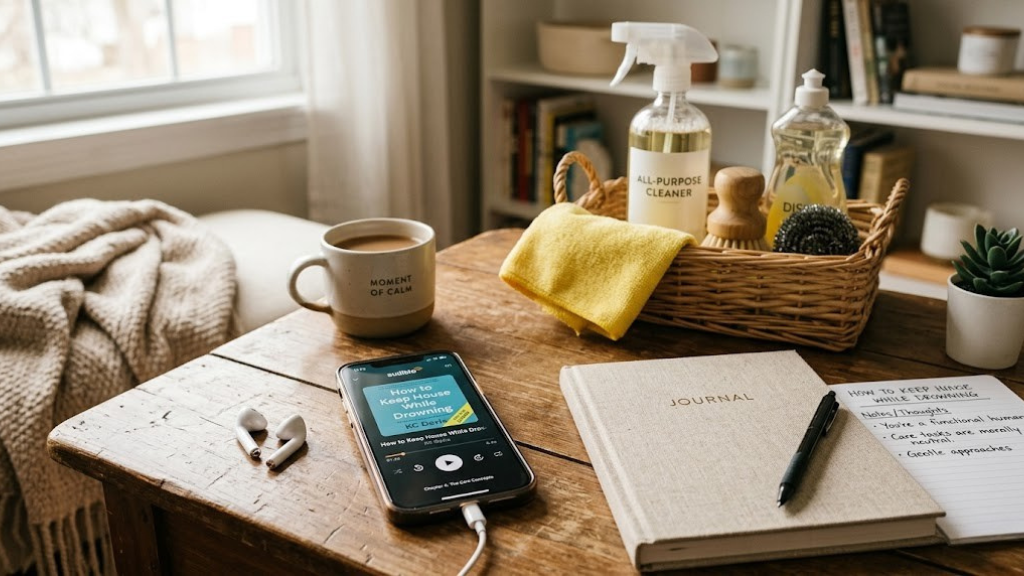
How to Keep House While Drowning: The Audiobook That Might Actually Change How You Talk to Yourself
KC Davis’s compassionate reframe of domestic care tasks — narrated by the author herself — is short, honest, and more emotionally resonant in audio than almost anything else in the genre.
There are self-help books about cleaning, and then there is How to Keep House While Drowning. The former tend to promise transformation through systems and schedules — the latter dismantles the premise that your domestic environment reflects your moral worth. KC Davis, a licensed professional counsellor who built a following on TikTok by talking openly about ADHD, motherhood, and the shame of a messy house, wrote a book that functions less like a housekeeping guide and more like a conversation with someone who genuinely understands why you haven’t done the laundry in three weeks.
In audio format, narrated by Davis herself, it becomes something else again. At just under four hours, it’s among the shortest significant self-help audiobooks on the market — and arguably the most emotionally dense for its length. This review covers everything: what the book actually says, how the narration performs, who it’s genuinely for, where it falls short, and how to decide whether the audio or print version better suits your needs.
What Is How to Keep House While Drowning?
Published in 2022 by Simon & Schuster, How to Keep House While Drowning began as a series of TikTok videos in which KC Davis — a therapist and mother with ADHD — spoke candidly about the relationship between mental health, executive function, and the impossible social expectation that a clean home equals a well-organised mind. The videos went viral, not because they offered clever cleaning hacks, but because Davis said something very few voices in the domestic self-help space had said clearly before: care tasks are morally neutral.
The book expands on that core insight across approximately 130 pages (the print version) or four hours (audio). It’s divided into short, accessible chapters that address the emotional and psychological barriers to basic domestic maintenance — not with productivity frameworks or cleaning schedules, but with compassion, cognitive reframes, and the kind of practical permission-giving that many readers report crying through.
Davis draws on her background as a licensed professional counsellor throughout. This isn’t a therapist pretending to be a cleaning expert. It’s a therapist applying clinical thinking to a problem that typically gets addressed by cheerful organisers with before-and-after photos: the gap between knowing you need to do the dishes and being able to make yourself do them when your brain is underwater.
The Book’s Origin and Cultural Context
The book landed at a cultural moment when conversations about ADHD in women — historically underdiagnosed and poorly served by productivity literature written for neurotypical people — were gaining significant mainstream traction. Davis’s core message resonated particularly sharply with women who had spent years believing they were lazy, broken, or uniquely inadequate because they couldn’t maintain the domestic standards the world seemed to expect of them without apparent effort.
That resonance is inseparable from the book’s reception. Across Goodreads, social media, and audiobook review platforms, the response is striking in its consistency: readers describe feeling seen in a way that self-help rarely provides. Many describe emotional responses — tears, relief, a kind of retroactive compassion for earlier selves — that have more in common with therapeutic breakthroughs than with the satisfaction of discovering a better filing system.
The Audiobook Version: What to Expect
The audiobook edition of How to Keep House While Drowning runs 3 hours and 54 minutes. That makes it one of the shorter significant self-help titles on most platforms — roughly a third the length of typical entries in the genre — and that brevity is part of its character. Davis didn’t pad the book to meet a word count, and the audio reflects the same economy. There’s no throat-clearing, no extended preamble, no repetition of concepts already established.
For listeners unfamiliar with the print version, the audio covers the book’s full content: the emotional framing around care tasks and shame, the practical “mess hierarchy” system, the body-doubling concept, the “good enough” standards framework, and the closing reflection on self-compassion as the foundation rather than the reward of domestic competence. Nothing is abridged — this is the full text read by its author.
Production Quality
The production is clean and professionally executed. Studio sound quality is consistent throughout, with no noticeable room noise or audio artefacts. Volume levels are stable. There’s no ambient music or sound design — this is a straight narration, which suits the material. A book about reducing overwhelm and noise in your life doesn’t need a synthesised string pad underneath it. The restraint is appropriate.
Chapter transitions are clear and well-paced. Shorter chapters — some running only a few minutes — work particularly well in audio because the natural pause between chapters provides a kind of built-in space for reflection.
Narration Quality: KC Davis Reads Her Own Work
Author-narration is always a gamble. Not every writer is a natural performer, and the gap between writing brilliantly about something and reading that writing aloud with skill and authenticity is real. Davis, however, belongs to a small category of authors for whom self-narration is not just acceptable but genuinely superior to any alternative. This is a book whose power depends significantly on feeling like a direct conversation — and that is exactly what Davis delivers.
Her voice is warm without being saccharine. She speaks at a pace that conveys genuine thought rather than rehearsed performance — the slight hesitations and natural emphases you’d hear from someone who believes what they’re saying and has felt the weight of it personally. This quality is particularly important for a book that asks a lot emotionally of its reader. Being told that your worth isn’t contingent on your laundry pile lands differently when it’s delivered in a voice that sounds like it knows from experience what that shame actually feels like.
There is something unusually powerful about hearing a therapist say “this is not your fault” in their own voice — not performed, not produced, just honest.
Common listener response to the author-narrated editionTonal Consistency Across Emotional Range
The book moves between registers — analytical and clinical in some sections, vulnerable and personal in others, gently humorous in still others. Davis navigates these shifts without jarring transitions. She’s funny when the material allows it, without undercutting the gravity of the more difficult sections. Her delivery of the more emotionally weighted passages — particularly those addressing shame, self-worth, and the specific experience of drowning in a sea of undone tasks — is measured and present without becoming theatrical.
Where the Narration Is Strongest
The book’s most effective audio sections are the ones where Davis speaks in the second person — addressing the listener directly as someone she has sat across from professionally, or someone whose internal monologue she recognises from her own experience. These passages feel genuinely intimate in a way that printed text rarely achieves, and they’re the moments where the audiobook format most clearly justifies itself over the print edition.
Content Breakdown: What the Book Actually Covers
One of the most frequent surprises for first-time readers is how much of the book is devoted to the psychological and emotional framework around care tasks rather than specific techniques. This is not a criticism — it’s the book’s primary value. But understanding what you’re getting before you start will help you arrive in the right frame of mind.
-
1You Are Not Behind — You Are DrowningThe opening reframe: the problem isn’t that you need to catch up. It’s that “catching up” as a concept may be fundamentally wrong for where you are. Davis introduces the central metaphor and immediately signals the book’s tone — no cheerfulness, no false urgency.
-
2Care Tasks Are Morally NeutralThe philosophical cornerstone. Davis dismantles the moralisation of domestic maintenance — the deep cultural assumption that cleanliness reflects character. This is the chapter most often cited in reader responses as the turning point.
-
3The Mess HierarchyThe first practical framework: a triage approach to domestic tasks based not on aesthetics but on function. What needs to happen for safety and basic functioning? What comes after? This reorientation from “clean” to “functional” is deceptively liberating.
-
4Body Doubling and External AccountabilityDavis introduces body doubling — doing tasks in the presence of another person or, in its digital form, over video call — as a legitimate and effective tool for people with ADHD and executive function difficulties.
-
5Good Enough Is Not a FailureThe “good enough” standard — and the specific, measurable definition of what that means in practice — addresses perfectionism as a driver of paralysis. Many readers identify this as the chapter that most immediately changes their daily behaviour.
-
6Shame, Motivation, and Why Guilt Doesn’t WorkDavis draws explicitly on her clinical training to explain why shame is uniquely ineffective as a motivator for people already in overwhelm — and why compassion is not self-indulgence but neurological strategy.
-
7Relationships and the Mental LoadWho is doing this work, and how is that negotiated? Davis addresses the gendered dimensions of domestic labour without making it the book’s entire focus — a careful balance that keeps the book accessible without avoiding the reality.
-
8The Reset, Not the CleanPractical strategies for resetting (not perfectly cleaning) a space — and the psychological difference between those two objectives. One is achievable in fifteen minutes; the other exists in an imaginary future when you “have time.”
The Core Concepts: What KC Davis Is Really Saying
The book’s ideas are more interconnected than a chapter summary suggests. Understanding how they build on each other helps you get more from both the print and audio experience.
Functional vs. Aesthetic Standards
Davis makes a fundamental distinction that sounds obvious but runs counter to how most housekeeping culture frames the question: the difference between a home that functions for the people who live in it, and a home that meets an external aesthetic standard. The latter is a moving target, shaped by social comparison, class anxiety, and a hospitality culture that developed at a time when the domestic work behind it was effectively invisible.
The mess hierarchy operationalises this distinction. Is there food available? Are sleeping areas usable? Are hygiene basics being maintained? If yes, then the space is functioning, even if it isn’t visually tidy. The shift from “this is messy” to “this is or isn’t functional” is the foundational cognitive reframe the book offers.
Shame as a Neurological Problem
Davis approaches shame with clinical precision. The book doesn’t just say “don’t be so hard on yourself” — it explains why shame specifically undermines the executive function and motivation systems that care tasks depend on, and why someone in a shame spiral about an undone task is neurologically less able to do that task, not more.
Body Doubling: Legitimate Tool, Not Crutch
The body doubling concept is the section of the book that has generated the most surprised and grateful responses from ADHD readers. Many people with attention difficulties intuitively know they work better with someone else present but have internalised it as a sign of inadequacy. Davis reframes it as a legitimate neurological accommodation. For many ADHD listeners, this single reframe has more immediate practical impact than years of productivity advice.
“Good Enough” as Liberation
The “good enough” standard sounds like an excuse. Davis explains why it’s the opposite. Perfectionism in domestic contexts doesn’t produce better outcomes — it produces paralysis, procrastination, and eventually the complete cessation of effort because the only acceptable standard is one that’s never achievable in real life. “Good enough” removes the binary of perfect/failed and replaces it with a range of genuinely achievable states.
Who Is This Audiobook Actually For?
Honest audience targeting matters. How to Keep House While Drowning is a genuinely excellent book for a specific type of listener, and a potentially frustrating one for another.
| You Will Love It If… | It May Disappoint You If… |
|---|---|
| You have ADHD, depression, anxiety, or chronic overwhelm | You’re looking for detailed cleaning systems or schedules |
| You feel shame about your living environment | Your home is generally managed and you want optimisation tips |
| You’ve tried cleaning systems and found them unworkable | You want Marie Kondo-style philosophy with different content |
| You want to understand why you can’t do basic tasks | You’re uninterested in emotional or psychological framing |
| You’ve been told you’re lazy when you know that isn’t the whole truth | You want something longer and more comprehensive |
| You’re a parent trying to rethink household expectations | You prefer highly structured, system-based approaches |
| You experience executive function difficulties around initiation | You’re already at peace with your relationship to care tasks |
ADHD, Mental Health, and Why This Book Works Differently
Most self-help books about housekeeping and organisation are written for neurotypical people who have temporarily lost the plot, not for people whose neurological wiring makes the plot categorically harder to follow in the first place. The former needs a system and some motivation. The latter needs something more fundamental: an explanation of why the systems keep failing, and permission to stop interpreting that failure as evidence of personal inadequacy.
Task Initiation: The Real Barrier
For many people with ADHD and depression, the hard part of doing laundry isn’t the laundry. It’s starting the laundry. The gap between “I need to do this” and “I am now doing this” — which neurotypical people cross automatically and without significant cognitive overhead — can be a chasm for people with executive function difficulties. Davis names this gap directly rather than treating it as a moral failing to be overcome with better willpower.
Shame Spirals and the Paralysis Cycle
One of the most clinically precise sections of the book addresses the shame spiral in detail: the process by which undone tasks generate shame, which reduces executive function capacity, which makes tasks harder to do, which generates more undone tasks and more shame. Breaking it requires interrupting the cycle at the shame stage — removing the moral valence from the task entirely. Dishes in the sink are not a statement about your character. They’re dishes in the sink. The distinction is the entire intervention.
Davis references several concepts with strong research support: the role of dopamine in ADHD task motivation, the impact of cortisol (stress hormone) on working memory and executive function, and the established relationship between chronic shame and reduced motivation. She doesn’t over-cite, but the clinical foundations are visible throughout.
Audiobook vs. Print: Which Version Should You Choose?
- Author’s voice delivers emotional content authentically
- Listen while doing the care tasks the book discusses
- Perfect for readers whose ADHD makes sustained reading difficult
- Short runtime achievable in a single session
- Davis’s warmth creates therapeutic intimacy
- No visual format to feel intimidated by
- Ideal for bad-brain days
- Includes worksheets and visual frameworks audio doesn’t carry
- Easier to re-read specific sections for reference
- Underlining and annotation support active engagement
- Some readers process emotional material better in silence
- Print allows non-linear reading — jump to the most relevant chapter
- Ebook version searchable and quotable
The Unique Case for Audio with This Specific Book
There’s something almost too apt about listening to How to Keep House While Drowning while doing the tasks the book describes. Doing that in the literal presence of Davis’s voice — hearing her explain why the pile of laundry in front of you doesn’t mean anything about who you are while you actually fold it — creates an experiential reinforcement that the print version, by definition, can’t offer.
Pros & Cons of the Audiobook
- Author-narration is authentically warm and skilled
- Core reframe (care tasks as morally neutral) is profound
- Short enough to be accessible during low-capacity periods
- ADHD and mental health framing is clinically grounded
- Non-judgemental tone is consistent — never preachy
- Body doubling concept introduced in a normalising, practical way
- Available free on Libby/Hoopla via most library cards
- Production quality is clean and professional
- Emotional impact disproportionate to length
- Not a practical housekeeping guide
- Worksheets from print edition not available in audio
- Some listeners want more depth on specific topics
- Short runtime may feel insubstantial at full purchase price
- Less useful if you’re already at peace with domestic life
- Doesn’t address executive function strategies in depth
- Some readers want more research citations
Similar Audiobooks for the Same Reader
If How to Keep House While Drowning resonates — or if you want to approach its themes from complementary angles — these audiobooks address adjacent territory with comparable quality and relevance.
Where to Listen: Platform Guide
| Platform | Availability | Cost | Notes |
|---|---|---|---|
| Audible | Available | 1 credit (~£8–£12) or purchase | Author-narrated version. Consistent production quality. |
| Libby / OverDrive | Check your library | Free (library card) | Widely stocked. May have short waitlists. Worth checking first. |
| Hoopla | Check your library | Free (library card) | Instant access where available — no waitlist. Check before Libby. |
| Libro.fm | Available | ~£15/mo subscription credit | Supports independent bookshops. Good ethical choice. |
| Google Play Books | Available | Direct purchase | Pay once, own the file. Reasonable prices, clean app. |
| Apple Books | Available | Direct purchase | Good option for iOS listeners. Integrates with AirPods seamlessly. |
The Free Listener’s Recommendation
Start with Hoopla. If not available there, check Libby — if there’s a waitlist, place the hold and listen to one of the companion books in the meantime. For most listeners with a public library card, this audiobook should cost nothing.
Final Verdict: Should You Listen?
Yes — with a caveat about expectations: if you know what this book is, it’s exceptional. If you don’t know what it is and you need a cleaning guide, you may feel let down by something that is genuinely excellent at a different thing.
As a reframe of the emotional and psychological relationship between domestic maintenance and self-worth, it’s one of the most effective short-form self-help titles of the past decade. The author-narrated audio version is the preferred format for the majority of listeners — the intimacy and authenticity of Davis’s own voice are not incidental but central to the book’s impact.
The book is particularly valuable for listeners with ADHD, depression, anxiety, or any condition that makes basic domestic maintenance genuinely difficult. For that audience, “valuable” may be underselling it. For many readers, it’s a book that changes something — not just how they approach laundry, but how they talk to themselves about being a person who sometimes cannot do the laundry.
A Note on Repeat Listening
An unusual feature of the listener response to this audiobook is the frequency with which people report returning to it — not because they forgot what it said, but because the emotional permission it grants needs renewal. In the same way that therapy sessions aren’t one-and-done, some listeners treat this audiobook as a tool to re-engage periodically during particularly difficult stretches. The four-hour runtime makes this practical rather than ambitious.
Frequently Asked Questions
Yes. The audiobook edition is available on Audible, Libby/OverDrive, Hoopla, Libro.fm, Google Play Books, and Apple Books. It runs 3 hours and 54 minutes and is narrated by KC Davis, the author. It’s available free through many public library systems via the Libby and Hoopla apps.
KC Davis narrates the audiobook herself. As a licensed professional counsellor, therapist, and the creator of the Struggle Care TikTok community, Davis brings a quality of authentic warmth and clinical authority that professional voice actors would struggle to replicate. Her delivery is conversational, unhurried, and consistently non-judgemental.
The audiobook runs 3 hours and 54 minutes. This makes it one of the shorter significant self-help titles on major platforms — achievable in a single listening session or across a handful of shorter ones during daily tasks. The brevity is a deliberate choice, not a limitation.
For most listeners, the audiobook is the recommended format — with one significant exception. The print edition includes worksheets and visual frameworks that don’t appear in the audio. For the book’s emotional and reframing content, Davis’s own voice in the audio delivers something the print version can’t match. If you have access to both formats (Kindle + Audible), using Whispersync to combine them is close to ideal.
It’s specifically excellent for people with ADHD. Davis addresses executive function difficulties, task initiation, the shame spiral that ADHD-related domestic struggles often produce, and body-doubling as a legitimate neurological accommodation. The audiobook format particularly suits ADHD listeners — short runtime, author’s voice, and the ability to listen during the actual tasks being discussed.
The book’s central argument is that care tasks are morally neutral — they don’t measure your worth, reflect your character, or define you as a person. Davis argues that the moralisation of domestic maintenance is both historically contingent and actively harmful, especially for people whose neurological or mental health situations make maintenance genuinely difficult.
Availability depends on your library system, but yes — the audiobook and ebook are widely stocked on both Libby and Hoopla. Hoopla offers instant access where available, with no holds or waitlists. In most cases, you should be able to access this title at no cost with a public library card.
Yes. Davis, as a licensed professional counsellor, weaves mental health throughout — addressing the relationship between depression and domestic paralysis, the role of shame in perpetuating cycles of avoidance, and the specific way anxiety can make the gap between “I know I need to do this” and “I am doing this” feel insurmountable.
The closest companion books are: Laziness Does Not Exist by Devon Price, Burnout by Emily and Amelia Nagoski, The Gifts of Imperfection by Brené Brown, ADHD 2.0 by Hallowell and Ratey, and Unfuck Your Habitat by Rachel Hoffman. All are available as audiobooks with strong narration.
Yes — though ADHD listeners tend to find it most immediately transformative. The book speaks broadly to anyone whose domestic situation has become overwhelming for any reason: new parenthood, depression, grief, burnout, chronic illness, or simply the accumulated weight of a life with more demands than hours. The core framework is universally applicable. If you’ve ever felt inadequate because of your home, this book is likely speaking to your experience.
Conclusion: A Short Book That Asks a Big Question
How to Keep House While Drowning is the rare self-help book that asks the right question first. Not “how do I clean more effectively?” but “why is the state of my home so bound up with how I feel about myself — and does it need to be?” The answer KC Davis offers — carefully, compassionately, and without pretending it’s simple — is one of the more useful things a short book has offered the genre in recent years.
In audio, narrated by the author in a voice that carries genuine clinical wisdom and personal experience, it becomes something close to therapeutic. The fact that it’s under four hours means it asks very little of you in terms of time and commitment — which feels deliberately and thoughtfully calibrated to the audience it’s trying to reach. People who are drowning don’t need a 20-hour system. They need someone who understands what drowning feels like, and a first handhold.
This is that handhold. Listen to it while doing the dishes. Or while the dishes pile up. Either way, try to be kind to yourself about whichever one it turns out to be.
Find More Audiobooks That Actually Move You
Explore our guides on the best self-help, wellness, and personal development audiobooks — narration quality reviewed, platforms compared, and everything else you need to listen well.