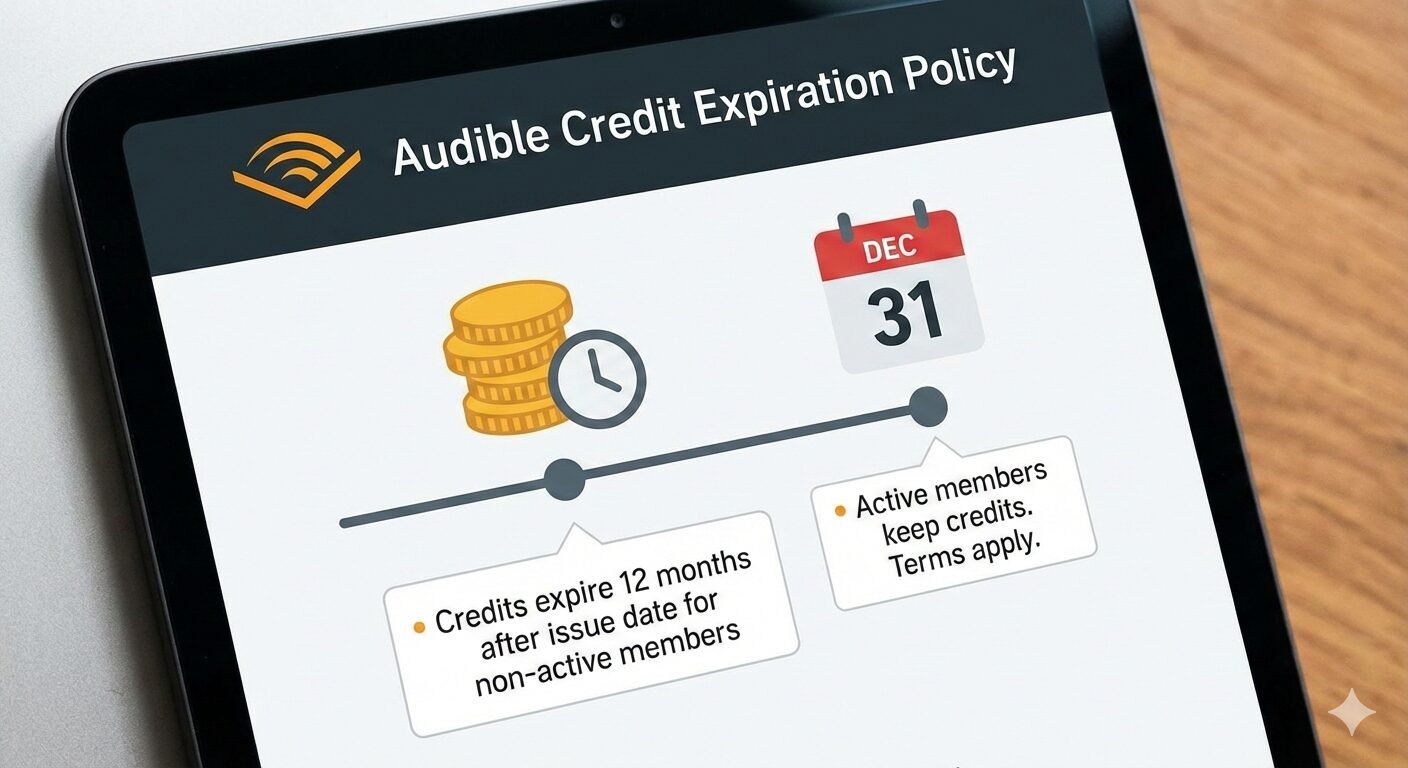
Audible Credit Expiration Policy: Do Credits Really Expire?
There is nothing worse than logging into your Audible account, expecting to see a stockpile of 5 credits, and finding only 2. You paid for them. Where did they go? Did they vanish into the digital ether?
Audible credits are valuable currency (worth roughly $15 each), but they are not yours to keep forever. Unlike physical gift cards which often have legal protections against expiration, Audible credits are technically a “membership benefit” and come with strict time limits.
In this guide, we will break down the confusing Audible credit expiration policy. We will explain exactly when your credits expire, the massive difference between “pausing” and “canceling,” and the one specific loophole that allows some users to keep credits indefinitely.
The Golden Rule: 12 Months to Spend
For the vast majority of users (those subscribed directly through Audible.com or Amazon), the rule is simple:
Credits expire 12 months after the date they were issued.
It does not matter if you are on a monthly plan or an annual plan. Each individual credit has its own 1-year timer.
Example: If you receive a credit on January 15, 2025, it will expire on January 15, 2026.
If you do not use the credit within that 365-day window, it is removed from your account. Audible does not typically offer refunds for expired credits, so vigilance is key.
The Cancellation Trap: Immediate Loss
This is the #1 complaint from angry customers. If you cancel your Audible membership, you lose all your remaining credits immediately.
Unlike the books you’ve already purchased (which are yours forever), credits are considered a “perk” of the active subscription. The moment you hit “End Membership,” your credit balance drops to zero. They do not wait for the end of the billing cycle.
The App Store Loophole (iOS & Google Play)
There is a major exception to the expiration rules. If you subscribed to Audible through the Apple App Store or Google Play Store (meaning you pay Apple/Google, not Amazon directly), your credits behave differently.
According to current terms for Apple/Google subscriptions:
Credits do NOT expire.
Credits are NOT lost upon cancellation.
Why? Because Apple and Google treat credits as “purchased currency” rather than a membership perk. However, there is a catch: subscriptions through the App Store are often more expensive (e.g., $16.00+ per month instead of $14.95) to cover Apple’s 30% commission fees.
How to Check Your Credit Expiration Date
Audible hides this information deep in the menus. You usually cannot see expiration dates inside the mobile app.
On Desktop / Mobile Browser:
- Go to Audible.com and sign in.
- Click on your name/account menu at the top.
- Select “Account Details” (or “Credit Summary”).
- Look for the section titled “Credit Summary.”
Here you will see a breakdown of exactly how many credits you have and the specific date each one expires.

Kindle Paperwhite Signature Edition
Prefer to read and listen? The Kindle Paperwhite allows you to switch seamlessly between text and Audible audiobooks via Bluetooth.
Check Price on AmazonHow to Save Credits Without Spending
If you have 5 credits expiring soon but nothing to buy, do not cancel! Instead, use the “Pause Membership” feature.
You can pause your account for up to 90 days once every 12 months. During the pause:
– You pay $0.
– You get no new credits.
– You keep your existing credits active.
This buys you three months to find books you actually want to listen to. Alternatively, you can use your credits to buy gifts for friends.
Rollover Limits Explained
Technically, Audible US does not have a “rollover limit” (a cap on how many credits you can hold), other than the 12-month expiration timer. If you buy an annual plan with 24 credits, you hold 24 credits.
However, Audible UK, AU, and other regions DO have rollover limits. For example, on a 1-credit monthly plan in the UK, you can often only roll over a maximum of 6 credits. If you have 6 credits and your renewal date arrives, you will not receive your new credit. Always check your specific region’s terms if you are outside the US.