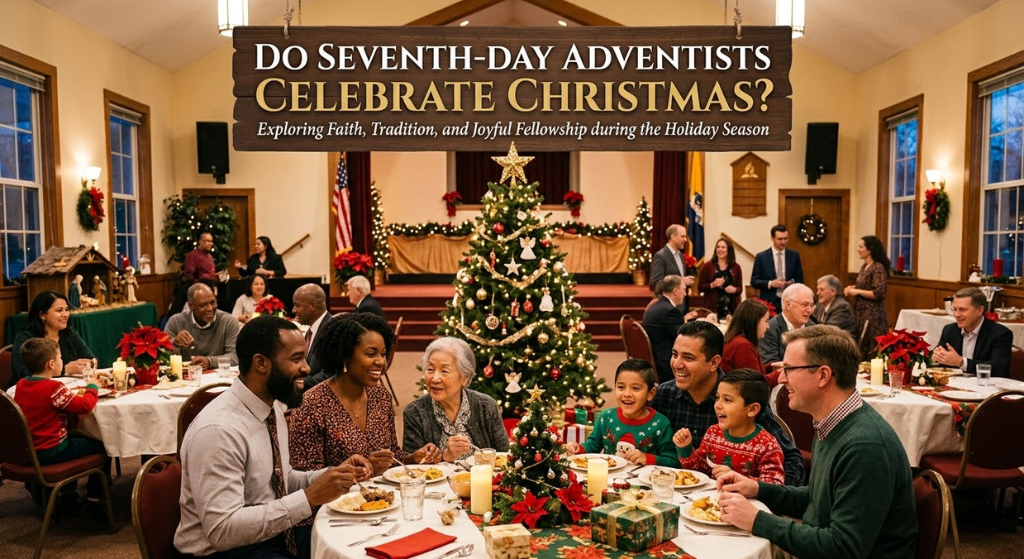
Do Seventh-day Adventists Celebrate Christmas? The Honest Answer You Were Not Expecting
Every December, the same question circulates in workplaces, families, and online forums: do Seventh-day Adventists celebrate Christmas? It seems like a simple yes or no question. It is not. The answer sits in genuinely contested territory — shaped by a denomination that has never issued a binding official ruling on the holiday, a founding prophetess who expressed strong reservations about it, and a global membership of 22 million people who navigate the question in dramatically different ways depending on their culture, generation, and personal convictions.
The short answer is: most Seventh-day Adventists do celebrate Christmas in some form — but the denomination has a long and unresolved internal debate about whether they should, and a significant minority of members do not observe it at all. The debate is not frivolous. It draws on serious theological arguments about the origins of Christmas, the authority of Ellen White’s writings, the nature of Sabbath-keeping, and what it means to be a community called to be “different” from the surrounding world.
In this article we cover everything: what the Seventh-day Adventist Church officially says about Christmas, what Ellen White actually wrote, why some Adventists refuse to celebrate it, how Christmas practices vary across cultures and generations within the global church, what an Adventist Christmas looks like in practice, and how this compares to other communities navigating similar questions — such as the Amish, who celebrate Christmas but in a radically stripped-down form, and Muslims debating whether to participate in Thanksgiving.
In This Article
- Who Are Seventh-day Adventists? Understanding the Denomination First
- What the Adventist Church Officially Says About Christmas
- Christmas Dates and the Adventist Calendar 2025–2030
- What Ellen White Actually Said About Christmas
- The Pagan Origins Argument: Why Some Adventists Reject Christmas
- The Sabbath Question: When Christmas Falls on Saturday
- The Spectrum of Positions Within the Adventist Church
- What an Adventist Christmas Actually Looks Like
- Do Adventists Have Christmas Trees?
- Christmas Gifts, Charity, and the Adventist Approach to Giving
- Adventist Christmas vs. Mainstream American Christmas
- How Christmas Varies Across Global Adventist Communities
- Adventist Children and Christmas: What Parents Teach
- Do Adventists Believe in Santa Claus?
- New Year and the Adventist Holiday Season
- Comparing Adventists to Other Communities on Holiday Questions
- Talking to Adventist Children About Christmas
- FAQ: Adventists and Christmas
- The Bottom Line
Who Are Seventh-day Adventists? Understanding the Denomination First
Before exploring the Christmas question, it helps to understand who Seventh-day Adventists are — because several of their distinctive beliefs bear directly on how they approach December 25.
The Seventh-day Adventist Church emerged from the Millerite movement of the 1840s in North America. After the “Great Disappointment” of 1844 — when the anticipated return of Christ did not occur as predicted — a group of Millerites reorganised around a set of distinctive beliefs: the imminent Second Coming of Christ (Adventism), the observance of the seventh-day Sabbath (Saturday, not Sunday), the prophetic gift of Ellen G. White, the “state of the dead” (the belief that the dead are unconscious until resurrection), and a holistic approach to health that shapes Adventist diet, lifestyle, and medical practice.
The denomination was formally organised in 1863 and has grown from a small American sect into a global denomination of approximately 22 million baptised members, with the majority of its membership now in Africa, Latin America, and Asia. It operates one of the largest Protestant networks of hospitals, schools, and universities in the world.
A Protestant Christian denomination founded in 1863, distinguished by Saturday Sabbath observance, the prophetic authority of co-founder Ellen G. White, belief in the imminent Second Coming of Christ, dietary guidelines (many members are vegetarian), and a strong emphasis on health, education, and global mission. With approximately 22 million baptised members and over 90,000 congregations worldwide, it is one of the fastest-growing Protestant denominations. Its headquarters are in Silver Spring, Maryland, USA. The church has never issued a binding denominational ruling on whether members should celebrate Christmas.
Several of these distinctive beliefs create friction with Christmas as typically observed in mainstream American culture. The emphasis on separation from worldly culture, the historical suspicion of “Sunday worship” practices (which shapes how some Adventists view all inherited Christian calendar observances), Ellen White’s specific comments about Christmas excess, and the broader Adventist identity as a community called to be “peculiar” — distinct from surrounding culture — all feed into the Christmas debate in ways we will explore throughout this article.
What the Adventist Church Officially Says About Christmas
Here is the most important fact for framing everything that follows: the Seventh-day Adventist Church has no official binding position on whether members should celebrate Christmas. This is not an evasion — it is the genuine institutional reality. The General Conference (the church’s governing body) has never issued a statement declaring Christmas either required or prohibited for Adventist members.
This official silence is itself significant. It reflects the denomination’s historical ambivalence about the holiday — an ambivalence rooted in Ellen White’s writings, which we cover below — and its commitment to leaving certain matters of personal conscience to individual members rather than mandating uniformity across a global, culturally diverse community.
What the church has done is produce a range of materials — through the Review and Herald (the official Adventist publishing house), the Adventist Review (the denomination’s flagship magazine), and various pastoral resources — that approach Christmas with qualified acceptance: acknowledging it as an opportunity for evangelism and family celebration while consistently warning against its commercial excesses.
The Seventh-day Adventist Church does not require members to celebrate Christmas, nor does it prohibit them from doing so. It is a matter of personal and family conscience. The church’s pastoral guidance consistently emphasises keeping Christmas Christ-centred and simple, avoiding commercial excess, and using the season as an opportunity for evangelism and giving. Individual Adventist congregations vary widely in how much they incorporate Christmas into their worship calendar.
Christmas Dates and the Adventist Calendar 2025–2030
Christmas falls on December 25 every year — but for Seventh-day Adventists, the day of the week on which December 25 falls matters in a way it does not for most other Christians. When Christmas Day falls on a Saturday — the Adventist Sabbath — it creates a specific tension that we address in detail in the Sabbath section below.
| Year | Christmas Day | Day of Week | Sabbath Conflict? |
|---|---|---|---|
| 2025 | December 25, 2025 | Thursday | No |
| 2026 | December 25, 2026 | Friday | Sabbath begins at sunset |
| 2027 | December 25, 2027 | Saturday | Yes — full Sabbath conflict |
| 2028 | December 25, 2028 | Monday | No |
| 2029 | December 25, 2029 | Tuesday | No |
| 2030 | December 25, 2030 | Wednesday | No |
Christmas 2027 falls on a Saturday — a full Sabbath conflict that will generate significant discussion within Adventist communities, as it does every time this occurs. Christmas 2026 falls on a Friday, meaning Adventist families who observe Sabbath from Friday sunset will need to navigate the transition from Christmas Day activities into Sabbath rest. These calendar realities shape Adventist Christmas practice in ways that non-Adventists rarely anticipate.
What Ellen White Actually Said About Christmas
Ellen G. White (1827–1915) is one of the most prolific religious writers in American history and is considered by Seventh-day Adventists to have held the “spirit of prophecy” — a prophetic gift that gives her writings a level of authority second only to scripture within the denomination. Her comments on Christmas are therefore not merely historical curiosities — they carry significant weight for practising Adventists and are central to every internal debate about the holiday.
What is often missed in popular summaries of Ellen White on Christmas is that her position was nuanced and context-specific — neither a blanket prohibition nor an unreserved endorsement. Here is what she actually wrote:
Ellen White on Christmas — Key Statements
On the pagan origins concern: White acknowledged that December 25 has no biblical basis as the birth date of Jesus and that the holiday has pagan historical roots. However, she did not conclude from this that Adventists must avoid it entirely.
On celebration: In Adventist Home (p. 477), she wrote: “As the twenty-fifth of December is observed to commemorate the birth of Christ, as the children have been instructed by precept and example that this was indeed a day of joy and rejoicing, you will have to be wise and consider the influence which one course or another will have upon them.”
On giving: White strongly endorsed using Christmas as an occasion for charitable giving — specifically giving to God’s work rather than exchanging expensive gifts. She wrote that money spent on lavish Christmas gifts should instead be given to support Adventist mission and education.
On excess: Her strongest language was reserved for commercial excess and worldly celebration. She wrote extensively against expensive gifts, extravagant feasting, and the ways in which Christmas had become a commercially driven occasion disconnected from its supposed religious meaning.
On evangelism: White saw Christmas as a valuable opportunity for Adventists to reach non-believers — a moment when the general culture’s attention was turned toward religious themes, making it easier to share the Adventist message.
The key takeaway from White’s actual writings is this: she did not prohibit Christmas. She redirected it — away from expensive gifts and worldly excess, toward charitable giving, evangelism, and simple family celebration focused on Christ. Her position is closer to the Adventist mainstream of today than either the “never celebrate Christmas” camp or the “celebrate it fully like everyone else” camp.
However, some Adventists read her acknowledgement of pagan origins and her warnings about worldly celebration as implying that the holiday should be avoided altogether. This interpretation, while a minority position, draws genuine support from her writings and cannot be dismissed as simply misreading her.
The Pagan Origins Argument: Why Some Adventists Reject Christmas
The most common theological argument among Adventists who do not celebrate Christmas is the pagan origins argument — the claim that December 25 and many Christmas traditions derive from pre-Christian winter festivals, and that Christians adopting these practices are engaging in syncretism that the Bible forbids.
The argument typically runs as follows: December 25 was not the birth date of Jesus (most scholars agree the date is unknown and was chosen by the early church to coincide with existing winter festivals). The Christmas tree, the exchange of gifts, the Yule log, and various other Christmas traditions have roots in pre-Christian Roman (Saturnalia), Germanic, or Norse celebrations. The Bible commands God’s people not to worship Him in the ways that pagans worship their gods (Deuteronomy 12:30–31). Therefore, Christians — and especially Adventists, called to a higher standard of biblical faithfulness — should not observe Christmas.
This argument is taken seriously by a meaningful minority of Adventist members and pastors. It connects to the broader Adventist identity as a movement that emerged partly as a critique of mainstream Protestant Christianity’s departure from biblical practice — particularly around Sunday worship, which Adventists argue replaced the biblically commanded Saturday Sabbath under the influence of Roman tradition. The Christmas argument follows the same logic: if the church got the Sabbath wrong by adopting a human tradition over biblical command, it may have got Christmas wrong too.
However, the majority of Adventist scholars and pastoral leaders push back on this argument, for several reasons. The historical evidence for Christmas deriving directly from Saturnalia or other pagan festivals is more complicated and contested than popular summaries suggest. More importantly, the theological argument from Deuteronomy 12 addresses worshipping other gods using their methods — not adopting cultural practices that have been thoroughly Christianised over centuries. And the practical reality is that for most contemporary observers, Christmas has no pagan religious meaning whatsoever — it is a Christian (or secular) holiday, regardless of its distant historical origins.
The pagan origins argument is taken seriously within Adventist circles but is not the majority position. Most Adventist scholars and leaders acknowledge Christmas’s complex historical origins while arguing that the holiday’s meaning is determined by how it is observed today, not by what happened in ancient Rome. The argument has more force within the Adventist community than in mainstream Christianity, because Adventists are already accustomed to critiquing inherited Christian traditions (like Sunday worship) that they believe departed from biblical practice.
The Sabbath Question: When Christmas Falls on Saturday
One of the most distinctively Adventist dimensions of the Christmas debate involves the Sabbath — the Saturday observance that is the denomination’s most defining practice. When Christmas falls on a Saturday (as it does in 2027), the tension between Christmas celebration and Sabbath observance becomes explicit and unavoidable.
For Adventists who observe Sabbath strictly — from Friday sunset to Saturday sunset — Christmas Day in 2027 will be entirely within the Sabbath period. This raises practical questions that most Christians never have to consider: Can you open Christmas presents during Sabbath hours? Can you prepare a special Christmas meal on the Sabbath? Can you travel to visit family? Can you play Christmas music?
Different Adventist families resolve this differently:
- Some celebrate Christmas on December 24 (before Sabbath begins at sunset) or on December 26 (after Sabbath ends at sunset), effectively moving their family Christmas to accommodate the Sabbath rather than compromising either.
- Some observe a Sabbath-shaped Christmas — treating December 25 as a Sabbath day with worship, rest, and family time, but postponing gift-opening, special meals, and festivities to after sunset Saturday.
- Some argue that the spirit of Christmas — family, worship, giving thanks — is entirely consistent with Sabbath observance, and that the conflict is only with the commercial dimensions of Christmas that Adventists should be avoiding anyway.
- Some use the Sabbath conflict as an argument for not celebrating Christmas at all — noting that a holiday whose celebration conflicts with the biblical Sabbath is precisely the kind of human tradition the Bible warns against.
The Sabbath question is uniquely Adventist — no other major Christian denomination faces it in this form. It is one of the clearest examples of how Adventist distinctives shape their relationship to holidays in ways that have no parallel in mainstream Christian practice.
The Spectrum of Positions Within the Adventist Church
The Range of Adventist Positions on Christmas
What an Adventist Christmas Actually Looks Like
For the majority of Adventists who do observe Christmas, the celebration typically has several distinctive features that set it apart from mainstream American Christmas culture — even when it includes familiar elements like trees and gifts.
The Church Programme
Many Adventist churches hold a Christmas programme in the weeks leading up to December 25 — typically a Saturday evening or Sunday event featuring children’s presentations, choir cantatas, dramatic readings of the nativity narrative, and special music. These programmes serve both a congregational and evangelistic function: they bring the community together and provide a natural point of contact for inviting non-Adventist friends and neighbours to church.
On Christmas Day itself — which falls on different days of the week each year — Adventist practice varies. If Christmas Day is a Sabbath (Saturday), the regular Sabbath service incorporates Christmas themes. If it falls on another day, some congregations hold a special Christmas service while others do not, treating December 25 as a family day rather than a church day.
The Family Gathering
For Adventist families who celebrate, Christmas Day typically centres on a family meal and, for families with children, the opening of modest gifts. The meal is often vegetarian or vegan — reflecting the Adventist health message that emphasises plant-based eating — though this is not universal. Many Adventist Christmas tables feature dishes that would surprise mainstream American guests: lentil roasts, nut loaves, and vegetable-based mains alongside traditional sides.
The Giving Emphasis
One of the most consistently Adventist features of Christmas celebration is the emphasis on charitable giving. Following Ellen White’s counsel, many Adventist families make Christmas an occasion for contributions to Adventist Missions, ADRA (the Adventist Development and Relief Agency), local community service, or other charitable causes. Some families explicitly limit commercial gift-giving and redirect that money to charity. This giving-centred approach to Christmas is one of the most distinctive and admirable features of how many Adventists navigate the holiday.
The Absence of Certain Elements
Even among Adventists who celebrate Christmas, certain mainstream Christmas elements are commonly absent or modified. Santa Claus is rarely a significant figure in Adventist Christmas celebrations (more on this below). Alcohol is absent entirely — the Adventist health message prohibits it. Excessive commercial spending is actively discouraged. And in more conservative Adventist homes, Christmas carols with non-religious themes, Christmas films, and other secular Christmas culture may be minimised or absent.
Do Adventists Have Christmas Trees?
The Christmas tree question within Adventism is genuinely divided, and the answer depends significantly on which Adventist family you are asking.
Many Adventists do have Christmas trees — particularly in Western cultural contexts where the tree is a standard family tradition. Ellen White herself is recorded as having a Christmas tree at her home on at least one occasion, which is frequently cited by Adventists who use a tree as evidence that the practice is not prohibited by the tradition’s founding prophetess.
Some Adventists do not have Christmas trees, citing the pagan origins argument (the Christmas tree’s association with pre-Christian winter festivals), the general principle of simplicity, or the conviction that the tree is primarily a commercial and worldly symbol rather than a genuinely Christian one.
Some Adventists have a tree but modify its use — using it as a giving tree, where gifts for local charities or mission projects replace or supplement personal gifts, or decorating it with explicitly Christian symbols rather than generic secular ornaments.
The honest answer is that the Christmas tree question within Adventism has no single correct answer — it is resolved differently by different families, congregations, and cultural communities within the global church. What is consistent is the broader Adventist value of simplicity: an elaborate, heavily decorated tree surrounded by piles of expensive gifts is not what any strand of Adventist Christmas culture encourages.
Christmas Gifts, Charity, and the Adventist Approach to Giving
Ellen White’s most practical and enduring contribution to Adventist Christmas culture is her teaching on giving — specifically, her argument that the money typically spent on elaborate Christmas gifts should be redirected toward God’s work and the needs of others.
This giving-centred approach to Christmas has shaped Adventist practice in distinctive ways. Many Adventist families operate with explicit gift-giving limits at Christmas — a modest budget per person, or a focus on practical and meaningful gifts rather than expensive luxury items. Some families have replaced commercial gift-giving almost entirely with charitable giving, making donations in family members’ names to organisations they care about.
The Adventist Development and Relief Agency (ADRA) runs annual Christmas giving campaigns that many Adventist families participate in — giving to development projects, disaster relief, or local community services as their primary Christmas “gift.” This practice directly enacts Ellen White’s counsel and is one of the most genuinely counter-cultural things about Adventist Christmas culture.
The Adventist Gift-Giving Dilemma: A Common Family Scenario
An Adventist family with three children faces the annual December tension: mainstream American Christmas culture — shaped by advertising, school friends, and extended non-Adventist family — creates expectations of significant gift-giving. The parents want to observe Christmas in an Adventist spirit — simple, Christ-centred, giving-focused — but their children are surrounded by peers who receive expensive gifts. How do they navigate this?
Most Adventist pastoral guidance suggests: set a modest per-child gift budget, ensure at least one family gift goes to charity or mission, use the gift-giving conversation as an opportunity to teach children about generosity and the meaning of Christmas, and involve children in choosing a charitable gift as part of the family Christmas observance. The goal is not deprivation but reorientation — from receiving to giving, from spending to serving.
Adventist Christmas vs. Mainstream American Christmas
Adventist Christmas vs. Mainstream American Christmas
How Christmas Varies Across Global Adventist Communities
With 22 million members across more than 200 countries, the Seventh-day Adventist Church is genuinely global — and Christmas practice varies significantly across its cultural communities.
North America and Western Europe
In North America and Western Europe, most Adventists participate in Christmas in some form, shaped by the dominant cultural context. Christmas trees, family gatherings, modest gifts, and church programmes are common. The internal debate about Christmas exists but does not prevent most members from observing the holiday. The tension between Ellen White’s counsel and mainstream Christmas culture produces a range of approaches, from fully secular-style celebration to deliberately simple, Christ-centred observance.
Africa
African Adventist communities show considerable variation. In some African cultural contexts, Christmas is deeply associated with community gathering, special foods, and church celebration — and Adventists participate enthusiastically. In other contexts, more conservative theological positions prevail, and a higher proportion of members do not observe Christmas as a personal or family holiday, even if they attend church Christmas programmes. The question of cultural Christmas traditions versus Adventist distinctiveness is negotiated differently across the continent’s diverse communities.
Latin America
In Latin American countries, Christmas is deeply embedded in Catholic cultural tradition — and Adventist communities, which often grew by converting from Catholicism, navigate a complex relationship with this heritage. Many Latin American Adventists participate in Christmas gatherings with extended family while being selective about which elements they adopt. The family-centred, communal dimension of Latin American Christmas culture (which is less commercially oriented than North American Christmas) fits more comfortably with Adventist values than the gift-centred North American version.
Asia
In Asian countries where Christianity is a minority religion — including much of East Asia and South Asia — Christmas carries different cultural weight. Adventist communities in these contexts may observe Christmas as a distinctively Christian identity marker — a way of marking their difference from the surrounding non-Christian majority — while keeping the celebration simple and focused on worship and community.
Adventist Children and Christmas: What Parents Teach
For Adventist parents, Christmas presents a challenge that is both practical and theological: how do you raise children in a community that is genuinely divided about whether to observe the holiday, in a broader culture where Christmas is inescapable from October onward?
The Advertising Problem
Unlike the Amish, who can largely shield their children from commercial Christmas culture through community separation, Adventist children attend public or Adventist schools, watch television, use the internet, and participate in the wider world. The commercial Christmas machine reaches Adventist children just as it reaches everyone else. Adventist parents who want to shape their children’s Christmas experience have to do so against the current of the surrounding culture rather than in the shelter of a separate community.
What Most Adventist Parents Teach
Most Adventist parents who celebrate Christmas teach their children a version of what Ellen White counselled: Christmas is an occasion to celebrate Christ’s birth, to give to those in need, to gather with family, and to share faith with those who don’t share it. The commercial dimension — the endless gift lists, the Santa mythology, the pressure to spend — is actively resisted and explained. Children are taught the nativity story as the meaning of the season and are often involved in charitable giving as part of the family Christmas practice.
Adventist Children in Non-Adventist Contexts
Adventist children regularly encounter Christmas celebrations — at school, with non-Adventist friends and family, in the wider culture — that look very different from what their families teach. Preparing children with a clear, confident understanding of why their family’s Christmas looks the way it does — and equipping them to explain it warmly and without judgment to peers — is one of the most practically important things Adventist parents can do.
Do Adventists Believe in Santa Claus?
Santa Claus is not a significant figure in mainstream Adventist Christmas culture, and a large proportion of Adventist parents choose not to teach the Santa mythology to their children. The reasons are several:
- The truth principle: The Adventist health message and broader ethical culture place a high value on honesty and plain speech. Teaching children to believe in Santa — knowing they will eventually discover the deception — sits uncomfortably with this value for many Adventist parents.
- The displacement concern: Santa Claus, in Adventist eyes, displaces Christ from the centre of Christmas. A holiday that is supposed to commemorate the birth of Jesus becomes organised around a commercial mythology that has nothing to do with Christian faith.
- Ellen White’s counsel: While White did not specifically address Santa Claus (the modern Santa mythology was still developing in her lifetime), her warnings about Christmas excess and the displacement of Christ from Christmas are widely applied to the Santa phenomenon.
- The commercial connection: Santa is primarily a commercial figure — his modern form was substantially shaped by 20th-century advertising. For Adventists committed to resisting commercial Christmas culture, this is an additional reason for caution.
This does not mean Adventist children never encounter Santa — they do, inevitably, in the wider culture. But many Adventist families treat Santa as a cultural figure their children know about rather than a family mythology they actively maintain. The honest conversation — “this is something many families enjoy, but in our family we focus on Jesus’s birthday” — is more common in Adventist homes than in most other Christian traditions.
New Year and the Adventist Holiday Season
New Year’s Eve (December 31) is another holiday that generates discussion within Adventist communities — and the approach taken to it is revealing of broader Adventist values around celebration and worldliness.
Many Adventist churches hold Watch Night services on December 31 — a tradition of gathering for worship and prayer as the year ends and the new year begins. These services, common in many Protestant churches, replace or supplement secular New Year’s Eve celebrations and reflect the Adventist commitment to framing time transitions in spiritual rather than purely social terms.
New Year’s Eve party culture — the alcohol, the late nights, the secular festivity — is generally inconsistent with Adventist values, and many Adventists do not participate in it. Watch Night services, family gatherings, and quiet reflection are more common Adventist ways of marking the transition to a new year.
New Year’s Day itself is not a significant religious occasion for Adventists, though some churches hold special services. The first Sabbath of the new year is often treated with particular spiritual significance — a natural moment for renewed commitment and dedication.
Comparing Adventists to Other Communities on Holiday Questions
The Seventh-day Adventist Christmas debate does not exist in isolation — it is part of a much wider pattern of religious communities wrestling with how to relate to dominant cultural holidays. Comparing the Adventist situation to other communities illuminates what is distinctive about it.
The Amish approach to Christmas offers an interesting contrast: the Amish do celebrate Christmas but have largely insulated themselves from commercial Christmas culture through community separation and the Ordnung. They have resolved the tension between Christian observance and commercial excess by removing themselves from the commercial world almost entirely. Adventists, who are deeply embedded in mainstream society through their hospitals, schools, and media presence, cannot and do not seek the same kind of separation — which makes the Christmas tension more ongoing and less resolved.
The Muslim debate about Thanksgiving has structural similarities to the Adventist Christmas debate: a community with distinctive theological commitments wrestling with a dominant cultural holiday, drawing on religious authority figures (scholars in the Muslim case, Ellen White in the Adventist case) whose guidance is interpreted differently by different members, and arriving at a range of positions rather than a single community answer. In both cases, the majority participates in some form, a significant minority does not, and the internal debate continues.
What is unique about the Adventist situation is the Sabbath dimension — a layer of complexity that neither the Amish nor Muslim communities face in exactly this form when it comes to Christmas specifically.
Talking to Adventist Children About Christmas
Be Clear About What Your Family Believes and Why
Whether your Adventist family celebrates Christmas or not, children deserve a clear and confident explanation of your family’s position. “We celebrate Christmas as Jesus’s birthday — we focus on giving to others and spending time with family” is a clear positive framing. “We don’t celebrate Christmas because the Bible doesn’t command it and we prefer to focus on the Sabbath and the Second Coming” is equally clear and can be communicated with warmth rather than judgment.
Teach the Giving Principle Actively
If your family does celebrate Christmas, involve children actively in the charitable giving dimension — let them choose a cause to support, participate in the giving decision, and understand why giving is more important than receiving. This is one of the most practically valuable things Adventist Christmas culture offers children.
Address Commercial Culture Honestly
Adventist children are not insulated from commercial Christmas culture. Addressing it honestly — explaining what advertising is designed to do, why your family makes different choices, and what the Adventist understanding of Christmas means — is more effective than simply refusing to engage with the culture children are surrounded by.
Use the Season for Spiritual Depth
The Christmas season, however you approach it as an Adventist family, is an opportunity for genuine spiritual conversation: about the incarnation, about God becoming human, about what Jesus’s birth means for the Adventist understanding of salvation and the Second Coming. Children who grow up with a theologically rich understanding of the nativity are better equipped for both faith and the questions the world will ask them.
FAQ: Seventh-day Adventists and Christmas
Most Seventh-day Adventists celebrate Christmas in some form, but a significant minority do not, and the denomination has no binding official position either way. The majority of Adventists in North America, Europe, and Latin America observe Christmas with family gatherings, church programmes, modest gifts, and charitable giving. A meaningful minority — more common in certain cultural contexts and among more conservative members — do not observe the holiday, citing pagan origins, the lack of biblical mandate, and Ellen White’s concerns about worldly excess.
The Seventh-day Adventist Church has no binding official position on Christmas. The General Conference has never issued a statement requiring or prohibiting its observance. Official church publications consistently encourage members who celebrate Christmas to keep it Christ-centred and simple, avoid commercial excess, and use the season for charitable giving and evangelism. Individual observance is treated as a matter of personal and family conscience.
Ellen White did not prohibit Christmas. She acknowledged its pagan historical origins and the lack of biblical basis for December 25 as Jesus’s birth date, but she redirected the holiday rather than rejecting it. Her main counsel was to avoid expensive gifts and commercial excess, to give money to mission and charity instead, and to use Christmas as an opportunity for family celebration focused on Christ and for evangelistic outreach. She is recorded as having had a Christmas tree in her home on at least one occasion.
Adventists who do not celebrate Christmas typically cite the following reasons: the holiday has no biblical mandate and Jesus’s birth date is unknown; December 25 and many Christmas traditions have roots in pre-Christian winter festivals; Ellen White’s warnings about worldly celebration imply the holiday should be avoided; the commercial Christmas culture is inconsistent with Adventist values of simplicity; and when Christmas falls on the Sabbath, celebrating it creates a conflict with a biblically commanded observance. These are legitimate theological positions within Adventist tradition.
Many Adventists do have Christmas trees; others do not. Ellen White herself reportedly had a Christmas tree on at least one occasion. Those who have trees are often influenced by the broader cultural tradition and Ellen White’s implicit acceptance. Those who do not typically cite the pagan origins of the Christmas tree tradition, the principle of simplicity, or the conviction that the tree is primarily a commercial symbol. There is no church-wide rule either way.
Santa Claus is generally absent from or minimised in Adventist Christmas culture. Many Adventist parents choose not to teach the Santa mythology to their children, citing the value of honesty, the concern that Santa displaces Christ from the centre of Christmas, and the figure’s strong association with commercial Christmas culture. Adventist children encounter Santa in the wider world but many Adventist families treat him as a cultural figure they know about rather than a family mythology they actively maintain.
When Christmas Day falls on a Saturday — as it does in 2027 — Adventist families who observe Sabbath from Friday sunset to Saturday sunset face a direct conflict. Different families resolve this differently: some move their Christmas celebration to December 24 or 26 to avoid the conflict; some observe a Sabbath-shaped Christmas focused on worship and rest; and some argue that the conflict itself demonstrates why human-made holidays should not be elevated above biblically commanded observances like the Sabbath. Christmas 2027 will generate significant discussion within Adventist communities.
Ellen White’s counsel to redirect Christmas gift money toward charitable giving and mission has had a lasting influence on Adventist gift-giving culture. Many Adventist families operate with modest gift budgets and include charitable donations — to ADRA, Adventist Missions, or local community service — as part of their Christmas observance. Some families have moved away from commercial gift-giving almost entirely, focusing their Christmas generosity on others rather than on each other. This giving-centred approach is one of the most distinctively Adventist features of Christmas practice.
Many Adventist churches hold Christmas programmes — typically in the weeks before December 25, often on a Saturday evening or Sunday — featuring special music, children’s presentations, nativity readings, and evangelistic outreach. Whether a church holds a service on Christmas Day itself depends on what day of the week December 25 falls. If it falls on the Sabbath, Christmas themes are incorporated into the regular Sabbath service. If it falls on another day, some congregations hold special services while others treat it as a family day.
Key differences: no alcohol (ever); often vegetarian or vegan food; Santa Claus generally absent or minimised; strong emphasis on charitable giving over commercial gift-giving; genuine internal debate about whether the holiday should be observed at all; and the Sabbath dimension, which shapes how Christmas is celebrated when it falls on or near Saturday. The commercial dimensions of Christmas that dominate mainstream American culture are actively resisted in Adventist tradition across the spectrum of members who do observe the holiday.
Christmas 2025 falls on Thursday, December 25, 2025 — a weekday, with no Sabbath conflict. Christmas 2026 falls on Friday, December 25, meaning Adventist families will transition from Christmas Day into the Sabbath at sunset. Christmas 2027 falls on Saturday, creating a full Sabbath conflict. See the date table earlier in this article for details through 2030.
Growing — substantially. The Seventh-day Adventist Church has approximately 22 million baptised members as of 2025, with the majority of its membership in Africa, Latin America, and Asia. It is one of the fastest-growing Protestant denominations globally, driven by strong mission activity, a distinctive health and lifestyle message, and high birth rates in communities where Adventism is culturally established. The growth of the global church means that Adventist Christmas practice is increasingly shaped by non-Western cultural contexts where the holiday carries different meaning than in North America.
The Bottom Line
So, do Seventh-day Adventists celebrate Christmas? Most do — but not without ongoing internal debate, not without significant variation across the global church, and not in ways that look exactly like mainstream American Christmas. The Adventist Christmas is shaped by Ellen White’s counsel toward simplicity and giving, by the denomination’s historical suspicion of unbiblical traditions, by the Sabbath question that arises every time December 25 falls on a Saturday, and by a genuine minority conviction that the holiday should not be observed at all.
What makes the Adventist Christmas situation genuinely interesting — and worth understanding beyond the simple yes-or-no question — is that it represents a live theological negotiation in real time. Unlike the Amish, who have largely settled the question through community consensus and the Ordnung, Adventists are a denomination embedded in mainstream society that has never officially resolved its Christmas question. The debate continues every December, in congregations and families and online forums, between members who celebrate fully and members who do not celebrate at all, with the majority somewhere in the middle trying to honour both their faith and the season.
The giving-centred approach that Ellen White modelled and encouraged is, arguably, the most genuinely counter-cultural thing about Adventist Christmas practice — and the thing most worth borrowing regardless of your own tradition. A Christmas defined primarily by charitable giving rather than commercial receiving is a meaningful alternative to the dominant culture’s version of the holiday, and it is one that the Adventist tradition has been practising and preaching for over a century.
Questions about how religious communities navigate holidays that sit outside their core theological calendar — or that conflict with their distinctive practices — are ones we explore throughout this series. The Muslim approach to Easter involves a holiday whose theological claims directly contradict Islamic doctrine. The Thanksgiving debate in Muslim communities involves a secular holiday with no theological content Islam disputes. The Amish approach to Christmas shows a community that observes the holiday but has stripped away everything commercial and worldly. The Adventist Christmas sits in its own category: a Christian denomination celebrating a Christian holiday while remaining genuinely divided about whether it should, and producing, in its best expressions, a celebration that is quieter, more generous, and more Christ-centred than the surrounding culture’s version of the same day.
This article is for informational and educational purposes only. Seventh-day Adventist beliefs and practices vary across congregations, cultures, and individual families. Information presented here reflects the range of positions within the denomination as documented in official publications, scholarly studies of Adventism, and publicly available pastoral resources. For guidance specific to your congregation or community, consult your local Adventist pastor.