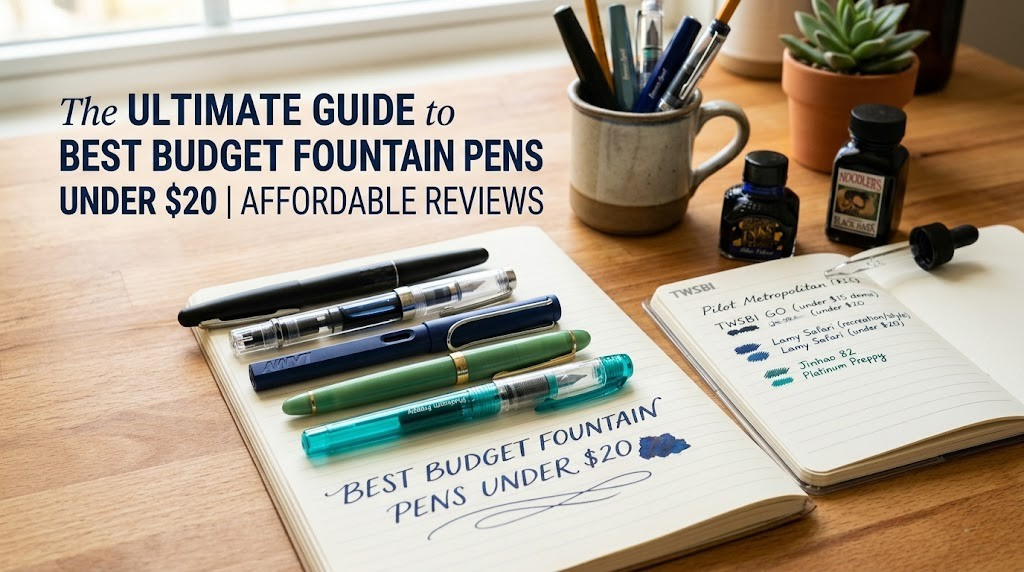
The Best Budget Fountain Pens Under $20
There’s a unique magic to writing with a fountain pen. It’s the smooth, effortless glide of a nib across paper, the vibrant flow of ink, and the feeling of connecting with your words in a more intentional way. For too long, this experience has been perceived as expensive and inaccessible. That myth ends today.
This guide is designed for the curious beginner. We’ll explore the absolute best workhorse pens under $20 that are perfect for students, journalers, artists, and anyone ready to elevate their daily writing. Beyond the pen reviews, we’ve also packed this guide with everything else you need to get started: understanding inks, choosing the right paper, cleaning and maintenance tips, and answers to the most common beginner questions.
📖 What’s Inside This Guide
- Fountain Pen 101: What to Know Before You Buy
- A Complete Guide to Nib Sizes & Types
- Fountain Pens by Budget
- Our Top 3 Fountain Pen Picks Under $20
- Full Head-to-Head Comparison
- The Beginner’s Guide to Fountain Pen Inks
- Choosing the Right Paper for Fountain Pens
- How to Set Up and Start Using Your Pen
- Writing Technique: How to Hold a Fountain Pen
- How to Clean and Maintain Your Fountain Pen
- Common Problems & How to Fix Them
- What Is an Eyedropper Pen & How to Convert One
- Taking the Hobby Further: What Comes After $20
- Frequently Asked Questions
Fountain Pen 101: What to Know Before You Buy
A little knowledge goes a long way. Before you pick your first pen, it helps to understand the core components and terminology that define the fountain pen world. Unlike ballpoints or rollerballs, fountain pens are precision instruments with several working parts — and understanding them will make you a more informed buyer and a more satisfied writer.
How a Fountain Pen Works
At its heart, a fountain pen is a surprisingly elegant device. Ink flows from a reservoir inside the barrel, through an ink feed (a grooved piece of hard rubber or plastic that controls the flow), and out through the nib onto paper. The process is driven by two forces: gravity (pulling the ink down) and capillary action (the natural tendency of liquid to flow into narrow spaces). You add almost no pressure — the pen essentially writes itself, which is what makes the experience so distinctly smooth and relaxing compared to other writing instruments.
The Main Components
- Nib: The metal tip that touches the paper. It determines the character of the writing experience more than any other part.
- Feed: The grooved channel beneath the nib that regulates ink flow. A well-designed feed is the key to a consistent writing experience.
- Grip Section: The part you hold. Can be plastic, metal, rubber, or resin. Its diameter and texture significantly affect comfort during long writing sessions.
- Barrel: The body of the pen that houses the ink reservoir. Can be metal, resin, plastic, or wood.
- Cap: Protects the nib when not in use and prevents the nib from drying out. The quality of the cap seal is crucial — a poor seal leads to a dried-out nib.
- Filling System: The mechanism by which ink gets into the pen — either via cartridges, a converter, or a built-in piston/vacuum filler.
The Nib: Where the Magic Happens
The nib is the metal tip of the pen. The most important factor is its size. At the budget end, most nibs are made from stainless steel, which is perfectly reliable and can last for decades with proper care. Gold nibs (found in more expensive pens) offer more flex and adapt to your writing style over time — a concept called “nib tuning” — but for beginners, a well-made steel nib is all you need.
Filling Systems: Cartridge vs. Converter
- Cartridges: Small, pre-filled plastic tubes of ink. They’re incredibly convenient and easy to use — just pop one in and write. Most budget pens come with one or two cartridges included. The downside is cost per mL of ink; cartridges are significantly more expensive than bottled ink over time, and your color choices are limited to what the manufacturer produces.
- Converters: A small, refillable piston or squeeze mechanism that fits where a cartridge would go. It allows you to draw ink directly from a bottle, which is far more economical and opens up a world of thousands of ink colors from dozens of manufacturers. Most serious enthusiasts quickly move to converters. The Pilot Metropolitan helpfully includes one right in the box.
- Eyedropper: Some pens (like the Platinum Preppy) can be converted to use the barrel itself as the ink reservoir, filled directly with a dropper. This gives the highest ink capacity of any method, but requires some care to avoid leaks.
- Piston Fillers: Common in higher-end pens like the TWSBI Eco. A built-in piston mechanism screws up to draw ink directly from a bottle — no separate converter needed. Very convenient and high-capacity.
A Complete Guide to Nib Sizes & Types
Choosing the right nib is the single most important decision you’ll make when buying a fountain pen. The nib determines the width of your line, the wetness of the ink flow, and the overall character of your writing experience. Here’s a complete breakdown of every nib size and type you’re likely to encounter.
Standard Nib Widths
Extra Fine (EF)
The narrowest common size. Ideal for small, precise handwriting. Good for standard copy paper as less ink reduces bleeding and feathering. Japanese EF nibs can be almost hair-thin.
Fine (F)
A great everyday choice. Provides a clean, precise line that works on most paper. The most popular size among beginners. Japanese Fine nibs tend to write similarly to Western Extra Fine.
Medium (M)
The sweet spot for showing off ink properties like shading and sheen. Smoother and wetter than fine nibs. Best on fountain-pen-friendly paper. Recommended for beginners who prioritize the writing experience.
Broad (B)
A wide, wet line that is spectacular on quality paper. Not recommended for ordinary copy paper. Exceptional for showcasing shimmer and dual-tone inks. Favored by those with larger handwriting.
Stub / Italic
A speciality nib with a flat edge that produces thick downstrokes and thin cross-strokes, giving handwriting a semi-calligraphic look. Fun for journaling and creative writing. Lamy’s 1.1mm stub is a popular starting point.
Flex
A nib designed to flex under light pressure, creating dramatic line variation between thick and thin strokes. Beloved for calligraphy and artistic writing. Requires practice and is generally not recommended for true beginners.
This is one of the most important things to understand before you buy. Japanese nibs (Pilot, Platinum, Sailor) are typically ground finer than Western nibs (Lamy, Pelikan, Montblanc). As a rule of thumb: a Japanese Medium (M) writes like a Western Fine (F), and a Japanese Fine (F) writes like a Western Extra Fine (EF). So if you have small handwriting and order a Lamy Medium, you may be surprised by how broad the line is.
Specialty Nib Considerations for Beginners
As a first-time buyer, stick to a standard Fine or Medium nib. Once you’ve understood your preferences — your handwriting size, how much pressure you naturally apply, the paper you use most — you can start exploring the more exotic options. A Lamy Safari’s nib is user-swappable, which makes it an ideal “platform” pen for experimenting with different nib sizes without buying a new pen each time.
Fountain Pens by Budget: Finding Your Entry Point
The fountain pen market spans an enormous price range, from $3 plastic beginners to $1,500+ handcrafted limited editions. Here’s how to think about the different budget tiers when you’re just starting out.
Ultra-Budget
The Platinum Preppy and Pilot Varsity live here. Excellent for testing whether you enjoy fountain pens before committing more. Performance is genuinely impressive for the price.
Sweet Spot
The Pilot Metropolitan and Lamy Safari dominate this tier. Metal or premium plastic bodies, reliable nibs, converter compatibility. This is where the hobby truly begins.
Enthusiast Entry
The TWSBI Eco, Pilot Prera, and Kaweco Sport. Built-in ink capacity, exceptional build quality, and nibs that will tune themselves to your writing over time.
For this guide, we focus on the under-$20 range — the sweet spot where you can experience genuine fountain pen joy without any financial anxiety. These pens are not “starters” you’ll outgrow — the Pilot Metropolitan, in particular, remains in active daily rotation for thousands of experienced enthusiasts who also own pens costing hundreds of dollars.
Our Top Fountain Pen Picks Under $20
These pens are community-approved giants of the budget category. You cannot go wrong with any of them. Each excels in a different dimension, so the right choice depends on your specific priorities.

1. Pilot Metropolitan — Best Overall Beginner Pen
If you ask ten pen enthusiasts what the best beginner pen is, at least seven will say the Pilot Metropolitan. It’s a legend for a reason. With a brass body, it has a premium weight and feel that defies its price tag. The Japanese steel nib is famously smooth and reliable right out of the box.
| Feature | Specification |
|---|---|
| Nib Sizes | Fine, Medium, Italic |
| Filling System | Cartridge & Piston Converter (Included) |
| Body Material | Brass (Metal) |
| Weight | ~22g (uncapped) — reassuringly substantial |
| Approx. Price | ~$13 |
Crucially, it comes with a converter, giving you immediate access to the world of bottled inks from day one. Its classic, cigar-shaped design is timeless and professional enough for the office. In independent testing, the Metropolitan has consistently performed best in smoothness compared to its peers, with no snagging or feedback even on lower-quality paper. The Metropolitan isn’t just a great pen for the price; it’s a great pen, period.
One thing to know: Pilot uses a proprietary cartridge and converter system, meaning you can only use Pilot cartridges and Pilot converters. The included squeeze converter (CON-20) is functional but small. If you want more ink capacity and the ability to see your ink level, the separately sold CON-40 transparent piston converter is a worthwhile upgrade.
Pros
- Premium metal body feels expensive
- Exceptionally smooth, reliable nib
- Includes a converter
- Professional look for the office
- Available in many colors and finishes
Cons
- Proprietary cartridge/converter (Pilot only)
- Grip step can bother some writers
- CON-20 converter has small capacity

2. Platinum Preppy — Best Pen Under $7
Don’t let the price or the plastic body fool you: the Platinum Preppy is a serious writing instrument. Its nib is shockingly good, and its killer feature is the patented “Slip & Seal” cap mechanism. This airtight seal prevents the nib from drying out for months — even reportedly over a year — making it the most maintenance-free pen on this list.
| Feature | Specification |
|---|---|
| Nib Sizes | Extra Fine (02), Fine (03), Medium (05) |
| Filling System | Cartridge (Converter sold separately) |
| Body Material | Plastic (clear grip section) |
| Cap Mechanism | Platinum “Slip & Seal” — airtight |
| Approx. Price | ~$4–7 |
It’s the perfect pen to buy in multiples, ink up with different colors, and leave in your bag, car, or on your desk without worry. The clear grip section allows you to see the ink feeding to the nib — a wonderful feature for beginners who want to understand how their pen works. It can also be “eyedroppered” — filled directly with ink using the barrel as a reservoir — for an enormous ink capacity relative to its size. It’s the undisputed champion of value.
One additional surprise: the Preppy is compatible with Platinum’s carbon black waterproof cartridges — a rare find in this price range. Waterproof ink is ideal for anyone who wants their writing to survive spills or moisture.
Pros
- Incredibly low price — buy multiples
- “Slip & Seal” cap prevents drying
- Surprisingly smooth, consistent nib
- Clear grip shows ink flow
- Compatible with waterproof carbon black ink
- Easily converted to eyedropper
Cons
- Looks and feels inexpensive
- Printed barrel branding can wear off
- Converter sold separately

3. Lamy Safari — The Iconic Workhorse
The Lamy Safari is an icon of design, featured in design museums and beloved by students and professionals for decades. It’s made from the same tough ABS plastic as LEGO bricks — virtually indestructible under normal use. Its most debated feature is its triangular grip, which guides your fingers into the proper position for writing.
| Feature | Specification |
|---|---|
| Nib Sizes | Extra Fine, Fine, Medium, Broad, Stub (1.1mm) |
| Filling System | Cartridge (Converter sold separately) |
| Body Material | ABS Plastic (Lego-grade durability) |
| Nib Swappability | Yes — nibs swap without tools |
| Approx. Price | ~$20–25 |
The German-made Lamy nibs are easily swappable, so you can buy one pen and multiple nib units to experiment with different line widths at a fraction of the cost of buying multiple pens. This makes the Safari a uniquely versatile “platform” pen. Lamy nibs run slightly broader than other European brands, so consider sizing down (choosing Fine instead of Medium) if you have smaller handwriting or typically write on standard copy paper.
Pros
- Virtually indestructible ABS body
- Triangular grip great for beginners
- Nibs swap in seconds, no tools needed
- Available in a huge range of colors
- Iconic, award-winning design
Cons
- Triangular grip uncomfortable for some
- Converter must be purchased separately
- Nibs run broad — size down if unsure
- Price slightly above $20
Full Head-to-Head Comparison
Not sure which pen wins in your specific situation? This table breaks down every key consideration side by side.
| Feature | Pilot Metropolitan | Platinum Preppy | Lamy Safari |
|---|---|---|---|
| Best For | Overall best / daily driver | Value / multiple pens | Durability / experimentation |
| Body Material | Brass (metal) | Plastic | ABS Plastic |
| Nib Origin | Japanese steel | Japanese steel | German steel |
| Nib Sizes | Fine, Medium, Italic | EF, Fine, Medium | EF, F, M, B, Stub |
| Converter Included | ✓ Yes | ✗ Sold separately | ✗ Sold separately |
| International Cartridges | ✗ Pilot proprietary | ✗ Platinum proprietary | ✓ Standard international |
| Cap Seal Quality | ⚠ Good | ✓ Excellent (Slip & Seal) | ⚠ Good |
| Eyedropper Conversion | ✗ Not recommended | ✓ Excellent candidate | ⚠ Possible with care |
| Nib Swappability | ✗ No | ✗ No | ✓ Yes — a key feature |
| Weight / Feel | Substantial (brass) | Light (plastic) | Light (plastic) |
| Price Range | ~$13 | ~$4–7 | ~$20–25 |
The Beginner’s Guide to Fountain Pen Inks
One of the greatest joys of the fountain pen hobby is the ink. Unlike ballpoints and rollerballs, which are locked into the ink inside them, a fountain pen opens you up to a world of hundreds of colors, textures, and special effects from dozens of manufacturers worldwide. Here’s everything you need to know to get started.
Understanding Ink Properties
Wet vs. Dry Inks
Fountain pen inks are often described as “wet” or “dry,” referring to how freely the ink flows from the nib. Wet inks flow quickly and generously — they feel smoother to write with, tend to show off beautiful ink effects like shading, and look more vibrant on paper. However, wet inks take longer to dry and can bleed through thinner paper. Dry inks flow more conservatively — they dry faster (great for lefties who smudge), work better on ordinary copy paper, and produce thinner lines. For beginners, a medium-flow ink is the safest starting point.
Saturation
Saturation refers to how much colorant is in the ink. Highly saturated inks produce deeply colored, rich lines but take longer to dry and can leave dye build-up in the pen’s nib and feed over time. Less saturated inks are lighter in color but lower maintenance. For your first inks, choose medium-saturation options that behave well and clean out easily.
Special Effects Inks
As you get more experienced, you’ll discover inks with special properties: Sheening inks produce a shimmery second color at the edges of letters (red ink that sheens green is a classic); Shimmer inks contain fine metallic particles that glitter in the light; Shading inks produce variation in color intensity across a stroke, adding a watercolor-like quality to handwriting. Beginners should hold off on shimmer inks specifically — the metallic particles can clog fine nibs. Save them for medium or broad nibs once you’re comfortable cleaning your pens.
Recommended Beginner Inks
Pilot Iroshizuku
Widely considered the gold standard of well-behaved inks. Extremely smooth flow, easy to clean, beautiful colors. 24 Japanese-inspired shades. Kon-peki (azure blue) is a community favorite.
Diamine
Over 100 colors, very affordable, compatible with virtually all fountain pens including vintage models. Easy to clean. A brilliant entry point for exploring color. ~$9 for 30ml.
Pelikan 4001
Over 125 years of reliable performance. Dry flow that works well on ordinary copy paper and dries quickly — great for students. Royal Blue can even be erased with a standard ink eradicator.
Pilot Blue-Black
The classic blue-black reference ink. Behaves impeccably, available everywhere, inexpensive. Pen reviewers use it as a benchmark ink for testing pens objectively. A reliable workhorse.
Herbin
The oldest ink manufacturer in the world. Their standard range is well-behaved and affordable. Emerald of Chivor — a teal with gold shimmer — is one of the most beautiful inks ever made.
Noodler’s
An American brand known for bulletproof (waterproof, permanent) inks. Extremely useful for important documents. Baystate Blue and Black are community icons. Note: some formulas can stain pens.
(1) Don’t use shimmer inks in Extra Fine nibs — the metallic particles will clog the fine channels of the feed. (2) Don’t mix inks from different brands in the same pen without thoroughly cleaning it first — some combinations react chemically and cause clogs. (3) Avoid India ink or acrylic inks in a fountain pen — they will permanently clog the feed. Only use inks specifically formulated for fountain pens.
Choosing the Right Paper for Fountain Pens
Here is a truth that surprises most beginners: the paper you write on matters almost as much as the pen itself. A magnificent $200 fountain pen with a perfectly tuned nib can look and feel mediocre on poor-quality paper. Conversely, even a humble Platinum Preppy can produce beautiful, crisp writing on a good notebook. The right paper makes every pen better.
What Makes Paper “Fountain Pen Friendly”?
Standard office copy paper is relatively absorbent and has a rough texture at the microscopic level. When fountain pen ink — which is water-based — hits this paper, it spreads laterally through the paper fibers, causing:
- Feathering: The edges of your letters look fuzzy or frayed, like a feather, instead of crisp and clean.
- Bleeding: The ink soaks all the way through the paper and is visible on the other side.
- Show-through: The ink doesn’t bleed fully through but is visible from the back, making both sides of a page hard to use simultaneously.
Fountain pen-friendly paper is coated or manufactured to be less absorbent, allowing the ink to sit on the surface for longer before drying, producing crisper lines, richer colors, and the full expression of special ink properties like shading and sheen.
Paper Recommendations by Use Case
| Paper / Brand | Best For | Notes |
|---|---|---|
| Tomoe River | Showcasing ink properties (shading, sheen, shimmer) | Ultra-thin (52gsm), almost no bleed-through ever. The gold standard. Ink can take 30+ seconds to dry. Available in notebooks and loose sheets. |
| Leuchtturm1917 | Journaling, bullet journaling, daily use | 80gsm. Very good fountain pen performance. Minimal bleed-through with most inks. Widely available. A reliable, practical everyday choice. |
| Rhodia / Clairefontaine | Writing practice, note-taking, smooth writing feel | 90gsm. Silky smooth paper. Excellent ink performance. Fast dry time relative to Tomoe River. French paper manufacturing heritage. |
| Midori MD Paper | Long-form writing, creative writing | Japanese cream-colored paper with a lovely texture. Great shading. Moderate dry time. The MD notebooks have a cult following among writers. |
| Kokuyo Campus | Students, everyday note-taking | Affordable Japanese student paper that performs surprisingly well with fountain pens. Widely available in Asia, findable online in Western markets. |
| Standard Copy Paper | Temporary use only | Works reasonably with Extra Fine nibs and dry inks. Expect feathering and show-through with Medium+ nibs and wet inks. Acceptable in a pinch, not ideal. |
Before committing to a full notebook at $20–40, buy paper samplers. Retailers like Goulet Pens sell paper sampler packs that let you try 10–15 different papers at a fraction of the cost of buying separate notebooks. This is the smartest way to find your preferred paper before investing.
How to Set Up and Start Using Your Fountain Pen
Got your new pen in hand? Excellent. Here’s a complete step-by-step guide to going from unboxed to writing in under ten minutes.
If Using a Cartridge (Quickest Setup)
- Unscrew the grip section from the barrel by gently twisting counterclockwise. Don’t pull — twist.
- Insert the cartridge firmly into the rear of the grip section (where the nib is). Push until you hear or feel a small snap — this punctures the seal on the cartridge and starts the ink flowing.
- Reassemble the pen by screwing the grip section back into the barrel.
- Wait 1–2 minutes for the ink to flow down through the feed to the nib tip. Be patient — the first fill takes a moment.
- Test on scrap paper. If it doesn’t write immediately, gently circle the nib on paper a few times to encourage flow. Do not press hard.
If Using a Converter (Accessing Bottled Ink)
- Insert the converter into the grip section exactly as you would a cartridge. Make sure it seats firmly.
- Turn the converter’s piston knob counterclockwise to push air out (for squeeze converters, simply squeeze and hold).
- Submerge the nib and grip section into your ink bottle, making sure the nib is fully below the ink surface.
- Draw ink in by twisting the piston knob clockwise (or releasing the squeezed converter). Watch the ink fill the chamber.
- Withdraw the nib from the bottle and gently blot the outside of the nib on a paper towel. This removes excess ink from the exterior surface.
- Cap the pen and test. Write a few strokes on scrap paper to confirm flow, then you’re ready to go.
Writing Technique: How to Hold and Use a Fountain Pen
The most common mistake beginners make is writing with a fountain pen exactly the same way they use a ballpoint — pressing down firmly. This approach will damage the nib and produce an inconsistent, scratchy writing experience. Fountain pens operate on a completely different principle.
The Zero-Pressure Rule
The most important thing to internalize is this: use zero downward pressure. A fountain pen nib only needs the weight of the pen itself to deposit ink on paper. The moment you press down, you’re fighting against the design of the pen. Over-pressuring causes the two tines of the nib to splay wider than intended, which creates an inconsistent line and can permanently damage the nib alignment.
Angle and Grip
Hold the pen at approximately 45–55 degrees relative to the paper surface. This is slightly more upright than most people hold a ballpoint. At this angle, the sweet spot of the nib (where the two tines meet in a small round ball of iridium) makes optimal contact with the paper, delivering a consistent ink flow. Holding the pen too upright (closer to 90 degrees) can cause the underside of the nib to scratch the paper.
Your grip should be relaxed — a “death grip” is the enemy of smooth writing. If your hand aches after a few minutes, you’re holding too tight. This is perhaps the most unexpected benefit of fountain pen writing for many people: because they can’t press, they relax their grip, and the resulting reduction in hand fatigue can be genuinely transformative for anyone who writes extensively by hand.
Direction of Writing
Fountain pen nibs are optimized for pulling strokes — writing where the pen is pulled toward you. Pushing the nib away from you (into the paper) can cause the tines to catch on the paper’s fibers and produce a scratchy or even digging sensation. This is rarely a problem in normal cursive or print writing, where most strokes pull downward. However, if you write in a style that involves a lot of upward push strokes, you may experience some scratching that has nothing to do with pen quality.
How to Clean and Maintain Your Fountain Pen
Cleaning a fountain pen sounds intimidating to beginners, but it’s genuinely simple. Regular cleaning keeps your pen writing smoothly and prevents ink from drying inside the feed, which can cause stubborn clogs. Here’s everything you need to know.
When to Clean
- When switching between different ink colors
- When the pen hasn’t been used for more than 2–4 weeks (less critical for the Platinum Preppy with its Slip & Seal cap)
- When ink flow seems inconsistent, sluggish, or the pen skips
- When storing the pen for an extended period
Basic Cleaning: The Water Flush Method
- Remove the cartridge or converter from the grip section. Empty any remaining ink from the converter back into its bottle.
- Fill the converter with room-temperature water (never hot — hot water can damage the pen). Reinstall it and gently flush water through the nib section.
- Repeat until the water runs clear. This usually takes 3–5 flushes for a recently used pen, more for a pen with dried ink.
- Gently blot the nib on a paper towel — don’t rub or wipe aggressively. The paper towel will absorb excess water.
- Let air dry overnight nib-down on a folded paper towel before re-inking. Attempting to re-ink before the pen is fully dry will over-dilute your ink.
Deep Cleaning for Stubborn Clogs
If the water flush doesn’t fully restore flow, try soaking the nib section (grip section with nib) in a cup of room-temperature water for 12–24 hours. The long soak softens even badly dried ink. After soaking, repeat the flush process. For truly stubborn clogs, a solution of 10:1 water to plain ammonia can dissolve iron gall and other stubborn inks without damaging the pen. Avoid soaking metal-bodied pens fully in water as it can affect the finish.
Long-Term Storage
If you need to store a pen for more than a few weeks, always clean it thoroughly first. A pen stored with ink inside will inevitably clog as the ink slowly evaporates and the remaining solid components dry in place. Store clean, empty pens horizontally or with the nib upward. Never store a pen nib-down for long periods, as this causes ink to pool in the nib and potentially leak from the cap.
Common Fountain Pen Problems & How to Fix Them
Even reliable pens run into occasional issues. Here’s a practical guide to diagnosing and fixing the most common problems you’ll encounter.
Problem: Pen Won’t Start Writing / Ink Won’t Flow
Cause: Dried ink in the feed, air bubble in the converter, or nib not properly primed after a new ink fill. Fix: Gently circle the nib on paper to encourage flow. If that doesn’t work, give the converter a gentle squeeze to push a small amount of ink to the nib tip. If the pen has been sitting unused for weeks, flush with water and re-ink.
Problem: Ink Skips or Flows Inconsistently
Cause: Air bubbles in the ink channel, the ink is too dry for the pen, or there’s partial residue from a previous ink. Fix: Give the pen a gentle shake (nib pointing down) to dislodge air bubbles. Try a wetter ink. If switching from a previous ink, clean the pen thoroughly — residue from mixed inks is a very common cause of inconsistent flow.
Problem: Ink Leaks From the Cap
Cause: Cap is not fully closed, the pen was stored nib-down for too long, or pressure changes (e.g., in an airplane cabin) forced ink past the nib. Fix: Ensure the cap is fully snapped or screwed on. Store horizontally when not in use. For air travel, either empty the pen before flying or make sure it’s completely full — a half-full pen has an air pocket that expands at altitude and can cause leaks.
Problem: Writing Feels Scratchy
Cause: You’re writing at too steep an angle (too upright), the paper surface is too rough for the nib, or a tine is slightly misaligned. Fix: Lower the pen angle to 45–55 degrees. Try a higher quality, smoother paper. If the scratching persists across all paper types and angles, the nib may need “tuning” — a process of micro-adjustment using specialized tools that is a learned skill in the hobby.
Problem: Ink Feathers Badly on Paper
Cause: The paper is too absorbent for the ink/nib combination you’re using. Fix: Switch to fountain pen-friendly paper (Rhodia, Leuchtturm, Tomoe River). Use a drier ink. Switch to an EF or F nib, which deposits less ink per stroke and tends to feather less on absorbent paper.
What Is an Eyedropper Pen & How to Convert One
An eyedropper conversion is one of the most satisfying tricks in the budget fountain pen world. It transforms a small, modest pen into a high-capacity ink-holding machine — and it costs absolutely nothing extra if you have a dropper or old ink syringe lying around.
How It Works
In a standard pen, the ink lives in a small cartridge or converter, which takes up only part of the barrel’s interior volume. An eyedropper conversion removes the cartridge/converter entirely and uses the hollow barrel itself as the ink reservoir, filled directly using an eyedropper or syringe. The result is an ink capacity 3–5 times larger than a converter — sometimes enough ink for weeks of daily writing.
Which Pens Can Be Eyedroppered?
The pen must have a barrel that is sealed at one end (the top of the barrel when capped) and connects to the nib section at the other end with a simple threaded joint that can be made airtight with silicone grease. The Platinum Preppy is the ideal candidate — its transparent plastic barrel lets you watch your ink level, its simple threaded joint takes silicone grease perfectly, and at $4–7, losing one to a seal failure is no catastrophe.
Step-by-Step Eyedropper Conversion
- Clean the pen thoroughly and ensure it is completely dry. Any water residue will dilute your ink.
- Apply a tiny amount of silicone grease to the threads where the grip section screws into the barrel. This creates an airtight seal to prevent leaks. Pure silicone grease is available cheaply online — do not use petroleum-based products, which can damage the rubber in some pen components.
- Draw up your ink into an eyedropper or blunt-tip syringe.
- Fill the barrel almost to the top — leave a small air pocket (about 5–10% empty) to prevent hydraulic pressure issues when the ink expands slightly in warm conditions.
- Quickly screw the grip section back into the barrel before air bubbles form, then cap the pen immediately.
- Test on scrap paper. If ink flows freely, you’re done. If it seems hesitant, a small bubble may have formed — gently swirl the pen to break it up.
The eyedropper method is not recommended for metal-bodied pens or pens with non-threaded grip sections. Avoid using highly saturated or iron gall inks in eyedropper conversions until you are experienced — a leak from a fully loaded eyedropper pen can be spectacular. Always have a paper towel handy for your first test, just in case.
Taking the Hobby Further: What Comes After $20
The pens in this guide are not just “starter” pens — they are genuinely excellent writing instruments that many experienced enthusiasts continue to use daily alongside pens costing ten times more. But if you get bitten by the fountain pen bug (and many people do), here’s how the hobby naturally expands.
The Next Tier: $30–$80 Pens
The most natural step up from our budget picks is the TWSBI Eco (~$35), a pen with a built-in piston filler mechanism — no cartridge or converter required. You simply twist the knob, dip the nib in ink, and fill directly. It holds a generous amount of ink and is made from clear acrylic that shows the ink inside beautifully. The Kaweco Sport is another beloved option at around $25–40 — a tiny pocket pen that is one of the most portable fountain pens ever made.
Exploring Inks More Deeply
Many fountain pen enthusiasts find that the ink collection grows faster than the pen collection. With hundreds of colors from brands like Diamine, J. Herbin, Pilot Iroshizuku, Robert Oster, and De Atramentis, there is truly no end to the exploration. Buying ink samples (typically 2ml, sold by retailers like Goulet Pens) before committing to a full bottle is smart, economical, and fun.
Community & Resources
The fountain pen community is one of the friendliest in the hobby world. Reddit’s r/fountainpens community has over 200,000 members who are genuinely helpful to beginners. YouTube channels dedicated to pen reviews provide hours of detailed content. The Goulet Pen Company’s blog and video library is one of the best free educational resources in the hobby. Joining the community is almost as rewarding as the pens themselves.
Frequently Asked Questions (FAQ)
Not at all! The key is to use no downward pressure. Unlike a ballpoint, you don’t need to press down — just let the nib glide across the paper and let the ink flow. Hold the pen at a comfortable 45-degree angle. Most people find it is actually less fatiguing than writing with a ballpoint once they make the adjustment, because the zero-pressure technique naturally releases tension from the hand and wrist.
Cleaning is easy and should be done when changing ink colors or if the pen seems clogged. Remove the cartridge or converter, then flush the nib section with cool water until the water runs clear. You can use a bulb syringe for a more powerful flush. Let it dry overnight on a paper towel before re-inking. Most fountain pen inks are water-soluble and clean out easily with plain water.
This is generally due to differences in writing traditions. Japanese characters (Kanji) are often complex and require fine, precise lines, so Japanese manufacturers historically ground their nibs to finer tolerances. A Japanese Medium (M) nib from Pilot writes approximately the same width as a Western Fine (F) from Lamy. Always factor this in when ordering — if you want a fine line from a Lamy, order EF; if you want a broader line from Pilot, order Medium.
Only use inks specifically formulated for fountain pens. Never use India ink, drawing ink, acrylic ink, or calligraphy ink (like Higgins) in a fountain pen — these contain pigments or binders that will permanently clog the fine channels of the feed and nib. Fountain pen inks are water-based and flow cleanly. If the bottle or packaging doesn’t specifically say “fountain pen ink,” don’t use it.
For a first ink, Pilot Blue-Black is an excellent choice — reliable, behaves well, and broadly available. Diamine inks are also highly recommended for beginners: they come in over 100 colors, are very affordable, and are compatible with virtually all fountain pens. Avoid shimmer inks (with metallic particles) until you are comfortable cleaning your pen, as they require more thorough maintenance.
The best papers for fountain pens are smooth, less absorbent papers that prevent feathering and bleed-through. Top recommendations include Rhodia, Leuchtturm1917, Clairefontaine, and the legendary Tomoe River paper (ultra-thin but virtually bleed-proof). Avoid standard office copy paper where possible — it works reasonably with Extra Fine nibs and dry inks, but produces feathering and show-through with wider nibs and wetter inks.
They can, due to cabin pressure changes causing the air inside the barrel to expand, which pushes ink past the nib. The solution is simple: either fly with a completely empty pen (cleaned before travel) or a completely full pen (the full ink leaves no air pocket to expand). Half-full is the most risky state for air travel. The Platinum Preppy’s Slip & Seal cap also provides an extra layer of protection against pressure-related leaks.
Yes, but there are considerations. Left-handed writers smudge wet ink as their hand drags across the page. The solutions are: (1) choose a faster-drying ink (Pelikan 4001 and Diamine inks dry relatively quickly); (2) use an EF or F nib, which deposits less ink; (3) adjust writing posture — “underwriters” (who hook their wrist below the line) actually have no smudging problem at all with fountain pens. Many left-handed fountain pen users say that the reduced hand pressure required actually makes fountain pens more comfortable than ballpoints.
This depends heavily on the cap seal quality. A poorly sealed cap will allow the nib to dry out in days. The Platinum Preppy’s Slip & Seal mechanism is genuinely exceptional — Platinum claims over a year before the ink dries, and users regularly report finding the pen writing perfectly after months without use. The Pilot Metropolitan and Lamy Safari have good (but not extraordinary) cap seals, typically keeping a nib fresh for 2–4 weeks of non-use.
Conclusion: Your Journey Begins Here
The world of fountain pens is a rewarding one, full of color, texture, and a renewed appreciation for the simple act of writing. Getting started doesn’t require a hefty investment — just a bit of curiosity and one of the three pens in this guide.
For a truly premium start that defies its modest price, the Pilot Metropolitan is the undisputed champion — smooth, substantial, and includes a converter right out of the box. For the most budget-conscious adventurer, the Platinum Preppy offers a level of performance that punches far above its weight class, especially with its legendary Slip & Seal cap. And for a durable, iconic, endlessly customizable workhorse, the Lamy Safari is a choice you’ll never regret — the swappable nib system alone makes it uniquely versatile.
Pick one, grab a bottle of Diamine ink, find yourself a Rhodia notebook, and rediscover the joy of writing. The nib is waiting.