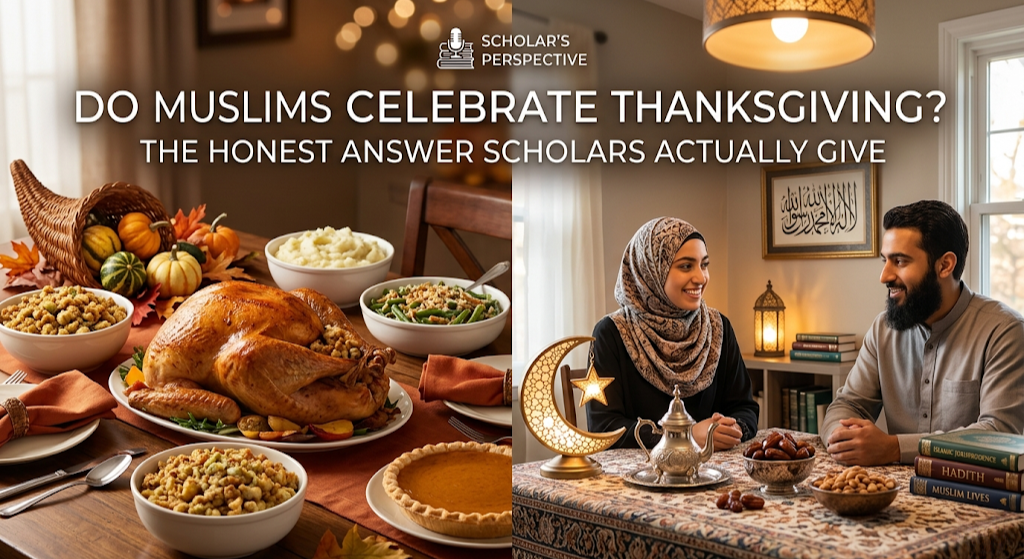
Do Muslims Celebrate Thanksgiving? The Honest Answer Scholars Actually Give
Every year as November rolls around, millions of American Muslims face the same question at the dinner table, in their group chats, and sometimes at the school gate: do Muslims celebrate Thanksgiving?
The short answer is: it depends — on who you ask, where you live, and what your intention is. Islamic scholars are genuinely divided on this one. And unlike some religious questions, there is no single fatwa that settles it for everyone.
In this article we break down exactly what the scholars say, why some Muslim families celebrate Thanksgiving freely, why others avoid it entirely, and what Islamic teachings actually say about gratitude — and we go deeper into the questions most articles skip: the difference between shukr and hamd, the concept of tashabbuh, what Muslim converts should do, what halal Thanksgiving food looks like, and whether saying “Happy Thanksgiving” is even allowed. Because that part matters too.
In This Article
- What Is Thanksgiving, Really?
- Thanksgiving Dates: US and Canada 2025–2030
- The Two Camps: Scholars Who Allow It vs. Those Who Don’t
- Is Thanksgiving Haram? The Specific Ruling Explained
- Understanding Tashabbuh — The Principle Behind the Debate
- What the Quran and Hadith Say About Gratitude
- Shukr vs. Hamd: The Distinction That Changes Everything
- How Muslim Families Actually Handle Thanksgiving
- Muslim Converts and Thanksgiving: The Hardest Case
- What’s Allowed and What Isn’t: A Practical Guide
- Can Muslims Say “Happy Thanksgiving”?
- Halal Thanksgiving Food: What Muslims Eat and Cook
- Muslim Thanksgiving Traditions Across America
- The Historical Context That Complicates Things
- Islam’s View on National Holidays Generally
- Do Muslims in Canada Celebrate Thanksgiving?
- Talking to Muslim Children About Thanksgiving
- FAQ: Thanksgiving and Islam
- The Bottom Line
What Is Thanksgiving, Really?
Before we get into the Islamic perspective, it helps to understand what Thanksgiving actually is in 2025 — because its modern form is very different from its origins.
Thanksgiving began in the 17th century as a harvest celebration between early European settlers and the Wampanoag people in what would become Massachusetts. It carried Christian overtones of giving thanks to God for a successful harvest. Abraham Lincoln made it a federal holiday in 1863, and Franklin D. Roosevelt fixed it to the fourth Thursday of November in 1941.
Today, Thanksgiving is widely considered a secular, national holiday. There are no formal religious ceremonies attached to it. People of all faiths — or no faith — gather around a table, eat, and express gratitude. The symbols are turkey, family, and football, not scripture or prayer.
This shift from religious observance to cultural tradition is exactly why Islamic scholars are divided. The question is no longer “should Muslims participate in a Christian holiday?” It’s more nuanced: “Can Muslims participate in an American cultural tradition that happens to involve giving thanks?”
The Pilgrims who celebrated the first Thanksgiving in 1621 were Puritan Christians, and the original feast did carry prayers and religious significance. But over four centuries, the holiday has been thoroughly secularised. Today’s Thanksgiving dinner table in America is likely shared by Christians, Jews, atheists, Hindus, and — yes — Muslims. That diversity itself is part of why the “imitation of non-Muslims” argument becomes complicated when applied to Thanksgiving specifically.
Thanksgiving is no longer classified as a religious holiday by most scholars. It is a national, cultural tradition. This distinction is central to how most Islamic scholars evaluate whether Muslims can participate.
Thanksgiving Dates: US and Canada 2025–2030
One thing that often surprises people: Thanksgiving is not only an American holiday. Canada has its own Thanksgiving, celebrated on the second Monday of October — a full month and a half before the US date. The Canadian version has similar themes but different historical roots and a lower cultural profile than its American counterpart.
Here are the upcoming Thanksgiving dates for both countries, useful for Muslim families planning gatherings or making decisions about the holiday well in advance:
| Year | US Thanksgiving (4th Thursday, November) | Canadian Thanksgiving (2nd Monday, October) |
|---|---|---|
| 2025 | November 27, 2025 | October 13, 2025 |
| 2026 | November 26, 2026 | October 12, 2026 |
| 2027 | November 25, 2027 | October 11, 2027 |
| 2028 | November 23, 2028 | October 9, 2028 |
| 2029 | November 22, 2029 | October 8, 2029 |
| 2030 | November 28, 2030 | October 14, 2030 |
The Islamic ruling debate about Thanksgiving applies to both the US and Canadian versions, though the cultural weight of the holiday is significantly heavier in the US — where the Muslim population is larger and more deeply integrated into the national fabric.
The Two Camps: Scholars Who Allow It vs. Those Who Don’t
On almost every Islamic ruling, you will find a spectrum of opinion. Thanksgiving is no different. Here is an honest summary of where respected scholars land:
Scholarly Positions on Thanksgiving
The honest reality? There is no consensus. Scholars of equal credibility land in different places on this. This is actually typical in Islamic jurisprudence for cultural questions that the Quran and Sunnah do not directly address. The field of Islamic legal reasoning — ijtihad — exists precisely for situations like this, where new circumstances require thoughtful application of existing principles.
Is Thanksgiving Haram? The Specific Ruling Explained
This is the most searched question on this topic, and it deserves a direct, careful answer. Is Thanksgiving haram?
The answer is not a simple yes or no — and any source that gives you one without context is oversimplifying. Thanksgiving is not explicitly addressed in the Quran or authentic Hadith. The holiday did not exist during the time of the Prophet (peace be upon him) or his companions. This means Islamic scholars must derive a ruling using ijtihad (independent legal reasoning) based on broader Islamic principles. And that is where the disagreement lives.
The scholars who say Thanksgiving is haram base their ruling on:
- The hadith of tashabbuh (imitation): “Whoever imitates a people is one of them” (Abu Dawud)
- The principle that Muslims should only celebrate what is prescribed in Islam — primarily the two Eids
- Ibn al-Qayyim’s position that congratulating non-Muslims on their holidays is forbidden by consensus
- The historical origins of Thanksgiving in Puritan Christian practice
- The concern that normalising non-Islamic celebrations weakens Muslim identity over time
The scholars who say Thanksgiving is permissible (mubah) base their ruling on:
- The principle that anything not explicitly prohibited in Islamic sources is permissible by default (al-asl fi al-ashya’ al-ibaha)
- The argument that Thanksgiving has become a national secular holiday embraced by people of all faiths
- The Quran’s command to maintain family ties (silat al-rahim), which Thanksgiving often enables
- The explicit Islamic value of gratitude (shukr), which Thanksgiving’s spirit embodies
- The principle that Islam should not be made unnecessarily difficult (Quran 22:78, Quran 4:28)
- The classical scholarly clarification that tashabbuh applies to distinguishing characteristics of a religious group — not to universally shared cultural practices
Thanksgiving is not definitively haram. It is a genuinely contested ruling in Islamic jurisprudence. Whether it is permissible for you personally depends on your intention, your scholarly reference, the specific practices at the gathering you attend, and whether you maintain all Islamic requirements (halal food, no alcohol, no participation in other religious rituals). Blanket statements that it is “definitely haram” or “completely fine” both misrepresent the scholarly reality.
Understanding Tashabbuh — The Principle Behind the Debate
If you want to understand why this debate exists in the first place, you need to understand the Islamic legal concept of tashabbuh — because it is cited in almost every scholarly opinion on Thanksgiving.
Literally meaning “resemblance” or “imitation,” tashabbuh in Islamic jurisprudence refers to the prohibition on Muslims imitating non-Muslims in their religious practices, customs, or distinguishing characteristics. The core hadith is from Ibn Umar: “Whoever imitates a people is one of them” (Abu Dawud 4031). This principle is used to discourage Muslims from adopting practices that are specifically tied to the identity or worship of other religious communities.
The strict application: Thanksgiving originated as a religious celebration by Puritan Christians. Participating in it constitutes imitation of a non-Muslim religious community, even if the religious dimension has faded. Shaykh al-Islam Ibn Taymiyah wrote in Iqtidaa al-Siraat al-Mustaqeem that imitating others in some of their festivals implies being pleased with their beliefs and practices — a concern that applies even to secularised versions of originally religious celebrations.
The limited application: Classical scholars, including Mulla Ali al-Qari in his commentary on Mirqat al-Mafatih, clarified that the tashabbuh hadith applies to practices that are specific distinguishing characteristics of a people’s religion or culture — not to practices that have become universal. When Thanksgiving is celebrated by Muslims, Christians, Jews, Hindus, and atheists alike, it can no longer be said to be a “distinguishing characteristic” of non-Muslim religious practice.
What the Quran and Hadith Say About Gratitude
Here is one thing nobody disagrees on: gratitude is a foundational Islamic value. The concept of shukr (thankfulness) appears throughout the Quran and is considered one of the highest spiritual states a Muslim can achieve.
“And if you are grateful, I will surely increase you [in favor].” — Quran 14:7
“O you who have believed, eat from the good things which We have provided for you and be grateful to Allah if it is [indeed] Him that you worship.” — Quran 2:172
“And as for the blessings (ni’mat) of your Lord, proclaim them!” — Quran 93:11
“Be thankful to Me, and do not be ungrateful.” — Quran 2:152
The Prophet Muhammad (peace be upon him) also said: “He who does not thank people has not thanked Allah.” Gratitude in Islam extends not just to Allah but to parents, neighbours, and the community around you.
The counterargument from stricter scholars is not that gratitude is wrong — it is that Islam has already designated specific times for communal celebration of gratitude: Eid al-Fitr and Eid al-Adha. These occasions already contain everything Thanksgiving offers — family, food, charity, and reflection. The Eids are complete — no supplements needed.
Khalil Abdur-Rashid, the first full-time University Muslim Chaplain at Harvard University, has written powerfully on this: Thanksgiving should be about remembering our duty to perform shukr, not just hamd — a distinction that gets to the heart of what Islamic gratitude really means.
Shukr vs. Hamd: The Distinction That Changes Everything
Hamd means praising and glorifying Allah for His attributes and perfections, regardless of any personal benefit received. When you say “Alhamdulillah” (All praise is for Allah), you are performing hamd. It is an acknowledgement of Allah’s greatness in the abstract — recognising that He is worthy of praise simply because of who He is.
Shukr goes further than hamd. It is not merely recognising Allah’s blessings verbally, but actively using those blessings in ways that please Him. A scholar who uses his knowledge to help others is performing shukr for the blessing of knowledge. A wealthy person who gives zakat is performing shukr for the blessing of wealth. A healthy person who fasts Ramadan is performing shukr for the blessing of health.
Khalil Abdur-Rashid of Harvard puts it this way: “For the American Muslim, Thanksgiving should be about remembering our duty to perform shukr, not just hamd; to strive to live a life of shukr and not become complacent with a life of hamd.”
This framing transforms the Thanksgiving question entirely. Instead of asking “Is it haram to eat turkey on a Thursday in November?”, the more productive Islamic question becomes: “How do I use this occasion to deepen my shukr — to actively live out my gratitude through charitable action, renewed commitment, and mindful use of my blessings?”
How Muslim Families Actually Handle Thanksgiving
For many immigrant Muslim families, Thanksgiving is a non-event. They did not grow up with it and see no reason to adopt it. For second-generation and convert Muslims, the picture is very different — Thanksgiving is deeply embedded in their cultural identity. Refusing to gather with extended family on Thanksgiving can create real social friction.
In practice, many Muslim families across North America celebrate Thanksgiving in an Islamically adapted form:
- Serving only halal food (halal turkey is widely available at halal butchers)
- Saying bismillah and a du’a before the meal instead of a Christian grace
- Framing the gathering explicitly as an expression of shukr to Allah
- Avoiding alcohol entirely (non-negotiable in any context)
- Not participating in religious rituals from other traditions if present
- Going around the table sharing what each person is grateful to Allah for
- Making a family donation to a food bank or charity as an act of shukr
If you’re curious about how celebrities and public figures navigate their cultural and religious identity, it’s a theme we see often. For instance, Jenna Ortega’s parents making deliberate choices about her cultural upbringing is a good example of how second-generation families navigate identity questions every day, not just at Thanksgiving.
Muslim Converts and Thanksgiving: The Hardest Case
For a convert, Thanksgiving may be the one day each year when the entire extended family gathers. Refusing to participate does not just mean skipping a meal — it can mean creating a gulf with family members who are still trying to understand and accept the convert’s new faith.
The Convert’s Dilemma: A Common Scenario
Consider a convert who became Muslim two years ago. Their parents, siblings, and extended family still gather every Thanksgiving. The convert’s absence would be deeply hurtful and confusing to their family — and may damage relationships that are already strained by the conversion. The convert wants to maintain family ties, which Islam explicitly commands. But they also want to honour their Islamic values. What should they do?
Most moderate scholars, including Sheikh Yasir Qadhi and Imam Luqman Ahmad, advise converts in this situation to attend — bringing halal food if necessary, politely declining alcohol, avoiding any non-Islamic religious rituals, and using the occasion to strengthen family bonds. The Islamic duty of silat al-rahim (maintaining family ties) is a weighty obligation, and abandoning it over a contested cultural question is not a position most scholars would support.
The risk of converts completely withdrawing from family life over contested cultural questions is that it can make Islam appear harsh and isolating — when the religion actually commands its followers to be the most generous and warmest members of their communities.
Imam Luqman Ahmad argues there is nothing in the Quran or Sunnah that prohibits a Muslim from being American in matters that do not conflict with Islamic doctrine. He cites the hadith: “Make things easy and do not make things difficult. Give glad tidings and do not become divided” (Sahih al-Bukhari 69, Sahih Muslim 1734).
What’s Allowed and What Isn’t: A Practical Guide
✓ Generally Permissible
- Gathering with family and friends
- Eating halal turkey and halal food
- Expressing gratitude to Allah (shukr)
- Taking time off work and enjoying rest
- Giving charity or feeding others
- Attending a gathering hosted by non-Muslim family members
- Saying bismillah and a du’a before eating
- Watching parades and football games
- Going around the table sharing blessings
- Volunteering at a food bank or shelter
- Participating in a charity run or community event
✕ Not Permissible
- Consuming alcohol or haram food
- Participating in non-Islamic religious rituals (e.g. a Christian grace prayer as an act of worship)
- Treating Thanksgiving as an Islamic religious obligation
- Eating non-halal meat including standard supermarket turkey
- Celebrating in a way that involves immodest behaviour
- Missing obligatory prayers (salah) due to Thanksgiving activities
- Approaching it as a religious holiday of another faith
Most scholars who permit Muslim participation in Thanksgiving emphasise that intention (niyyah) is everything. If you sit at a Thanksgiving table with the intention of thanking Allah for His blessings and maintaining family ties — and you eat halal food — most moderate scholars see no issue. If you approach it as a religious observance in imitation of non-Islamic practice, that is a different matter entirely.
Can Muslims Say “Happy Thanksgiving”?
Most modern North American scholars who view Thanksgiving as a secular cultural tradition see no problem with saying “Happy Thanksgiving.” Their reasoning:
- You are not endorsing a religious creed by acknowledging a national holiday
- Refusing to say “Happy Thanksgiving” to colleagues or family can cause unnecessary offence and misrepresent Islam as hostile to basic human warmth
- The spirit of the greeting is gratitude and goodwill — both deeply Islamic values
- The Prophet (peace be upon him) was known for responding to greetings warmly
If a non-Muslim coworker, neighbour, or friend wishes you “Happy Thanksgiving,” most Islamic scholars across the spectrum would agree that responding politely and warmly is both appropriate and a better representation of Islamic values of good character (akhlaq). Responding with cold silence or a lecture is not how the Prophet modelled engagement with his diverse community.
Halal Thanksgiving Food: What Muslims Eat and Cook
The Turkey Question
Standard supermarket turkey — Butterball, Jennie-O, and other major brands — is not halal unless specifically labelled as such. Halal turkey options in the US have expanded significantly in recent years. Many halal butchers stock fresh or frozen halal whole turkeys in the weeks leading up to Thanksgiving — call ahead, as they sell out quickly.
Side Dishes: What to Watch For
- Stuffing cooked inside a non-halal turkey: Absorbs juices from the non-halal meat — avoid it.
- Gelatin in desserts: Marshmallows, Jell-O products, and some pies contain pork-derived gelatin. Look for halal-certified or vegan alternatives.
- Alcohol in recipes: Some traditional dishes include wine, bourbon, or liqueur. Always ask before eating.
- Lard or bacon fat: Traditional green bean casserole sometimes includes bacon. Some pie crusts are made with lard.
- Non-halal broth in stuffing: If not halal-certified, any meat-based broth makes the dish non-halal.
A Fully Halal Thanksgiving Menu — The Muslim Family Version
100% HalalA typical Muslim Thanksgiving table might include:
- Main: Halal-slaughtered roast turkey rubbed with za’atar, cumin, and paprika
- Stuffing: Cooked separately, made with halal chicken broth and Middle Eastern spices
- Sides: Mashed potatoes, roasted root vegetables, maqluba or biryani rice, hummus and pita
- Salad: Fattoush or tabbouleh alongside a standard salad
- Dessert: Baklava, um ali, kunafa, or halal-certified pumpkin pie with agar-agar — plus dates for barakah
- Drinks: Sparkling white grape juice, ayran, fresh lemonade, and chai
Muslim Thanksgiving Traditions Across America in 2025
The Political Table
Political discussion is practically unavoidable at Muslim Thanksgiving gatherings. In 2025, with more than forty Muslims elected to local and state offices and Muslim voter turnout at historic levels, conversations at Muslim Thanksgiving tables covered Gaza, domestic Muslim political representation, and the future of Muslim civic engagement in America.
Charity-Centred Thanksgiving
Many Muslim families and Islamic organisations have reframed Thanksgiving as a day of community service — organising food drives, community dinners for the homeless, and volunteering at food banks. The Prophet (peace be upon him) said: “The best of people are those who are most beneficial to people” (Al-Tabarani). If Thanksgiving is an occasion to feed the hungry, it becomes deeply Islamic in its expression.
Muslim Students and Campus Thanksgiving
On university campuses, Muslim Student Associations have increasingly organised halal Thanksgiving dinners for students who cannot travel home, interfaith gatherings, and community service days at local shelters and food banks.
The Interfaith Thanksgiving Table
In cities with significant Muslim populations — Dearborn, Chicago, New York, Los Angeles, Houston, Minneapolis — interfaith Thanksgiving gatherings have become a growing tradition, modelling that gratitude and community are universal values that cross religious lines.
The Historical Context That Complicates Things
Thanksgiving’s origin story has been largely mythologised. The historical reality involved colonisation, displacement, and violence against indigenous peoples. Many Native Americans observe the fourth Thursday of November as a National Day of Mourning. For Muslims, commanded to stand for justice (‘adl) and acknowledge truth (haqq), participating in an uncritical celebration of colonialism creates its own ethical questions.
This is part of why some African American Muslims do not celebrate Thanksgiving — not only for Islamic reasons but because of the holiday’s entanglement with a history that also includes the enslavement of their ancestors.
Islam’s View on National Holidays Generally
Sheikh Luqman Ahmad has offered a helpful categorisation of American holidays:
- Religious holidays of other faiths (Christmas, Easter, Hanukkah): Muslims should not participate in specifically religious rituals. This is clear across all scholarly opinions.
- Political and patriotic holidays (Independence Day, Veterans Day, Memorial Day): The vast majority of scholars see no issue with Muslims participating in these.
- Cultural holidays with historical roots in another religious tradition (Thanksgiving, Halloween, Valentine’s Day): These are the contested cases. Thanksgiving is in this category.
- Awareness and civic days (Martin Luther King Jr. Day, Earth Day): Most scholars see these as entirely permissible.
Do Muslims in Canada Celebrate Thanksgiving?
Canadian Thanksgiving, celebrated on the second Monday of October, has its own distinct history not tied to the Pilgrim narrative. Canada has a significant Muslim population — over 1.7 million as of the 2021 census — concentrated in Toronto, Ottawa, Montreal, Calgary, and Vancouver. Canadian Muslim families largely treat Thanksgiving as a long weekend family gathering with halal food and perhaps some charity, without the existential identity debate that the US version provokes.
Talking to Muslim Children About Thanksgiving
1. Be Honest About What Thanksgiving Is
Tell children that Thanksgiving is an American cultural tradition when people gather with family and express gratitude. Be honest about the holiday’s complicated history — that the story of Pilgrims and Native Americans sharing a peaceful meal is not the whole truth.
2. Teach the Islamic Concept of Shukr Through Thanksgiving
Use Thanksgiving as a teachable moment about shukr: not just saying “Alhamdulillah” but actively counting blessings and thinking about those who have less. Ask children: what blessing are you grateful for? What will you do with that blessing to please Allah?
3. Be Clear About What Your Family Is Doing and Why
Whether your family participates or not, give children a clear, confident reason. What matters is that children understand the reasoning rather than feeling that their family’s choice is arbitrary or something to hide.
4. Address School Activities with Wisdom and Confidence
A Muslim child saying “I am thankful for my family and for Allah’s blessings” is not compromising their faith — it is expressing it. The Quran commands proclaiming Allah’s blessings (93:11).
5. Model the Balance You Want to See
A Muslim family that gathers with intention, eats halal food, makes du’a before the meal, goes around the table sharing gratitude to Allah, and then makes a charity donation together is teaching their children something profound about what Islamic gratitude looks like in an American life.
The best approach most scholars recommend: use Thanksgiving as a teaching moment for Islamic gratitude rather than a battle over cultural participation. Children who grow up understanding shukr as a daily Islamic practice are far better equipped to navigate questions of cultural identity than children who are simply told “we don’t celebrate that.”
FAQ: Thanksgiving and Islam
It depends on the scholar you ask. Stricter opinions consider any holiday outside of Islamic tradition to be discouraged or impermissible. Moderate and liberal scholars say Thanksgiving, as a secular cultural event focused on gratitude and family, is permissible — especially if Islamic values are maintained throughout. There is no single authoritative ruling that applies to all Muslims worldwide. Consult a scholar you trust in your own community.
Yes — if the turkey is halal. Standard supermarket turkey in the US (Butterball, Jennie-O, etc.) is not halal unless specifically labelled. Many Muslim families purchase halal-certified turkey from halal butchers, who typically stock whole turkeys in the weeks before Thanksgiving. If no halal turkey is available, eating vegetarian side dishes is a practical alternative.
In a sense, yes. Eid al-Fitr and Eid al-Adha both incorporate the core elements of Thanksgiving: family gatherings, shared meals, charity, and expressions of gratitude to Allah. Many scholars argue these occasions already fulfil the spiritual function that Thanksgiving serves for other communities. But Muslims also practice gratitude (shukr) as a daily lifestyle, not a once-a-year event.
Thanksgiving is not definitively haram. Scholars disagree. Those who say it is haram cite the tashabbuh principle and the rule that Muslims should celebrate only Islamic occasions. Those who say it is permissible argue that Thanksgiving is now a secular national tradition, not a religious one. Both are valid scholarly positions.
The key hadith cited is: “He who imitates any people in their actions is considered to be one of them” (Abu Dawud). However, classical scholars clarified that this prohibition applies to practices that are specific distinguishing characteristics of another religious community — not to practices that have become universal across all faiths and backgrounds. Most modern scholars agree Thanksgiving has become a universal national tradition.
Most scholars say yes, with conditions: eat only halal food (bringing your own dish if necessary), avoid alcohol, and do not participate in religious rituals specific to other faiths. The Prophet (peace be upon him) himself ate with non-Muslims and maintained good relations with his neighbours of different faiths.
Scholars who view Thanksgiving as a secular cultural holiday say yes. A practical middle ground: respond warmly to the greeting without necessarily initiating it, or say “Thank you, may Allah bless you and your family” in return — conveying warmth while expressing Islamic identity.
Tashabbuh (التشبه) means “imitation” — the Islamic prohibition on imitating non-Muslims in their religious practices or distinguishing characteristics. Classical scholars clarified that tashabbuh applies to practices specific to a religious group — not practices that have become universal. Since Thanksgiving is celebrated by Americans of all backgrounds, many scholars argue that tashabbuh does not apply to it.
Hamd means praising Allah for His attributes — saying “Alhamdulillah.” Shukr goes further: it means actively using Allah’s blessings in ways that please Him. The most Islamic approach to Thanksgiving is not just saying “Alhamdulillah” around the table but actively doing something with your blessings — giving to charity, feeding others, strengthening family bonds with intention.
Many publicly Muslim celebrities in the US do gather with family over Thanksgiving, though they rarely frame it as a religious celebration. How celebrities navigate cultural and religious identity is something we cover regularly — from relationship dynamics around the holidays to how stars like Zendaya’s family background shapes their values and public identity.
No. Thanksgiving is a North American holiday. The debate about whether Muslims should celebrate it is almost entirely a diaspora conversation — one happening in the US, Canada, the UK, and other Western countries with significant Muslim populations.
US Thanksgiving 2025 falls on November 27, 2025 (the fourth Thursday of November). Canadian Thanksgiving 2025 was on October 13, 2025 (the second Monday of October). See the date table earlier in this article for dates through 2030.
Most Muslim scholars advise converts to maintain family ties (silat al-rahim), which Islam commands strongly. Attending Thanksgiving with non-Muslim family — eating halal food you bring yourself, politely declining alcohol, and sitting respectfully while others say grace — is the approach most moderate scholars support.
Most vegetable-based sides (mashed potatoes, roasted vegetables, salads, cranberry sauce) are naturally halal unless they contain alcohol, lard, or non-halal broth. Halal turkey is available from halal butchers. Watch out for gelatin in desserts, alcohol in sauces and pies, bacon in casseroles, and stuffing cooked inside a non-halal bird.
The Bottom Line
So, do Muslims celebrate Thanksgiving? Many do. Many don’t. And both groups have reasonable Islamic grounds for their position.
The majority of Muslim scholars in North America land somewhere in the middle: Thanksgiving is not an Islamic holiday and Muslims have no religious obligation to observe it. But participating in a cultural tradition of gratitude, family, and halal food — with the right intention — is not prohibited. Scholars like Imam Shamsi Ali, Sheikh Abdullah ibn Bayah, and Imam Luqman Ahmad have all argued that a Muslim can sit at a Thanksgiving table, express gratitude to Allah, maintain family ties, and eat halal food without compromising their faith in any meaningful way.
What is clear, from every angle of this debate, is that gratitude itself is profoundly Islamic. Whether a Muslim marks Thanksgiving with a halal feast or spends the day in quiet dhikr thanking Allah, the spirit of shukr is something the Quran commands every single day — not just the fourth Thursday of November.
As with so many questions of cultural identity — something we see play out publicly all the time, from how celebrity families raise their children across cultures to the values parents instil that shape everything else — the answer is rarely black and white. Context, intention, and community all shape the answer you arrive at.
This article is for informational purposes only. For specific rulings on matters of Islamic jurisprudence, consult a qualified Islamic scholar in your community. Scholarly opinions cited represent those scholars’ publicly stated positions and are not endorsements by AllCelebsHub.