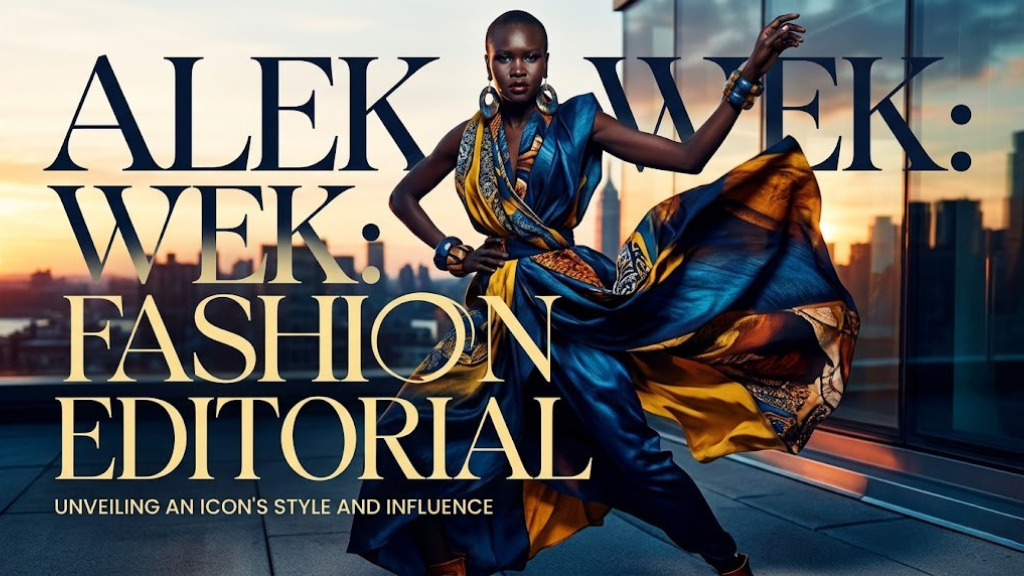
From War-Torn Sudan to International Runways
Alek Wek: Breaking Barriers and Redefining Beauty in Global Fashion
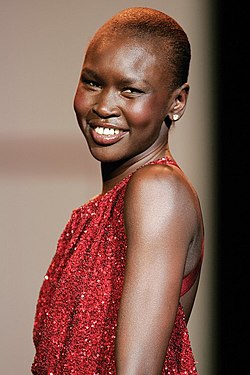
The Humble Beginnings: Growing Up in Wau, Sudan
Alek Wek was born on April 16, 1977, in Wau, a modest town in what is now South Sudan. She entered the world as the seventh of nine children in a family that, despite economic challenges, was rich in love, culture, and tradition. Her parents, Akuol and Athian Wek, raised their large family in a two-bedroom house devoid of modern conveniences—no electricity, no running water, just the simple rhythms of life that had sustained generations before them.
Her father, Athian Wek, born in 1933, worked as an education official, a respected position in their community. Her mother, Akuol, born in 1946, dedicated herself to managing the household and nurturing their nine children. The Wek family belonged to the Dinka ethnic group, one of the largest and most culturally significant communities in South Sudan, known for their rich traditions, pastoral lifestyle, and distinctive cultural practices.
Interestingly, Alek’s name carries profound cultural significance. In the Dinka language, “Alek” reportedly means “Black Spotted Cow,” a name that might seem unusual to Western sensibilities but represents beauty, value, and prestige within Dinka culture, where cattle hold immense social and economic importance. This naming tradition would later take on symbolic resonance as Alek herself became a symbol of beauty that transcended Western conventions.
Young Alek’s childhood, though materially modest, was filled with the warmth of a tight-knit community and the vibrant traditions of Dinka culture. She grew up learning the values of resilience, community, and cultural pride that would later serve as her anchor through the turbulent years ahead. The landscape of southern Sudan, with its vast plains and the rhythmic life of cattle herding, farming, and communal gatherings, shaped her early worldview.
However, this peaceful existence was not to last. The political tensions that had simmered in Sudan for years were about to erupt into one of Africa’s most devastating conflicts, forever changing the trajectory of Alek’s life and setting her on an unlikely path that would eventually lead to international fashion stardom.
Fleeing Terror: The Sudanese Civil War and Escape to London
In 1983, when Alek was just six years old, Sudan plunged into a brutal civil war that would rage for more than two decades, ultimately claiming nearly two million lives and displacing millions more. The conflict pitted the Muslim-dominated government in the north against southern rebels, with outlaw militias adding further chaos to an already devastating situation. The southern region where the Wek family lived became a battleground, transforming their once-peaceful existence into a daily struggle for survival.
Life as the family knew it came to a devastating end. The sounds of gunfire and explosions replaced the pastoral sounds of cattle and community gatherings. Schools closed, markets disappeared, and the basic infrastructure of daily life collapsed. Families were torn apart, communities scattered, and the very fabric of Sudanese society in the south was shredded by violence and displacement.
The Tragic Loss of a Father
Amidst this chaos, the Wek family suffered a profound personal tragedy. Alek’s father, Athian, had suffered a hip injury in a bicycle accident years earlier, requiring metal pins for repair. During the family’s desperate attempts to flee the violence, the prolonged periods of walking aggravated the infection in his hip. Upon reaching Khartoum, his condition deteriorated rapidly—he became paralyzed and suffered a hemorrhage. Athian Wek died in 1985 at a relative’s residence in Khartoum, leaving behind a widow and nine children in the midst of a brutal civil war.
The loss of their father was devastating, but Akuol Wek proved to be a pillar of strength for her family. Determined to save her children from the violence that had already claimed their father and threatened their very existence, she made the agonizing decision that countless refugee parents have faced: to flee their homeland in search of safety, even if it meant leaving behind everything they knew.
Journey to Refuge
In 1991, when Alek was fourteen years old, she and eight of her siblings embarked on a harrowing journey out of Sudan. The family fled on foot, joining the millions of displaced persons seeking refuge from one of Africa’s most devastating conflicts. Their destination was London, England—a world away from the Sudanese plains both geographically and culturally.
The journey itself was fraught with danger and uncertainty. Refugee routes were treacherous, controlled by various armed factions, and the risk of violence, exploitation, or simply perishing from hunger or disease was ever-present. But the Wek family persevered, driven by the desperate hope for safety and the possibility of a future free from the sound of gunfire.
Arriving in London represented both an ending and a beginning. The family had survived the immediate threat of violence, but they now faced the profound challenges of starting over in a completely foreign environment. For fourteen-year-old Alek, who had known only the cultural landscape of Sudan, the adjustment to life in one of the world’s most cosmopolitan cities would be both disorienting and transformative.
The trauma of war and displacement, the loss of her father, and the radical upheaval of everything familiar would mark Alek profoundly. Yet these experiences would also forge in her a resilience, adaptability, and perspective that would later distinguish her not just as a model, but as a humanitarian advocate and voice for refugees worldwide. The young girl who arrived in London as a war refugee had no idea that within just four years, she would be discovered and catapulted into the international fashion spotlight, changing the industry forever.
Discovered by Destiny: From London Market to Fashion Runways
Adjusting to life in London was an enormous challenge for the Wek family. The weather was cold and gray compared to the Sudanese sun. The language, though officially English, was filled with idioms and accents that were initially incomprehensible. The very rhythm of urban British life was alien to a family rooted in the pastoral traditions of southern Sudan. Yet, like countless refugee families before and after them, the Weks adapted, survived, and gradually began to build a new life.
Alek enrolled at the London College of Fashion, demonstrating an early interest in the industry that would soon become her career. She pursued studies in fashion business and technology, gaining both theoretical knowledge and practical skills. This education gave her insight into the mechanics of the fashion world—the business side that most models never fully understand. Little did she know that this academic foundation would later prove invaluable as she navigated her own career and eventually launched her own business ventures.
The Fateful Encounter at Crystal Palace
In 1995, when Alek was just eighteen years old and still adjusting to life in her adoptive country, fate intervened in the most unexpected way. She was attending an outdoor market in Crystal Palace, a district in South London, simply going about her daily life when a scout from Models 1, one of the most prestigious modeling agencies in the world, spotted her.
The scout, Fiona Ellis, saw something extraordinary in the young Sudanese refugee. In an industry that had long adhered to narrow, Eurocentric standards of beauty—favoring fair skin, European features, and specific body proportions—Alek represented something entirely different. Her striking dark skin, statuesque 5’11” frame, distinctive facial structure, and natural grace presented a radical departure from the conventional model aesthetic of the time.
What might have seemed like a random encounter was, in fact, a pivotal moment in fashion history. Ellis gave Alek her card, and after some consideration, the young woman decided to pursue this unexpected opportunity. The decision would not only transform her own life but would also contribute to a broader transformation in the fashion industry’s approach to beauty and representation.
First Steps into the Fashion World
Alek’s entry into professional modeling was swift and spectacular. Later in 1995, the same year she was discovered, she appeared in the music video for “GoldenEye” by Tina Turner. The video, which promoted the James Bond film of the same name, gave Alek her first taste of the entertainment industry and provided valuable exposure.
The following year, 1996, proved to be monumental in establishing her career. She was signed to Ford Models, one of the world’s most powerful and prestigious modeling agencies. This connection opened doors to opportunities that most aspiring models could only dream of. That same year, she appeared in Janet Jackson’s iconic music video “Got ‘Til It’s Gone,” further raising her profile and demonstrating her crossover appeal beyond traditional fashion venues.
But perhaps most significantly, 1996 marked Alek’s debut on the runway circuit. She traveled to Paris and walked in fashion shows during both Milan and New York Fashion Weeks. Her unusual look—unusual only by the narrow standards that had dominated fashion for decades—began to cause a stir in the industry. Here was a model who didn’t fit the established template, yet commanded attention and admiration wherever she appeared.
The trajectory from refugee to runway model in just five years was nothing short of extraordinary. But Alek’s rapid rise was about more than just personal success. Her presence on international runways represented a challenge to the status quo, a visible question about who gets to be considered beautiful and whose aesthetic deserves celebration. The fashion world was about to receive an answer that would reshape the industry for generations to come.
Understanding the significance of maintaining your own self-care routine while navigating demanding industries is crucial for long-term success, as Alek would discover throughout her career.

Master Fashion Photography
Learn the art and technique behind iconic fashion photography that has shaped the industry.
Explore Photography BooksThe Breakthrough Year: 1997 and the Rise of a Supermodel
If 1996 introduced Alek Wek to the fashion world, 1997 was the year she conquered it. Within just two years of being discovered at that London market, the former Sudanese refugee became one of the most talked-about models in the global fashion industry, accumulating accolades and achievements that many models never attain in entire careers.
Model of the Year: MTV’s Recognition
In 1997, MTV named Alek Wek “Model of the Year,” a prestigious honor that recognized not just her beauty or her work on the runway, but her broader cultural impact. This wasn’t merely about fashion—it was about representation, visibility, and the changing face of beauty in popular culture. The award acknowledged that Alek represented something larger than herself: a shift in consciousness about who deserved to be celebrated and whose aesthetic had value in mainstream media.
The MTV award was particularly significant because it came from a platform that reached millions of young people worldwide. Unlike traditional fashion accolades that might be known only within industry circles, this recognition came from a media outlet with massive cultural influence. Young people of color around the world, particularly young Black women who had rarely seen themselves represented in mainstream beauty standards, suddenly had a powerful new icon in Alek Wek.
Model of the Decade: i-D Magazine’s Historic Honor
As if MTV’s “Model of the Year” weren’t enough, 1997 also saw i-D Magazine, one of fashion’s most influential and avant-garde publications, name Alek their “Model of the Decade.” This was an extraordinary honor, particularly given that the decade in question—the 1990s—had already produced numerous iconic models including the original “supermodels” like Naomi Campbell, Linda Evangelista, Christy Turlington, and Cindy Crawford.
For i-D Magazine to single out Alek for this honor spoke to the profound impact she had made in an incredibly short time. The award recognized that her influence extended beyond the number of covers she’d graced or the designers she’d worked with. She represented a fundamental shift in fashion’s aesthetic paradigm, challenging decades of narrow beauty standards with her presence and success.
Breaking the Cover Barrier: Elle Magazine
Perhaps the most symbolically significant achievement of 1997 came when Alek became the first African model to appear on the cover of Elle magazine. This milestone cannot be overstated. Elle was (and remains) one of the world’s most influential fashion publications, with editions in dozens of countries reaching millions of readers monthly. Its covers were coveted real estate in the fashion world, typically reserved for established supermodels or emerging stars who fit traditional beauty standards.
For a dark-skinned African model to grace this cover was unprecedented. It sent shockwaves through the industry and provided a moment of validation and representation for Black women worldwide who had been told, either explicitly or implicitly, that they didn’t fit the definition of beauty worthy of such prominent display.
Following this breakthrough, Alek would go on to appear on the covers of Elle’s American, French, German, and South African editions, as well as covers of other major publications including i-D, Cosmopolitan, Glamour, Forbes Magazine Africa, and Ebony. Each cover was another small victory in the larger battle for diversity and representation in fashion media.
Ralph Lauren’s Unprecedented Move
Within her first year of moving to New York, Ralph Lauren—one of America’s most prestigious and established designers—chose Alek to walk in his runway show. This was an unprecedented achievement for such a new model. Ralph Lauren’s shows were not experimental platforms for unknown faces; they were carefully curated presentations that represented American luxury and classic elegance.
That Lauren would select Alek for this honor demonstrated that even traditionalist sectors of fashion recognized her star quality and the changing zeitgeist around beauty and representation. This assignment propelled her modeling career forward and helped her establish a strong foothold in what had been a predominantly white-dominated industry.
The year 1997 effectively transformed Alek from an emerging model into a bona fide supermodel with international recognition. But more importantly, it marked a turning point in fashion history—a moment when the industry began, however gradually, to expand its definition of beauty and acknowledge that excellence and beauty come in many forms, colors, and cultures.
Changing the Face of Beauty: Alek’s Impact on Fashion Standards
To truly appreciate Alek Wek’s significance in fashion history, one must understand the context in which she emerged. For decades, the fashion industry had operated within remarkably narrow parameters regarding beauty and desirability. The overwhelming majority of top models were white women with European features. When Black models did appear, they were often those with lighter skin tones or more Eurocentric facial features—what some have critically termed “acceptable” Black beauty that didn’t challenge white aesthetic preferences too dramatically.
The Pre-Alek Fashion Landscape
Before Alek’s breakthrough, dark-skinned African models were virtually absent from high fashion’s most prestigious stages. The few Black supermodels who had achieved mainstream success—including Naomi Campbell, Iman, and Beverly Johnson—were undeniably groundbreaking and faced their own battles against racism and exclusion. However, the industry still maintained implicit hierarchies even within its limited embrace of diversity.
Fashion’s beauty standards were not just about aesthetics—they reflected and reinforced broader social hierarchies about race, value, and desirability. By excluding or marginalizing dark-skinned models, particularly those with distinctly African features, the industry was making a statement about whose beauty deserved recognition and commercial investment. These exclusions had real psychological and cultural impacts, particularly on young women of color who absorbed messages about their own worth through the media they consumed.
Alek’s Disruption of the Status Quo
Alek Wek’s emergence disrupted this paradigm fundamentally. Her very dark skin, statuesque height, distinctive facial structure, and natural grace presented an aesthetic that hadn’t been celebrated in mainstream Western fashion. She didn’t conform to established standards; instead, she demanded that the standards expand to include her.
What made Alek’s impact particularly powerful was that she achieved success on the industry’s own terms. She wasn’t relegated to “ethnic” or “tribal” themed shoots (though she did those too). She walked for the most prestigious designers, appeared in the most coveted editorials, and graced the covers of the most influential magazines. She proved that beauty that didn’t conform to Eurocentric standards could still be commercially successful and critically acclaimed.
Cultural Icons Speak Out
The impact of Alek’s visibility extended far beyond fashion industry circles. Cultural icons from various fields spoke publicly about how seeing her representation affected them personally. Oprah Winfrey, one of the world’s most influential media personalities, stated that if Alek had been on magazine covers when she was young, she would have felt differently about herself. This powerful testimony from someone of Oprah’s stature underscored the profound psychological impact of representation.
Similarly, Academy Award-winning actress Lupita Nyong’o shared a deeply personal account of how Alek influenced her self-perception. Nyong’o revealed that she had felt insecure about her dark skin as a teenager, struggling with colorism and internalized beauty standards. But seeing Alek Wek in the spotlight fundamentally changed her perspective. “When I saw Alek,” Lupita said, “I saw a reflection of myself that I could not deny. Now, I had a spring in my step because I felt more seen, more appreciated.”
These testimonials reveal the ripple effects of Alek’s visibility. Her presence in fashion media didn’t just impact the industry—it impacted the psyches of countless individuals who had been told, in countless subtle and not-so-subtle ways, that their natural features weren’t worthy of celebration. For many, seeing Alek’s success was transformative, offering permission to embrace their own beauty without apology or modification.
| Before Alek Wek | After Alek Wek’s Impact |
|---|---|
| Predominantly Eurocentric beauty standards | Gradual expansion of beauty definitions |
| Dark-skinned models largely absent from high fashion | Increased visibility of diverse skin tones |
| Limited representation on major magazine covers | Growing diversity in cover models |
| African features marginalized or exoticized | African aesthetics increasingly celebrated |
| Narrow commercial acceptance of Black beauty | Broader commercial opportunities for diverse models |
The Ongoing Struggle for True Diversity
While celebrating Alek’s impact, it’s important to acknowledge that her breakthrough didn’t instantly solve fashion’s diversity problems. The industry still struggles with representation, colorism, and the tokenization of models of color. However, Alek’s success created an opening, a proof of concept that challenged the industry’s excuses and demonstrated that diverse beauty could be both critically acclaimed and commercially viable.
Her influence paved the way for subsequent generations of models who might not have had opportunities otherwise. From Adut Akech to Duckie Thot to countless others, dark-skinned African models who followed in Alek’s footsteps benefited from the doors she helped open and the standards she helped shift. The journey toward true equity and representation in fashion continues, but Alek’s contribution to that journey remains foundational and undeniable.
Just as Alek challenged limiting perceptions in fashion, many successful people have had to overcome negative self-talk and limiting beliefs to achieve their goals.
Elevate Your Style
Discover designer accessories and fashion essentials to express your unique aesthetic.
Shop Designer PiecesRunway to Stardom: Career Highlights and Iconic Moments
Alek Wek’s modeling career has been marked by numerous landmark achievements, groundbreaking campaigns, and memorable runway moments that have solidified her status as one of fashion’s most influential figures. Beyond the awards and recognition, her actual work—the campaigns, the editorials, the runway shows—demonstrated remarkable range and versatility that transcended any single aesthetic category.
Editorial Excellence in Major Publications
Throughout her career, Alek has been featured in editorials in the most prestigious fashion publications in the world. Her work has appeared in both American and British Vogue, the twin pillars of fashion journalism that represent the industry’s highest editorial standards. These weren’t token appearances or one-off diversity initiatives; they were recurring features that showcased her versatility across different styles, seasons, and creative visions.
Her editorial work extended across international editions and diverse publication types—from the avant-garde aesthetics of i-D to the glamorous appeal of Cosmopolitan, from the aspirational content of Glamour to the business-focused Forbes Magazine Africa. Each publication offered a different context and audience, yet Alek succeeded across all of them, demonstrating that her appeal was universal rather than niche.
Victoria’s Secret and Mainstream Visibility
In 2001, Alek made her Victoria’s Secret debut, walking in one of the brand’s increasingly publicized runway shows. She wore oversized wings, becoming part of one of the most commercially visible fashion spectacles in the world. While Victoria’s Secret has since faced criticism for its lack of diversity and narrow beauty standards, Alek’s participation in the early 2000s represented another barrier broken—bringing her particular aesthetic to one of the most mainstream fashion platforms in existence.
Reflecting on the experience later, Alek emphasized the importance of representation in such visible platforms: “For me, it’s important to show girls that we’re all beautiful, to show many versions of what it means to be sexy, and to own their bodies and their sexuality. It’s empowering!” This perspective reveals her understanding of her role as more than just a model—she was a visible reminder that beauty, sensuality, and desirability come in many forms.
High-Profile Advertising Campaigns
Alek’s commercial success was demonstrated through numerous high-profile advertising campaigns with major brands. She worked with Issey Miyake, bringing her distinctive aesthetic to the Japanese designer’s avant-garde vision. She appeared in campaigns for Moschino, Victoria’s Secret (beyond just the runway shows), and Clinique, demonstrating her commercial viability across fashion, lingerie, and beauty products.
Her campaign work extended to GAP Jeans, one of America’s most recognizable casual wear brands, proving that her appeal wasn’t limited to high fashion contexts but could translate to mass-market accessibility. Each campaign represented not just a paycheck or professional credit, but another incremental expansion of who the fashion and beauty industries considered marketable and desirable.
The Pirelli Calendar
Alek appeared in the Pirelli Calendar, one of fashion and photography’s most exclusive and prestigious platforms. The Pirelli Calendar, produced annually since 1964 (with some exceptions), features world-renowned photographers shooting top models and celebrities in artistic, often provocative imagery. Being selected for this calendar is considered a major honor in the modeling world, cementing Alek’s status among fashion’s elite.
Recent Runway Resurgence
Even decades into her career, Alek continues to command attention on the runway. In September 2015, she walked for Marc Jacobs at the S/S 16 New York Fashion Week, later appearing in the label’s S/S 16 campaign. This demonstrated that her appeal hadn’t waned with time; if anything, she had become even more iconic, representing not just contemporary beauty but also fashion history itself.
In 2020, at the A/W 20 shows, she walked for Lanvin, and in 2023, she opened the Thom Browne Couture FW23 show, a position of honor typically reserved for the most prestigious models. The fact that Alek, well into her forties, was still opening major fashion shows spoke volumes about her enduring relevance and the industry’s growing appreciation for models whose careers extend beyond their early twenties.
Recent Magazine Recognition
In May 2016, Alek modeled for four special edition covers of Brazilian Elle, demonstrating her continuing appeal to international markets and diverse audiences. Most recently, in January 2026, she appeared in Interview Magazine for their Winter Issue, reflecting on her thirty-year career in fashion while wearing fresh-off-the-runway Alaïa by Pieter Mulier. The feature included commentary about viral controversial silhouettes looking “elegant, chic and honestly comfy walking around NYC streets,” showing her continuing engagement with contemporary fashion discourse.
These recent appearances aren’t nostalgic callbacks to past glory—they represent Alek’s ongoing relevance in an industry that often discards aging models. Her continued presence on runways and in major publications challenges another industry bias: the assumption that models have expiration dates. Alek’s longevity proves that true icons transcend temporary trends and arbitrary age limits.
Walking for the Icons: Collaborations with Fashion’s Greatest Designers
Throughout her illustrious career, Alek Wek has walked the runways for virtually every major designer house in the global fashion industry. These collaborations represent more than just professional engagements—they signify the industry’s gradual but unmistakable acknowledgment that beauty transcends narrow Eurocentric definitions and that true fashion excellence requires diversity of aesthetic vision.
The Chanel Connection: Karl Lagerfeld’s Vision
One of Alek’s most significant designer relationships has been with Chanel, particularly during the era of Karl Lagerfeld’s creative direction. Lagerfeld, who passed away in 2019, was one of fashion’s most influential and sometimes controversial figures. His decision to feature Alek prominently in Chanel shows wasn’t just about filling a runway slot—it represented a creative choice by one of fashion’s most powerful arbiters of taste to showcase beauty that challenged conventional standards.
Walking “head to toe in Chanel shows,” as reported in fashion press, gave Alek an association with one of the world’s most prestigious luxury brands. Chanel’s aesthetic—timeless, elegant, definitively French—might have seemed an unlikely match for a Sudanese refugee-turned-model, yet Alek embodied Chanel’s elegance perfectly, demonstrating that luxury and refinement aren’t tied to any particular ethnicity or cultural background.
Ralph Lauren: American Classics Reimagined
As mentioned earlier, Ralph Lauren’s selection of Alek within her first year in New York was unprecedented and professionally transformative. Lauren’s brand represents quintessential American style—preppy, classic, aspirational. By featuring Alek in his shows, Lauren was making a statement about what American beauty looks like, expanding the traditional Ralph Lauren aesthetic to include a broader vision of American identity and style.
The relationship continued throughout Alek’s career, with her opening and closing Ralph Lauren shows—positions of honor on any runway that signify a model’s importance to the designer’s vision. These placements weren’t token gestures but creative choices that demonstrated Lauren’s appreciation for Alek’s particular presence and what she brought to his collections.
The French Connection: Dior, Givenchy, and Beyond
Alek has worked extensively with French fashion houses, the traditional bastions of high fashion. She walked for Christian Dior, one of France’s most storied maisons, bringing her aesthetic to a brand synonymous with French luxury and femininity. The juxtaposition of Dior’s classic French elegance with Alek’s distinctly African beauty created visual narratives that expanded both the brand’s image and broader perceptions about who embodies haute couture.
Similarly, her work with other French designers and houses demonstrated the international fashion capital’s gradual embrace of diversity. From the structured elegance of French fashion to the more experimental visions of avant-garde designers, Alek proved adaptable across different creative directions while maintaining her distinctive presence.
American Designers: Expanding Definitions
Beyond Ralph Lauren, Alek worked with numerous American designers who represent different facets of American fashion. She walked for Calvin Klein, the minimalist American brand that had its own history of using diverse models. Donna Karan, Michael Kors, Tommy Hilfiger, and DKNY all featured Alek in their shows, each representing different expressions of American style—from Karan’s urban sophistication to Hilfiger’s preppy Americana to Kors’s accessible luxury.
Marc Jacobs, perhaps American fashion’s most celebrated designer of recent decades, has featured Alek multiple times throughout her career, including the 2015 S/S 16 show and subsequent campaign. Jacobs has a history of championing diversity and unconventional beauty in his castings, making him a natural creative partner for Alek’s particular aesthetic.
Italian Excellence: Gucci, Fendi, Armani
Italian fashion houses, representing another pillar of global luxury fashion, have also collaborated extensively with Alek. She walked for Gucci, bringing her distinctive presence to Alessandro Michele’s maximalist, eclectic vision (and earlier creative directors’ visions as well). Fendi, the Roman luxury house known for both high fashion and accessible luxury, featured Alek in their shows.
Giorgio Armani, the epitome of Italian elegance and restraint, selected Alek for his runways, demonstrating that her aesthetic could embody Armani’s particular vision of sophisticated simplicity. Dolce & Gabbana, with their more theatrical, exuberant Italian aesthetic, also featured Alek, showing her versatility across different creative visions within Italian fashion.
Contemporary Visionaries
In more recent years, Alek has worked with contemporary designers who represent fashion’s current cutting edge. Her 2023 appearance opening the Thom Browne Couture FW23 show represents collaboration with one of American fashion’s most conceptual and theatrical designers. Browne’s shows are known for their artistic ambition and theatrical presentation, and selecting Alek to open demonstrates continued recognition of her iconic status.
Similarly, wearing Alaïa by Pieter Mulier for Interview Magazine in 2026 showed her engagement with one of fashion’s most respected contemporary design houses under new creative direction. These recent collaborations prove that Alek remains relevant not just as a historical figure but as a contemporary model whose presence still commands attention and respect.
The breadth and prestige of Alek’s designer collaborations underscore her exceptional career. She didn’t just break into fashion—she worked with virtually every major player in the industry, proving her commercial viability and creative value across different aesthetic visions, markets, and creative directions. Each collaboration represented another validation of her beauty, professionalism, and the industry’s gradual but undeniable shift toward more inclusive standards.
Like Alek’s ability to excel across various design aesthetics, developing effective personal habits can help anyone achieve excellence in their chosen field.
Beyond the Runway: Wek 1933 and Business Ventures
While Alek Wek’s modeling career brought her fame and recognition, she demonstrated early on that she had ambitions and talents that extended beyond wearing designer clothes on runways. Her entrepreneurial ventures, particularly her handbag line Wek 1933, showcase her business acumen and her desire to create something lasting that honored her family heritage while establishing her own creative vision.
The Birth of Wek 1933
In 2001, while her modeling career was in full swing, Alek launched AlekWek1933 Ltd (later simply known as Wek 1933), her own line of designer handbags and fashion accessories. The venture represented a significant entrepreneurial commitment—moving from being the face of other designers’ visions to creating and marketing her own products under her own brand.
The name “Wek 1933” carries deep personal significance. It references 1933, the year Alek’s father, Athian Wek, was born. This naming choice transformed the business venture into something more than just a commercial enterprise—it became a tribute to her father, who had passed away during the family’s flight from Sudan. The brass-clasp briefcase that Athian Wek carried served as the direct inspiration for the bag designs, creating a tangible connection between Alek’s past in Sudan and her present success in fashion.
Design Philosophy and Aesthetic
The Wek 1933 collection reflects Alek’s personal aesthetic—a blend of classic elegance with distinctive details that set the designs apart from mass-market accessories. The bags incorporate the brass-clasp element inspired by her father’s briefcase, creating a signature detail that gives the collection both visual interest and emotional resonance.
By drawing inspiration from a functional object from her Sudanese past rather than trying to simply replicate European luxury aesthetics, Alek created products that felt authentic to her own experience. This authenticity likely contributed to the collection’s appeal—these weren’t generic designer accessories but products with genuine personal meaning and cultural significance behind their design.
Retail Presence at Selfridges
Wek 1933 products have been available through selected Selfridges department stores, one of the United Kingdom’s most prestigious retail establishments. Selfridges, with its flagship store on London’s Oxford Street and additional locations in Manchester and Birmingham, represents a significant retail platform that brings products to affluent consumers with discerning taste.
Securing placement at Selfridges wasn’t just about retail distribution—it represented validation of the brand’s quality, design, and market appeal. Selfridges carefully curates its offering, particularly in accessories and designer goods, so being selected for this retail presence indicated that Wek 1933 met high standards for both design excellence and commercial viability.
The fact that Alek has maintained this retail relationship over years (the brand launched in 2001 and has continued presence in selected Selfridges locations) suggests sustainable business operations rather than a flash-in-the-pan celebrity brand that appeared and disappeared quickly. This longevity speaks to both the quality of the products and Alek’s commitment to the business beyond just lending her name.
Business Education Foundation
Alek’s studies at the London College of Fashion, where she focused on fashion business and technology, provided her with knowledge that many models never acquire. Understanding the business mechanics of fashion—production, distribution, marketing, retail relationships, pricing strategies—gave her tools to approach entrepreneurship with more sophistication than might otherwise be possible.
This education likely helped her navigate the complexities of launching and maintaining a product line: working with manufacturers, understanding production costs and retail markups, developing marketing strategies, managing retail relationships, and all the other operational details that determine whether a fashion business succeeds or fails. The combination of insider industry knowledge, personal brand recognition, and formal business education created a stronger foundation for entrepreneurial success than any one element alone could provide.
Expanding Brand Identity
The Wek 1933 venture also demonstrated Alek’s understanding of brand building and personal brand extension. Rather than just being a famous face who could be hired for campaigns, she became a creative force with her own products and business interests. This transition from model to entrepreneur gave her greater control over her career, additional revenue streams beyond modeling fees, and a business platform that could potentially outlast her runway career.
Many models have attempted to launch fashion or beauty brands with mixed results. The fashion industry is littered with celebrity-branded products that launched with fanfare but disappeared within a few years. That Wek 1933 has maintained presence for over two decades suggests that Alek approached this venture seriously, with attention to quality, design integrity, and sustainable business practices rather than just trying to capitalize quickly on her fame.
Alek’s business ventures demonstrate that her ambitions and capabilities extend well beyond modeling. She understood that runway careers, however successful, have finite durations, and that building sustainable success requires diversification, entrepreneurship, and strategic thinking about long-term career development. Her business acumen complements her modeling achievements, creating a more complete picture of a truly multifaceted professional who has succeeded across multiple domains.
Using Her Platform for Good: Humanitarian Work and Activism
Perhaps no aspect of Alek Wek’s career demonstrates her character more clearly than her extensive humanitarian work. Rather than simply enjoying the privileges that came with supermodel success, Alek has consistently used her platform, visibility, and resources to advocate for refugees, support vulnerable populations, and shine a spotlight on issues that often go unnoticed in mainstream media. Her activism isn’t performative—it’s deeply rooted in her own experiences as a refugee and her understanding of the struggles faced by displaced persons worldwide.
UNHCR Goodwill Ambassador
Alek’s most prominent humanitarian role has been with the United Nations High Commissioner for Refugees (UNHCR). She began supporting UNHCR in 2011, working with the organization to raise awareness about refugee issues and advocate for displaced persons. Her commitment and demonstrated dedication led to her appointment as UNHCR Goodwill Ambassador in 2013, a prestigious position that recognizes both her platform and her genuine commitment to the cause.
As a Goodwill Ambassador, Alek traveled across the globe, visiting refugee camps, meeting with displaced families, and using her media presence to draw attention to refugee crises that might otherwise be ignored by mainstream news outlets. In July 2012, she returned to South Sudan with the UNHCR to highlight the stories of refugees returning from the north following South Sudan’s independence, and to showcase the massive efforts needed to build and stabilize the new country.
After ten years of demonstrated commitment to the refugee cause, Alek became a UNHCR alumnus in 2023, a designation that recognizes her sustained advocacy work. As a former refugee herself, Alek brings unique authenticity and credibility to this advocacy. She doesn’t just intellectually understand refugee issues—she has lived them. “Life as we knew it came to a devastating end,” she has said about her own family’s experience with civil war, giving her a visceral understanding of what refugee families face.
U.S. Committee for Refugees Advisory Council
Since 2002, Alek has served as an advisor to the U.S. Committee for Refugees Advisory Council. This role involves helping to raise awareness about refugee situations in Sudan and globally, as well as the plight of displaced persons worldwide. The advisory position allows her to contribute strategic thinking and public advocacy to an organization dedicated to refugee rights and support.
Her work with this organization demonstrates a sustained, long-term commitment rather than occasional celebrity involvement. Being involved since 2002—before even being appointed UNHCR Goodwill Ambassador—shows that refugee advocacy was a priority for Alek from relatively early in her career success, not something she took up later for public relations purposes.
Additional Humanitarian Commitments
Beyond her refugee-focused work, Alek has supported multiple humanitarian organizations addressing different aspects of global suffering and injustice:
World Vision: Alek works as a missionary for World Vision, an organization that combats AIDS and provides humanitarian assistance globally. This relationship allows her to support efforts addressing the HIV/AIDS pandemic, particularly in Africa where the disease has had devastating impacts on communities.
Doctors Without Borders: She serves as an ambassador for Doctors Without Borders (Médecins Sans Frontières) in Sudan, supporting an organization that provides medical care in conflict zones and areas with limited healthcare infrastructure. Given her personal connection to Sudan and her understanding of how conflict destroys healthcare systems, this ambassadorship holds particular significance.
UNICEF: Alek devotes time to UNICEF, the United Nations Children’s Fund, which works to protect children’s rights and provide humanitarian assistance to children worldwide. Her support for UNICEF aligns with her broader commitment to humanitarian causes and protecting vulnerable populations.
W.E.K. – Working to Educate Kids
In 2006, Alek founded her own non-profit organization called W.E.K. (Working to Educate Kids). This initiative demonstrates her commitment to creating sustainable solutions to problems she cares about, rather than just lending her name to existing organizations. By founding her own non-profit, she took on additional responsibilities and challenges, but also gained greater control over how resources are deployed and what issues receive attention.
The organization’s focus on education reflects Alek’s understanding that education is foundational to escaping cycles of poverty and creating opportunities for better futures. Having benefited from education herself—attending the London College of Fashion and gaining skills that later supported her business ventures—she recognizes education’s transformative power.
Autobiography as Advocacy
In 2007, Alek released her autobiography titled “Alek: From Sudanese Refugee to International Supermodel.” The book documented her journey from a childhood of poverty in Sudan through the terrors of civil war to her eventual success in international fashion. While the book served multiple purposes—telling her personal story, providing insight into the fashion industry—it also functioned as a form of advocacy.
By publicly sharing her refugee experience in detail, Alek humanized refugee stories for readers who might otherwise see displaced persons as abstract statistics or faceless masses. Her story demonstrated that refugees are individuals with rich lives, deep family connections, talents, and potential—people who deserve dignity, safety, and opportunity. The book has been praised for its intimate voice and political punch, combining personal narrative with broader commentary on war, displacement, and resilience.
Impact and Authenticity
What distinguishes Alek’s humanitarian work from typical celebrity charity involvement is its authenticity and sustained commitment. She’s not making occasional appearances at fundraisers or allowing her name to be used on letterhead while remaining uninvolved. She travels to difficult locations, engages directly with affected populations, uses her media presence to draw attention to underreported crises, and has maintained these commitments for decades.
Her advocacy work also demonstrates strategic thinking about how to use her particular platform most effectively. She knows that her visibility as a supermodel can open doors, attract media coverage, and bring attention to issues that might otherwise be ignored. By combining her celebrity status with authentic commitment and personal credibility as a former refugee, she has created a powerful advocacy voice that has benefited countless displaced persons worldwide.
Alek’s dedication to helping others shows how effective communication skills and a platform can be used to create positive change in the world.
Life Beyond the Lens: Personal Life and Privacy
While Alek Wek has been remarkably open about certain aspects of her life—particularly her refugee experience and her professional journey—she has maintained significant privacy regarding her personal relationships and family life. This discretion stands in contrast to many celebrities who share intimate details of their lives on social media or in interviews. Alek’s approach to privacy reflects both cultural values and a deliberate choice to maintain boundaries between her public persona and her private self.
Relationship with Riccardo Sala
The most publicized relationship in Alek’s life was with Riccardo Sala, an Italian real estate developer. According to available information, the two dated from 2003 until approximately 2013, a relationship that lasted roughly a decade. During this time, they reportedly lived together, representing a serious, committed partnership.
However, details about their relationship remain limited. Alek has not extensively discussed this relationship in interviews, and there’s limited paparazzi coverage or social media documentation of their time together. Some sources have suggested they had a child together, but Alek has not publicly confirmed this information, and the details remain unverified through authoritative sources.
Conflicting Information and Privacy
Various websites and social media posts have made claims about Alek being married to individuals with names like Peter Wetherell or having daughters, but these claims lack verification from reliable sources or from Alek herself. In the age of social media and internet gossip, it’s not uncommon for unverified information about celebrities to circulate, sometimes based on confusion, speculation, or deliberately fabricated content.
The existence of conflicting information actually underscores how successfully Alek has maintained her privacy. In an era when many celebrities’ every movement is documented, photographed, and shared online, the fact that basic details about Alek’s personal life remain uncertain or unconfirmed demonstrates her commitment to keeping those aspects of her life private.
Current Relationship Status
As of 2026, Alek’s relationship status is not publicly confirmed. Some sources describe her as single, while others suggest she may be in a relationship but chooses not to discuss it publicly. Without direct confirmation from Alek herself, speculation about her current personal life remains just that—speculation.
This privacy extends to social media as well. While Alek maintains professional social media presence, particularly on Instagram where she has over 167,000 followers (as of recent reports), her posts focus primarily on professional work, advocacy activities, and public events rather than intimate personal details or family photographs.
Life in Brooklyn
Alek currently resides in Brooklyn, New York, having moved to the United States to further her modeling career. Brooklyn, with its diverse, creative communities and somewhat more relaxed atmosphere compared to Manhattan, has become home for many artists, models, and creative professionals. The borough offers both connection to New York’s fashion industry and a degree of distance from the most intensely scrutinized celebrity zones.
Living in Brooklyn allows Alek to maintain some semblance of normal life despite her fame. Unlike celebrities who live in heavily paparazzi-ed areas of Los Angeles or Manhattan’s most exclusive neighborhoods, Brooklyn residents often enjoy greater privacy and the ability to move through daily life without constant public attention.
Family Connections
What is confirmed is Alek’s continuing connection to her extended family. She is the aunt of Ataui Deng, a runway model who followed in her aunt’s footsteps into the fashion industry. This family connection in fashion suggests that Alek has maintained relationships with family members and potentially serves as a mentor or role model for younger relatives pursuing similar careers.
Her relationship with her mother, Akuol Wek, who survived the escape from Sudan and resettled the family in London, likely remains important. Having been through shared trauma and displacement together creates bonds that typically remain strong throughout life. While Alek doesn’t extensively discuss her mother in public interviews, her mother’s strength and determination in getting her children to safety clearly had a profound impact on who Alek became.
Health and Wellness
One aspect of Alek’s personal life that has been documented is her struggle with psoriasis, a chronic skin condition. Interestingly, her psoriasis reportedly improved significantly after she moved to London, possibly due to environmental factors or reduced stress after escaping the war zone. This detail, mentioned in various biographical accounts, represents one of the few health-related personal details she has shared publicly.
Approach to Fame and Privacy
Alek’s approach to privacy reflects a mature understanding of celebrity and public life. She recognizes that her work in fashion and advocacy requires public visibility and media engagement, but she has drawn clear boundaries about what aspects of her life she shares publicly and what she keeps private. This selective transparency allows her to maintain her effectiveness as a public figure while protecting her personal well-being and the privacy of those close to her.
In interviews, when asked about personal matters, Alek typically redirects conversations toward her work, her advocacy, or broader cultural issues. This isn’t evasiveness—it’s boundary-setting. She understands that she doesn’t owe the public access to every aspect of her life simply because she’s famous. This approach to fame demonstrates emotional intelligence and self-protection that many celebrities fail to maintain.
Ultimately, Alek’s approach to privacy serves as a reminder that celebrities are whole people with lives that extend beyond public consumption. While fans and media may be curious about her personal relationships and family life, her choice to maintain privacy in these areas is both understandable and respectable. Her public contributions—through fashion, advocacy, and entrepreneurship—stand on their own merit without requiring intimate personal revelations.
Financial Success: Alek Wek’s Net Worth and Earnings
Alek Wek’s financial success represents the tangible outcome of three decades of professional excellence across multiple domains—modeling, business entrepreneurship, and brand ambassadorships. Her estimated net worth of $20 million places her among the most financially successful African models of her generation and demonstrates the commercial viability of her career choices and business acumen.
Sources of Wealth
Alek’s wealth accumulation comes from diverse revenue streams, creating financial stability beyond what relying solely on modeling income could provide:
Modeling Contracts and Runway Fees: Throughout her career, Alek commanded premium rates for runway shows, editorial shoots, and advertising campaigns. Working with top designers and luxury brands meant elite compensation. Major runway shows can pay top models anywhere from $10,000 to $50,000 or more per show, while advertising campaigns with major brands can range from hundreds of thousands to millions of dollars depending on usage rights and campaign scope.
Magazine Covers and Editorial Work: Appearing on covers of major publications like Elle, Vogue, i-D, and Cosmopolitan provided both compensation and increased visibility that led to additional opportunities. While cover fees vary widely, appearing on major fashion magazine covers enhances a model’s market value for other work.
Wek 1933 Business Ventures: Her handbag line, Wek 1933, represents an ownership stake in a fashion business rather than just earning fees as an employee or contractor. Business ownership can provide both ongoing revenue from product sales and accumulated equity value. Having maintained this business for over two decades suggests it has been financially sustainable and potentially quite profitable.
Brand Ambassadorships and Endorsements: Alek has worked with major brands including Coach, Michael Kors, Nars, Marks & Spencer, and numerous others. Brand ambassador contracts typically involve substantial compensation in exchange for the celebrity’s association with the brand, appearances in advertising, and potentially social media promotion.
Television and Acting Appearances: Though not her primary career focus, Alek has earned income from television appearances including guest judging on “America’s Next Top Model” (2011) and “Britain & Ireland’s Next Top Model,” as well as acting roles in films like “The Four Feathers” (2002) and “Suspiria” (2018). While these may not represent major income sources, they contribute to overall wealth accumulation.
Income Recognition and Rankings
According to a December 2022 list of the highest-paid African models, Alek appeared as the second-highest-paid female model in Africa with an estimated worth of $20 million, behind only Candice Swanepoel of South Africa (estimated at $25 million). This ranking positioned her among the most commercially successful models from the continent, demonstrating sustained earning power over decades.
The fact that, in her forties and after three decades in the industry, Alek remained among the highest-earning African models speaks to her enduring commercial appeal and smart career management. Many models see their income decline sharply after their twenties; that Alek maintained elite earning status suggests continuing demand for her work and successful diversification into business ventures beyond just modeling.
Financial Management and Longevity
Accumulating $20 million over a modeling career requires not just high earnings but also smart financial management. The fashion industry is full of cautionary tales of models who earned substantial sums but squandered them through poor financial decisions, extravagant spending, or lack of planning for career transitions.
Alek’s formal education in fashion business and technology likely provided her with greater financial literacy than many models possess. Understanding business operations, financial planning, and wealth management would have helped her make smarter decisions about compensation negotiation, investment, and long-term financial planning.
Additionally, her entrepreneurial ventures demonstrate understanding that diversified income sources provide greater financial security than relying solely on modeling contracts. By building equity in her own business while continuing modeling work and brand ambassadorships, she created multiple revenue streams that could compensate if any single source declined.
Comparison and Context
To contextualize Alek’s $20 million net worth: the absolute top-tier supermodels of the 1990s and 2000s—including Gisele Bündchen, Kate Moss, and Heidi Klum—accumulated net worths ranging from $40 million to over $400 million. However, these outliers represent the extreme upper end of modeling wealth, often built on massive cosmetics contracts, extensive business ventures, and decades of being the absolute highest-paid models in the world.
For context, many successful working models who had solid careers never accumulate anything close to $20 million. The average fashion model, even those with reasonably successful careers in New York or Paris, might earn comfortable livings but wouldn’t approach this wealth level. Alek’s $20 million net worth places her well within the upper echelon of model financial success, representing both high earnings and smart financial management over a sustained career.
| Income Source | Significance |
|---|---|
| Runway Shows & Campaigns | Primary modeling income from top-tier fashion houses |
| Magazine Covers & Editorial | Compensation + increased market value |
| Wek 1933 Handbag Line | Business ownership + ongoing revenue |
| Brand Ambassadorships | Substantial contracts with major brands |
| Television & Acting | Supplementary income from media appearances |
Wealth and Values
Importantly, Alek’s financial success hasn’t translated into conspicuous consumption or the lavish lifestyle displays common among some celebrities. She maintains a relatively private life, and her public advocacy work suggests values that extend beyond material accumulation. Her humanitarian commitments—working with refugees, supporting educational initiatives, advocating for vulnerable populations—indicate that she views her wealth and platform as tools for positive impact rather than just personal indulgence.
This alignment between financial success and values-driven work creates a compelling narrative: Alek achieved substantial wealth through talent and business savvy, then used that success and platform to advocate for causes she cares about deeply. Her financial achievements enable her humanitarian work while her humanitarian commitments give deeper meaning to her commercial success.
Enduring Impact: Legacy and Continuing Influence on Fashion
As Alek Wek approaches the fourth decade of her career in fashion, her legacy extends far beyond her personal achievements. She fundamentally altered the trajectory of fashion’s approach to beauty, race, and representation, opening doors for countless models who followed and contributing to broader cultural shifts in how we understand and celebrate diverse forms of beauty.
The Representation Revolution
Before Alek, the fashion industry’s relationship with Black beauty operated within narrow parameters. When Black models did achieve success, they often had lighter skin tones or more Eurocentric features. Dark-skinned models, particularly those with distinctly African features, were largely relegated to editorial spreads with “ethnic” or “tribal” themes rather than being integrated into mainstream high fashion in the same way as their white counterparts.
Alek’s breakthrough challenged this paradigm fundamentally. Her success demonstrated that dark skin and African features could be not just accepted but celebrated in the most elite fashion contexts. She proved that beauty defined by Eurocentric standards wasn’t the only commercially viable aesthetic, opening space for a broader range of models to be seen, hired, and celebrated.
The models who have followed in Alek’s footsteps—including Adut Akech, Duckie Thot, Anok Yai, Ajak Deng, and countless others—benefited directly from the doors she helped open. While the fashion industry still has substantial work to do regarding representation and equity, the presence of dark-skinned African models in top campaigns, on major magazine covers, and walking prestigious runways would have been far less likely without Alek’s groundbreaking career.
Cultural Impact Beyond Fashion
Alek’s influence extended beyond professional models to affect how everyday people—particularly Black women and girls—viewed themselves. The testimonials from figures like Oprah Winfrey and Lupita Nyong’o about how seeing Alek changed their self-perception represent just the tip of the iceberg. Countless individuals who never spoke publicly about it experienced similar transformations in how they understood their own beauty after seeing Alek celebrated in mainstream fashion media.
This psychological and cultural impact is harder to quantify than modeling contracts or magazine covers, but it may ultimately be Alek’s most significant contribution. By challenging narrow beauty standards through her very presence and success, she contributed to broader cultural shifts in how beauty is understood and who gets to see themselves reflected in aspirational imagery.
Proving Longevity Is Possible
The fashion industry is notorious for discarding models as they age, operating under the assumption that only young faces sell products. Alek’s continued relevance and bookings into her late forties challenge this ageism. Her 2023 opening of the Thom Browne Couture show and her 2026 Interview Magazine feature demonstrate that true icons transcend arbitrary age limits.
By maintaining a successful career across three decades, Alek has helped create space for older models to continue working. She’s demonstrated that fashion doesn’t have to be exclusively youth-obsessed, that experience and presence can be as valuable as newness, and that the industry’s age bias is a choice rather than an inevitability.
Model as Entrepreneur and Advocate
Alek also helped establish a model for how fashion personalities can build multifaceted careers that extend beyond just modeling. Her business ventures with Wek 1933, her extensive humanitarian work, her advocacy for refugees, and her strategic use of her platform for causes she cares about demonstrate a career approach that many contemporary models and influencers have since adopted.
She showed that models don’t have to be just beautiful clothes hangers or blank canvases for designers’ visions. They can be entrepreneurs, activists, business owners, and cultural forces in their own right. This expansion of what a modeling career can encompass has influenced how subsequent generations of models approach their own careers and personal brands.
Inspiring a Generation of Refugee Advocates
Through her humanitarian work and her willingness to publicly share her refugee story, Alek has helped humanize refugee experiences for audiences who might otherwise view displaced persons as abstract statistics or distant problems. Her success story—from war refugee to international supermodel to successful entrepreneur and advocate—demonstrates that refugees bring talents, potential, and value to their adoptive communities.
In an era of increasing global displacement and often hostile political rhetoric toward refugees, Alek’s advocacy and her personal story serve as powerful counternarratives. She reminds audiences that refugees are individuals with dreams, talents, and potential who deserve dignity, safety, and opportunity. This advocacy work may ultimately prove as significant as her fashion achievements in terms of positive impact on the world.
Fashion Industry Recognition
The fashion industry has increasingly recognized Alek’s historic significance. In 2015, BBC listed her as one of BBC’s 100 Women, acknowledging her broader cultural impact. Fashion publications regularly include her in retrospectives about models who changed the industry, and designers who worked with her speak of those collaborations as career highlights.
Contemporary fashion discussions about diversity and representation inevitably reference Alek as a pivotal figure who helped shift industry standards. She’s become not just a working model but a fashion icon and historical figure whose career represents an inflection point in the industry’s evolution toward greater inclusivity.
Unfinished Business
While celebrating Alek’s achievements and impact, it’s important to acknowledge that the work of achieving true equity and representation in fashion remains incomplete. The industry still struggles with diversity, colorism persists, models of color often face discrimination and lower pay compared to white peers, and representation gains can feel fragile and subject to backsliding.
Alek herself would likely acknowledge that her success, while significant, doesn’t mean the battle is won. Each generation must continue pushing for progress, challenging bias, and demanding that the industry live up to its stated commitments to diversity and inclusion. Alek’s legacy includes not just what she accomplished but also the ongoing work she inspired and the standards she helped establish for what the industry should aspire to become.
Her story demonstrates that transformative change often comes from individuals who simply insist on their own worth and excellence despite systems designed to exclude them. By refusing to accept that she didn’t fit fashion’s beauty standards, and instead demanding that the standards expand to include her, Alek helped create space for countless others to do the same. That may be her most enduring legacy—not just what she achieved, but the possibilities she opened for those who followed.
Frequently Asked Questions
Is Alek Wek married?
Alek Wek has maintained privacy regarding her personal life. She was previously in a relationship with Italian real estate developer Riccardo Sala from 2003 to 2013, but has not publicly confirmed any marriage. Her current relationship status remains private.
What is Alek Wek’s net worth?
Alek Wek’s net worth is estimated at $20 million, earned through her successful modeling career, business ventures including her Wek 1933 handbag line, and various endorsements and collaborations with major fashion brands over three decades in the industry.
Does Alek Wek have a daughter?
There is limited verified information about Alek Wek’s children. She has maintained significant privacy regarding her family life and has not publicly confirmed details about having children. Various unverified claims exist online, but authoritative confirmation is lacking.
What tribe is Alek Wek from in Sudan?
Alek Wek is from the Dinka ethnic group in South Sudan. The Dinka are one of the largest ethnic groups in South Sudan, known for their rich cultural traditions and pastoral lifestyle. Her name ‘Alek’ reportedly means ‘Black Spotted Cow’ in Dinka, a name that represents beauty and value in Dinka culture.
When did Alek Wek become a model?
Alek Wek was discovered at an outdoor market in London in 1995 at age 18. She quickly rose to fame, appearing in Tina Turner’s ‘GoldenEye’ music video that same year, signing with Ford Models in 1996, and being named MTV’s Model of the Year in 1997.
What awards has Alek Wek won?
Alek Wek was named MTV’s Model of the Year in 1997 and i-D Magazine’s Model of the Decade in 1997. She was also the first African model to appear on the cover of Elle magazine in 1997 and was listed as one of BBC’s 100 Women in 2015, recognizing her broader cultural impact.
What is Wek 1933?
Wek 1933 is Alek Wek’s designer handbag line, launched in 2001. The name references the year her father was born (1933), and the designs were inspired by the brass-clasp briefcase her father carried. The collection is available at selected Selfridges department stores in the UK.
How did Alek Wek change the fashion industry?
Alek Wek revolutionized fashion by challenging Eurocentric beauty standards as one of the first dark-skinned African models to achieve international supermodel status. Her success opened doors for greater diversity and representation of Black models in high fashion, fundamentally expanding industry definitions of beauty.
What humanitarian work does Alek Wek do?
Alek Wek was appointed UNHCR Goodwill Ambassador in 2013 and became an alumnus in 2023 after ten years of service. She advocates for refugees globally, works with the U.S. Committee for Refugees Advisory Council, and supports organizations including Doctors Without Borders, World Vision, and UNICEF.
Where does Alek Wek live now?
Alek Wek currently resides in Brooklyn, New York. She moved to the United States to further her modeling career after initially fleeing Sudan to London in 1991 during the civil war and later establishing herself in the international fashion industry.
What designers has Alek Wek worked with?
Alek Wek has worked with numerous prestigious designers including Chanel (Karl Lagerfeld), Christian Dior, Ralph Lauren, Calvin Klein, Marc Jacobs, Michael Kors, Diane von Furstenberg, Gucci, Fendi, Tommy Hilfiger, Dolce & Gabbana, Giorgio Armani, Thom Browne, and many others throughout her career.
How did Alek Wek escape the Sudanese Civil War?
Alek Wek fled Sudan in 1991 at age 14 with eight of her siblings to escape the brutal civil war that ultimately killed nearly two million people. Her family sought refuge in London after a dangerous journey, leaving behind their homeland but gaining safety and the opportunity for a new life in the United Kingdom.
A Legacy That Transcends Fashion
Alek Wek’s journey from a war-torn Sudan to the pinnacles of international fashion represents far more than a personal success story—it embodies a fundamental shift in how beauty, worth, and potential are recognized in our global culture. Through determination, grace, and unwavering authenticity, she has not only achieved extraordinary personal success but has opened doors for countless others and helped reshape an entire industry’s understanding of beauty.
Her story reminds us that excellence knows no borders, that beauty comes in infinite forms, and that the barriers we face can become the foundations of our greatest strengths. As we continue the ongoing work of building more inclusive, equitable systems across all sectors of society, Alek Wek’s career stands as both inspiration and proof that transformative change is possible when individuals refuse to accept artificial limits on their potential.
Read Alek’s Story